Getting to know hue
Ethereal blue installation offers a unique experience of colour
Advertisement
Read this article for free:
or
Already have an account? Log in here »
To continue reading, please subscribe:
Digital Subscription
One year of digital access for only $1.44 a week*
- Enjoy unlimited reading on winnipegfreepress.com
- Read the E-Edition, our digital replica newspaper
- Access News Break, our award-winning app
- Play interactive puzzles
*Billed as $5.77 plus GST every four weeks. After 52 weeks, price increases to the regular rate of $19.95 plus GST every four weeks. Offer available to new and qualified returning subscribers only. Cancel any time.
To continue reading, please subscribe:
Add Free Press access to your Brandon Sun subscription for only an additional
$1 for the first 4 weeks*
- Enjoy unlimited reading on winnipegfreepress.com
- Read the E-Edition, our digital replica newspaper
- Access News Break, our award-winning app
- Play interactive puzzles
*Your next Brandon Sun subscription payment will increase by $1.00 and you will be charged $17.95 plus GST for four weeks. After four weeks, your payment will increase to $24.95 plus GST every four weeks.
Read unlimited articles for free today:
or
Already have an account? Log in here »
Hey there, time traveller!
This article was published 14/11/2013 (4726 days ago), so information in it may no longer be current.
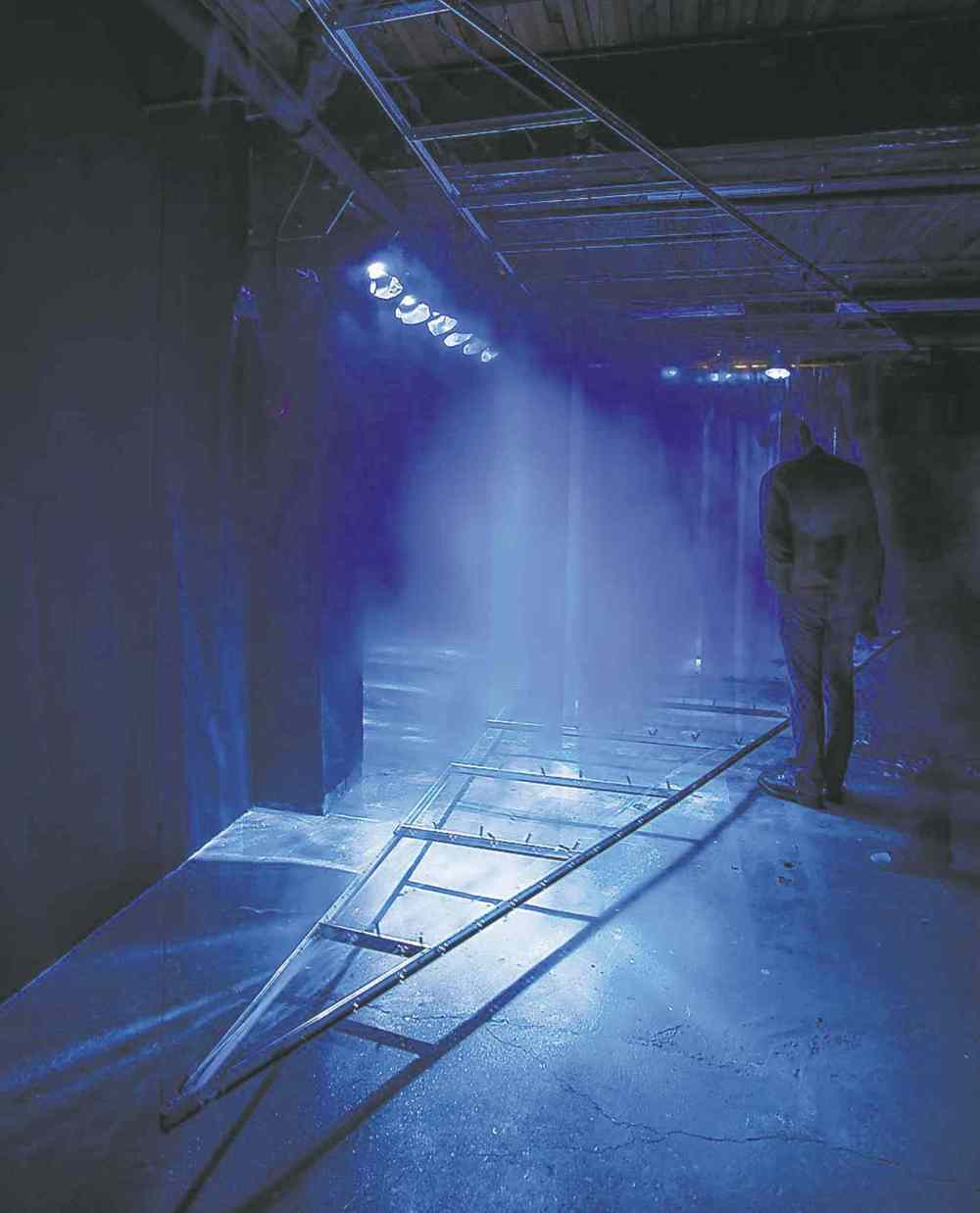
At first, your only impression of Blue, the light-based sculptural installation by David Spriggs currently at Raw Gallery, is of the colour itself. In the otherwise pitch-black exhibition space, an otherworldly blue light hangs silently in the air, formless at first but oddly contained, an indeterminate presence lacking context. Struggling to focus and find your bearings, you’re left with your own freewheeling associations — dusk light in summer, cobalt glass, Mary’s cloak, a TV left on at night — and not much else.
Colour seems like an intrinsic, stable quality of the world around us, when in fact it’s in a state of constant flux, vulnerable to minute variations in the spectrum of available light. What’s more, it exists entirely in our heads.
Seeing involves as much interpretation as perception. What we call “colour” is ultimately one attempt by the brain to find order in the otherwise-meaningless visual data that our eyes collect. It’s a loose interpretation, however, and a highly individual one: because each retina and neural pathway is unique, no two people can experience colour in exactly the same way.
Despite its unpredictability, colour is critically important in many areas of daily life, affecting our alertness, mood, and appetite; it’s tied deeply to individual memory; it informs our esthetic judgments, and it’s a cornerstone of visual communication. It’s no wonder, then, that so many visual artists have sought to capture, control, investigate or simply revel in it.
For the time being, Spriggs only has eyes for blue, and after a moment his vague apparition begins to take definite shape. What had been little more than a diffuse glow coalesces into an dense blue fog — nebulous, with perceptible depth, form and boundaries, but impossibly still. Gradually, the illusion’s simple mechanisms become apparent.
To create the sculpture, Spriggs hung sheets of transparent plastic film, which he’s painted with billowing, translucent blue forms, between two triangular metal frames. Illuminated by blue-tinted spotlights, the overlapping layers of film create the impression of a sharply-contained, wedge-shaped cloud that slices across the darkened gallery.

Other artists have sought to make colour and specifically the colour blue a “material” in their work — even an “artwork” in its own right. Yves Klein began his career as a teenager in postwar France by symbolically “signing” the sky, later patenting his signature “International Klein Blue,” a luminous ultramarine. James Turrell cuts skylights in buildings and tunnels in desert craters to single out passages of endless blue space. But where both are concerned with “infinity,” hinting at transcendent, even mystical experiences, Spriggs’ Blue is in some ways more down-to-earth.
The modesty of his hardware-store materials and the transparency of his stagecraft work to neutralize whatever awe or wonder we might feel upon encountering the luminous, ethereal cloud. The illusion is slow to establish itself, and it crumbles in an instant when the workings are revealed, but that “failure” creates avenues for understanding.
The colour “blue” might be an abstract concept or a fleeting sensation, but Blue is knowable. It unfolds over time and across space: we’re aware of our eyes adjusting; we see ourselves seeing; we navigate the work, relate it physically, allowing for an experience of colour we might not be able to have any other way.
Steven Leyden Cochrane is a Winnipeg-based artist, writer and educator.