

Buccaneer’s booty
Museum displays treasures and curiosities from the sunken ship of the world's richest pirate
Advertisement
Read this article for free:
or
Already have an account? Log in here »
To continue reading, please subscribe:
Digital Subscription
One year of digital access for only $75*
- Enjoy unlimited reading on winnipegfreepress.com
- Read the E-Edition, our digital replica newspaper
- Access News Break, our award-winning app
- Play interactive puzzles
*Billed as $5.77 plus GST every four weeks. After 52 weeks, price increases to the regular rate of $19.95 plus GST every four weeks. Offer available to new and qualified returning subscribers only. Cancel any time.
Monthly Digital Subscription
$4.99/week*
- Enjoy unlimited reading on winnipegfreepress.com
- Read the E-Edition, our digital replica newspaper
- Access News Break, our award-winning app
- Play interactive puzzles
*Billed as $19.95 plus GST every four weeks. Cancel any time.
To continue reading, please subscribe:
Add Free Press access to your Brandon Sun subscription for only an additional
$1 for the first 4 weeks*
- Enjoy unlimited reading on winnipegfreepress.com
- Read the E-Edition, our digital replica newspaper
- Access News Break, our award-winning app
- Play interactive puzzles
*Your next Brandon Sun subscription payment will increase by $1.00 and you will be charged $17.95 plus GST for four weeks. After four weeks, your payment will increase to $24.95 plus GST every four weeks.
Read unlimited articles for free today:
or
Already have an account? Log in here »
Hey there, time traveller!
This article was published 18/10/2014 (4233 days ago), so information in it may no longer be current.
There is an authenticity to the newly installed touring exhibit Real Pirates that is discernible the moment you walk into the Manitoba Museum.
Buccaneers were thought to be a malodorous lot and Barry Clifford, the renowned underwater explorer, immediately recognizes the distinct but undefinable scent.
“It’s the smell of a pirate ship,” says Clifford, who in 1984 discovered the Whydah, the first documented pirate ship recovered from American waters.
“When I go underwater into a ship with an anaerobic environment, you can actually smell — right through your face mask — human waste in the bottom of a ship after 300 or 400 years. These exhibits come from that environment.”
So visitors to Real Pirates, which runs through April 19, will be treated to not only the sights and sounds of an 18th-century sailing ship that high-seas raiders called home, but also the smell.
The show — organized by National Geographic and Premier exhibitions — features 200 artifacts recovered from the wreck of the Whydah (pronounced WIDD-uh), which sank in a fierce storm off the coast of Cape Cod on April 26, 1717. On display is a dazzling array of cannons, pistols, knives, grenades, gambling tokens and the ship’s bell, along with a replica of the ship’s stern that can be boarded. Then there is the bona fide treasure chest, which is a must-see for anyone who ever pulled on an eye patch, picked up a cutlass and shouted ‘Arrrrr!’
The pine chest, presented under glass, overflows with glittering pieces of cargo and thousands of one-of-a-kind coins that date back to the 15th century.
“How many people have walked a beach looking for this?” muses Clifford, a Boston native, nodding towards the display. “To find a pirate treasure is every kid’s dream. I would take my children to the beach and I would take a few coins and bury them in the sand. Then I would point with a shaking hand where they should dig and they would find the coins.”
His personal favourite in the collection is a seal on which is pictured two turtle doves flying over water, accompanied by French words that translate to “Death if I should lose thee.” An uncommonly romantic marauder would use it to stamp a wax seal on a letter to his wife or lover.
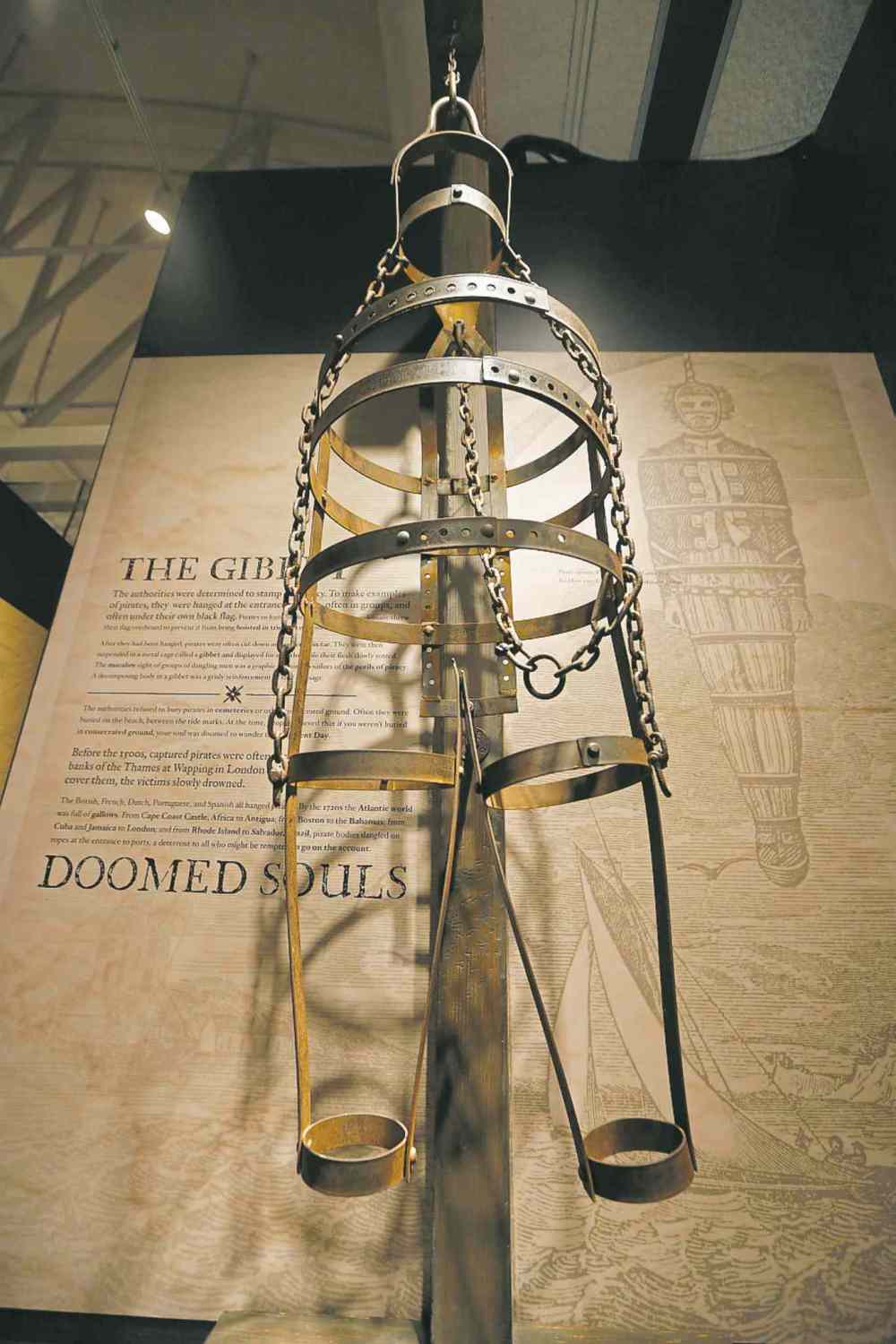
Sure also to draw plenty of attention is the replica of a gibbet, an iron cage similar to the one in which Capt. Kidd’s dead body was suspended for two years near the entrance to the Thames River as a rotting example as to what happens to pirates.
Clifford, a former commercial salvage expert and high school history teacher, was in town recently and talked about his headline-making claim to have discovered the wreck of Christopher Columbus’s flagship, Santa Maria, off Haiti’s northern coast, and Capt. Kidd’s ship, the Adventure Galley, near Mozambique. He has recovered hundreds of millions in pirate booty and has not sold one coin, opting to preserve the Whydah’s bounty as a complete collection for the world to appreciate.
This underwater Sherlock Holmes, sporting a black History Channel cap, is driven by the eternal quest for knowledge.
“It’s not what you find, but what you find out,” he says. “I do it because of my obligation to tell the truth and make sure that the story gets told correctly. I think it is important to find these ships or time will leave nothing left of them.”
The Whydah was the flagship of the notorious pirate Black Sam Bellamy, whose crew plundered 54 ships off the coast of North America, making him the wealthiest pirate in recorded history. That’s why the fleet, three-masted slaver, with its four tons of treasure, has been the single largest source of pirate artifacts.
Clifford’s recovery is credited with opening up a new page in history. Previously, the image of pirates was based on tall, white Hollywood swashbucklers like Errol Flynn, when in fact one-third of the Whydah crew was made up of former African slaves.
“On board the Whydah, they were free, they could vote and they got an equal share of the treasure,” says Clifford, a youthful looking 69-year-old who is as well-preserved as many of his artifacts. “Many Africans were being elected as officers by predominantly European crews. There was a very important experiment in democracy going on.”

It’s been 30 years since he excavated his first Whydah artifacts, many of which were wrapped in a concrete-like substance. No one was sure that the ship was the Whydah until a concretion was removed from around the bell, which was inscribed with “Whydah Galley 1716.” Another concretion, which contained a cache of eight cannons, was two metres tall, three metres wide and weighed 5,400 kilograms.
Clifford and his crew often did not know what they had found until the concretion was X-rayed and taken apart. He once gave his 10-year-old what he thought was a worthless chunk until the boy chipped away the covering to reveal a spectacular wooden pistol with a gleaming image of King James on the butt end.
They continue to discover much about the Whydah, and last year took apart a concretion that revealed a chest with a bronze plaque that read “Whydah 1713.” Clifford was perplexed until he theorized that the first Whydah must have been sunk some time after 1713 and another built in 1716, on which the chest was stowed.
“We have 30,000 pounds of concretions that we haven’t taken apart yet, with thousands and thousands of artifacts waiting to see the light of day,” says Clifford. “We’re still very much involved in excavating the Whydah.”
kevin.prokosh@freepress.mb.ca