

Blues musical takes a while to find groove
Play has passion, but script often misses a beat
Advertisement
Read this article for free:
or
Already have an account? Log in here »
To continue reading, please subscribe:
Monthly Digital Subscription
$0 for the first 4 weeks*
- Enjoy unlimited reading on winnipegfreepress.com
- Read the E-Edition, our digital replica newspaper
- Access News Break, our award-winning app
- Play interactive puzzles
*No charge for 4 weeks then price increases to the regular rate of $19.00 plus GST every four weeks. Offer available to new and qualified returning subscribers only. Cancel any time.
Monthly Digital Subscription
$4.75/week*
- Enjoy unlimited reading on winnipegfreepress.com
- Read the E-Edition, our digital replica newspaper
- Access News Break, our award-winning app
- Play interactive puzzles
*Billed as $19 plus GST every four weeks. Cancel any time.
To continue reading, please subscribe:
Add Free Press access to your Brandon Sun subscription for only an additional
$1 for the first 4 weeks*
*Your next subscription payment will increase by $1.00 and you will be charged $16.99 plus GST for four weeks. After four weeks, your payment will increase to $23.99 plus GST every four weeks.
Read unlimited articles for free today:
or
Already have an account? Log in here »
Hey there, time traveller!
This article was published 24/01/2015 (3976 days ago), so information in it may no longer be current.
As is often the case in these concert-theatre hybrids, finding the right measure of music and story is harder than it sounds.
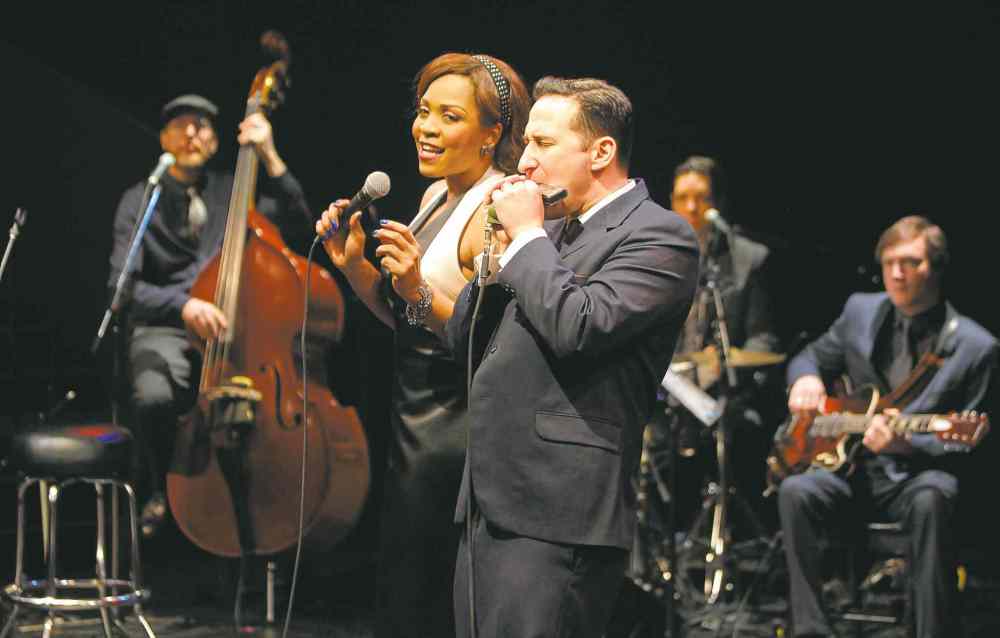
Raoul Bhaneja’s stage creation Life, Death and the Blues, which opened at Prairie Theatre Exchange Thursday night, is another uneasy duet between brilliant musicianship and an awkward script. It takes a while to get in sync, but the blues eventually gets the audience on its feet.
The first act consists of Bhaneja, a half-Indian, half-Irish Canadian, arguing that he is a natural-born bluesman, despite not fitting the stereotype of the one he’s briefly disguised as to open the 130-minute production.
“I’m not black, I’m beige,” he declares, “a Paddy Paki.”
Representing black mistrust is Bhaneja’s co-star, the sublime Toronto singer Divine Brown. Her black-and-white dress reflects her view that you have to be black to get what the blues are all about.
“You can’t do it justice,” she tells him firmly, but there is little snap to their exchanges and director Edna Holmes can do little to stop it from feeling clunky and contrived.
Bhaneja, looking sharp in a dark suit and tie, mixes his story as a blues nerd with musings about the ubiquity of stereotyping, which he underlines with a performance of Jim Croce’s 1973 hit Bad, Bad Leroy Brown. He is the longtime frontman of his band the Big Time, but his fine singing takes a backseat to his wicked harmonica playing. That’s on display when he starts remembering his idols and mentors, such as Montreal hip-hop artist Paul Frappier, known as Bad News Brown, a Haitian who rose to fame playing his harmonica in the subway, and bluesharp player Paul Oscher, who became the first white musician invited to join Muddy Waters’ band.
“Too much talk — let’s do some music,” says Brown. It’s as if she has read the audience’s mind. At one point, she sits, looking unimpressed with her arms crossed, as Bhaneja remembers being a boy with a dream and a harmonica as his ticket. The pair get in a couple of numbers between uninspiring stretches of dialogue before intermission, but almost all of the evening’s highlights are yet to come.
Bhaneja and Brown roam the PTE stage, set up as if for a concert, with the Big Time members — guitarist Jake Chisholm, drummer Tom Bona and Chris Banks on upright bass — sitting off to the side but in the middle of every tune. Behind the performers is a full-size screen supplying projections of black-and-white photographs of Chicago’s South Side or Clarksdale, Miss., and performance footage of T-Bone Walker, Oscher and Frappier.
Only in the second act does Life, Death and the Blues begin to cook. Divine again schools Bhaneja on the black reality of racial prejudice and sings a haunting work chant that gets at the roots of the blues. Even better is her gospel hymn, which earned the loudest applause of the evening. This lady sings the blues. She is a revelation for theatre-goers encountering her immense vocals talents for the first time.
The pair finally find common ground around Bhaneja’s father’s upbringing in India, and he sings a song of his childhood with true authenticity. His passion for the blues is never in doubt, but it spikes when he speaks about his Mississippi pilgrimage to see James (Super Chikan) Johnson, a blues guitarist and instrument maker. Bhaneja brings out his prize souvenir of that visit: a bojo, a curious cross between a guitar and a banjo, which he plays with dynamic flair.

With the audience enjoying the blues groove, Bhaneja ends each performance by inviting a fellow blues artist up on stage to take the show home. And it was taken in fine style by local legend Big Dave McLean, who upstaged his generous host in a rousing performance of I Feel Like Going Home, the first Muddy Waters tune he learned to play.
McLean, in a dapper black hat, told a few stories about opening for Waters several times and recalled how tickled his hero was when he first heard McLean’s musical tribute, Muddy Waters for President, on which Bhaneja provided a sizzling harmonica solo Thursday evening.
Life, Death and the Blues may not survive very long, but the power of the music revealed once again it will never die.
kevin.prokosh@freepress.mb.ca