Glorious sporting past on display at WAG’s Olympus exhibition
Advertisement
Read this article for free:
or
Already have an account? Log in here »
To continue reading, please subscribe:

Digital Subscription
One year of digital access for only $205*
- Enjoy unlimited reading on winnipegfreepress.com
- Read the E-Edition, our digital replica newspaper
- Access News Break, our award-winning app
- Play interactive puzzles
*First annual payment billed as $205.00 + GST for one year. This annual subscription will automatically renew at $233.00 + GST every 52 weeks (10% off the regular annual price of $259.35). Offer available to new and qualified returning subscribers only. Cancel any time.
To continue reading, please subscribe:
Add Free Press access to your Brandon Sun subscription for only an additional
$1 for the first 4 weeks*
- Enjoy unlimited reading on winnipegfreepress.com
- Read the E-Edition, our digital replica newspaper
- Access News Break, our award-winning app
- Play interactive puzzles
*Your next Brandon Sun subscription payment will increase by $1.00 and you will be charged $17.95 plus GST for four weeks. After four weeks, your payment will increase to $24.95 plus GST every four weeks.
Read unlimited articles for free today:
or
Already have an account? Log in here »
Hey there, time traveller!
This article was published 24/04/2015 (4137 days ago), so information in it may no longer be current.
The inconspicuous terra cotta vase just installed at the Winnipeg Art Gallery as part of the new touring exhibit, Olympus: The Greco-Roman Collections of Berlin, offers no hint of its glorious sporting past.
Back in 450 BC, Athens, the painted vessel, or amphora, was awarded to the winner of the most prestigious event at the Panathenaic Games: the chariot race.
“It was a prize like the Stanley Cup,” says Andreas Scholl, director of classical antiquities of the national museums in Berlin, where the Olympus exhibit originated.
In front of a raucous crowd, the victorious charioteer was presented with an amphora full of sacred and valuable olive oil. Painted on one side of the reddish-orange container was Athena, the city goddess; on the other, a depiction of a black-figured chariot rider and his two horses in full gallop. These trophies were found all over the Mediterranean region and the one on display at the gallery was discovered in Benghazi, Libya.
The amphora is one of the 160 ancient treasures drawn from the Antikensammlung der Staatlichen Museen zu Berlin, home to one of the most important collections of Greek and Roman art in the world. The priceless marble statues and reliefs, bronze statuettes, vases and jewelry are just the tip of the iceberg of artwork kept in its vast storerooms.
“This is the reason we can easily create and lend an exhibition as large as this one to take abroad,” says Scholl, who arrived in Winnipeg Monday and will be giving several lectures during the opening weekend of Olympus. “We don’t do this very much. This is actually the largest temporary exhibition we ever sent abroad.”
It is the first time that Olympus is on display in North America; the only stops are at the Musée de la civilisation in Quebec City and the WAG. It is also rare to see a major antiquities show in Winnipeg, the last one being The Treasures of Tutankhamun, which was presented at the Manitoba legislature in 1964, seven years before the WAG opened its distinctive home on Memorial Boulevard.
That Olympus is here is due to WAG director Stephen Borys being in the right place at the right time. He was visiting Berlin in 2013, scouting museum designs for the gallery’s Inuit Art Centre project, when he learned about plans for a Greek and Roman antiquities show in Quebec City. He was able to negotiate having the WAG added to the Olympus itinerary for the price of restoring a couple of large-scale reliefs.
“We don’t charge loan fees,” says Scholl. “For all our work, we want to see a modest, very modest return — that is a financial contribution towards restorations.”
These exhibits are crowd-pleasers — several antiquities exhibits typically appear on the annual Top 10 list of best-attended art shows.
“The public still has a fascination with ancient civilizations,” Borys says. “People understand the rarity and age of these objects. Standing between you and a bust of Zeus is 25 centuries. You realized it was carved when there were all these gods and goddesses.”
The influence of the Greeks is still evident today — whether in pop culture, through the bestselling book series Percy Jackson and the Olympians and big-budget movies such Troy, or in architecture, theatre and medicine. Today’s body-beautiful culture is rooted in Greek sculptures, in which the human form was depicted in an idealized state.
“It’s so obvious, even in a city like Winnipeg,” says Scholl. “The legislature is a marvellous example of Greek classical architecture. This architecture is meant to refer to the fact that democracy is a Greek invention. For a parliament building, there could be no better way to express that.”
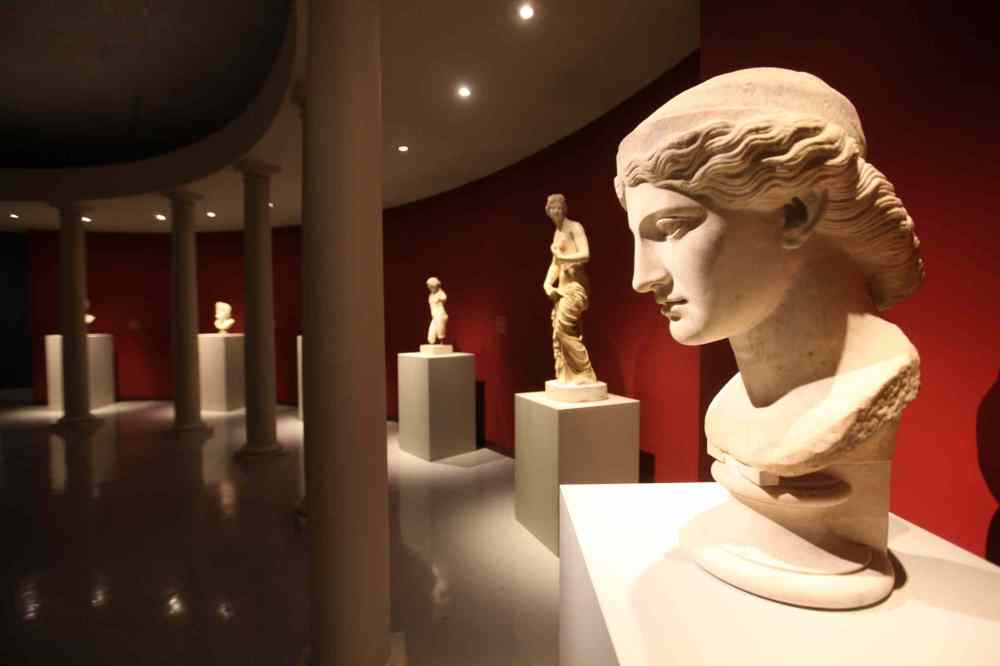
Covering the outdoor wall of the WAG is a gigantic banner with the image of the flawless marble face of Hera, the queen of the gods. She bears the dignified, blank-eyed, unvarnished look the public associates with this kind of art.
What’s startling to learn is that almost all the statues were at one time painted. The bright colours have faded and become weathered after thousands of years, leaving that familiar, plain old white.
“We have thousands of proofs they were brightly painted,” Scholl says. “Gold was applied; so was silver. Often the eyes were inset with glass or semi-precious stones. Even the Parthenon was coloured once.”
Olympus covers 10,000 square feet of gallery space, including one impressive room that replicates the rotunda of the gods from Berlin’s Altes Museum.
In the introductory gallery, patrons will be welcomed by three individual pieces, all of which are critically important to the show’s theme of Olympian gods, their personalities and attributes. Eyes will first be drawn to the huge marble foot, all that’s left of a colossal statue of a female goddess circa 150-50 BC. It’s the largest object in the show.
“She would have been nine metres high, or 30 feet,” says Borys. “I put it in the first gallery to show off one thing — the sense of scale with Greek art. It also gives us the idea of what we call the fragment.”
There is no work on display that is untouched, that doesn’t bear some kind of imperfection caused by man or time. The obvious extreme is a statue that has been reduced to a foot.
“It gives people an appreciation that it was part of a much larger sculpture and was part of a civilization that worshipped a whole group of deities,” he says.
The foot shares the space with another terra cotta vase, on which is painted a gathering-of-the-gods scene, and a life-size bust of Zeus.
“It’s one of the most high-quality marbles from Greece, outside of Athens, remarkably intact,” Borys says.
Many gallery visitors will be drawn to the Berlin Dancer, whose headless body is immortalized in a swirling motion. The folds in her dress delicately emphasize her unrestrained movement.
“It’s the most valuable piece,” says Scholl, who adds that the Berlin museums boast 4,400 stone and bronze sculptures. “In our world-class collection, this is a piece among the 10 best sculptures we have.”
kevin.prokosh@freepress.mb.ca
Throwing a block party
The treasures on display in Olympus are made of marble, terra cotta, bronze… and Lego.

Members of the Manitoba Lego Users Group are paying tribute to some of the famous antiquities with block versions sure to lighten the mood of gallery-goers young and old. Some WAG patrons will question whether they belong, but Chris Abrams, a lifelong Lego-lover, is not one of them.
“I think it’s an art, but art is in the eye of the beholder,” says the 42-year-old from Morden. “Instead of paint on canvas, I use Lego bricks on top of plates.”
WAG staff approached the group to use the popular plastic construction toys to put a new spin on old Greek and Roman art. The Lego masters produced panoramas of ancient times, including a chariot race, a Roman villa and an amphitheatre. Abrams, who owns hundreds of thousands of Lego pieces, has whipped up a Parthenon as well as three Greek gods.
“You do it for the look on people’s faces,” says Abrams. “You want to see their jaw drop.”
The Lego creations will be unveiled at the Olympus kids launch on June 21.
Event preview
Olympus: The Greco-Roman Collection of Berlin
Winnipeg Art Gallery
Opens Sunday, to April 2016
Tickets: $22, adults; $16, senior/student and $8, WAG members, at olympus.wag.ca
Related Articles
SIR at WAG: Shakespeare performance amid real Roman ruins
Advertisement Advertise With Us
Advertisement Advertise With Us