

Local artist’s austere drawings and videos contemplate astronomical distances and personal space
Advertisement
Read this article for free:
or
Already have an account? Log in here »
To continue reading, please subscribe:
Digital Subscription
One year of digital access for only $75*
- Enjoy unlimited reading on winnipegfreepress.com
- Read the E-Edition, our digital replica newspaper
- Access News Break, our award-winning app
- Play interactive puzzles
*Billed as $5.77 plus GST every four weeks. After 52 weeks, price increases to the regular rate of $19.95 plus GST every four weeks. Offer available to new and qualified returning subscribers only. Cancel any time.
Monthly Digital Subscription
$4.99/week*
- Enjoy unlimited reading on winnipegfreepress.com
- Read the E-Edition, our digital replica newspaper
- Access News Break, our award-winning app
- Play interactive puzzles
*Billed as $19.95 plus GST every four weeks. Cancel any time.
To continue reading, please subscribe:
Add Free Press access to your Brandon Sun subscription for only an additional
$1 for the first 4 weeks*
- Enjoy unlimited reading on winnipegfreepress.com
- Read the E-Edition, our digital replica newspaper
- Access News Break, our award-winning app
- Play interactive puzzles
*Your next Brandon Sun subscription payment will increase by $1.00 and you will be charged $17.95 plus GST for four weeks. After four weeks, your payment will increase to $24.95 plus GST every four weeks.
Read unlimited articles for free today:
or
Already have an account? Log in here »
Hey there, time traveller!
This article was published 06/08/2015 (3941 days ago), so information in it may no longer be current.
The moon appears often in A Certain Distance, the first exhibition by Winnipeg artist Sylvia Matas at Lisa Kehler Art and Projects, and it makes a similar first impression.
Like the moon, on their surfaces, the careful graphite drawings and silent videos seem elusive, distant and somewhat cold — silent and motionless above all else.
But first impressions can be misleading: the moon’s stillness is only relative, of course, a trick of perspective. Hold it against a fixed point (a treetop, the peak of a roof) and you can just make out its movement, a 3,683 km/h orbit slowed to an almost imperceptible crawl.

Relativity is a central concern for Matas, and her work explores diverse and sometimes counterintuitive means of measuring, mapping and categorizing time and space. The figures never quite add up. She might fastidiously draw out wind maps or list the dates of unnamed astronomical events, but these detached points of reference only serve to indicate how lost we are.
Though still elliptical and abstract, A Certain Distance locates us more securely (all things being relative). Instead of casting out untethered observations or invoking subtle parameter shifts, the new works adopt first-person perspectives and something like a coherent narrative voice. The result is a newfound immediacy and greater emotional impact. For all their formal restraint, they seem urgently expressive.
Matas favours modest materials and simple forms: near the entrance, Morning Sun, Afternoon Sun is just a semicircle sun-bleached onto black construction paper, and it’s one of the loveliest works in the show. In five suites of architecturally precise mid-size pencil drawings, minimal geometric forms and stylized perspective illustrate the play of light on the corner of a room or the passage of the moon over a suburban bungalow.
Despite the drawings’ astronomical focus and ample empty space, they often find us on the inside looking out. Abstract grids become panes of window glass, and beneath tranquil surfaces, the mood is anxious and mildly claustrophobic. The light is harsh, the angles sharp, the mark-making a tightly controlled frenzy. The flat black of the night sky shimmers with activity; coronas of heavy pencil marks offset celestial objects that pop off the page like inverse bullet holes.

Matas addresses “interior” experience and implicit trauma more directly in a pair of videos — the first she’s exhibited. Each overlays a single photograph with short, declarative captions that lend the works a lulling storybook cadence. Though open to broad interpretation, the “stories” are less than reassuring.
Over fragments of a roadside boreal forest scene, we read the account of a cataclysm that did or didn’t happen there. An unnamed something approaches at a “nearly a kilometre per second,” but “later, rain fell overnight.” “We had seen the beginning and the end. / And still the wind blew.” In the second video, we look toward an upstairs window while the man inside, we read, suffers an apparent break with reality. “Endless rooms” reflect endlessly in mirrors, filling with “indistinguishable” objects. The curtains are partly drawn, and there’s “the sound of a bird trapped between two panes of glass.”
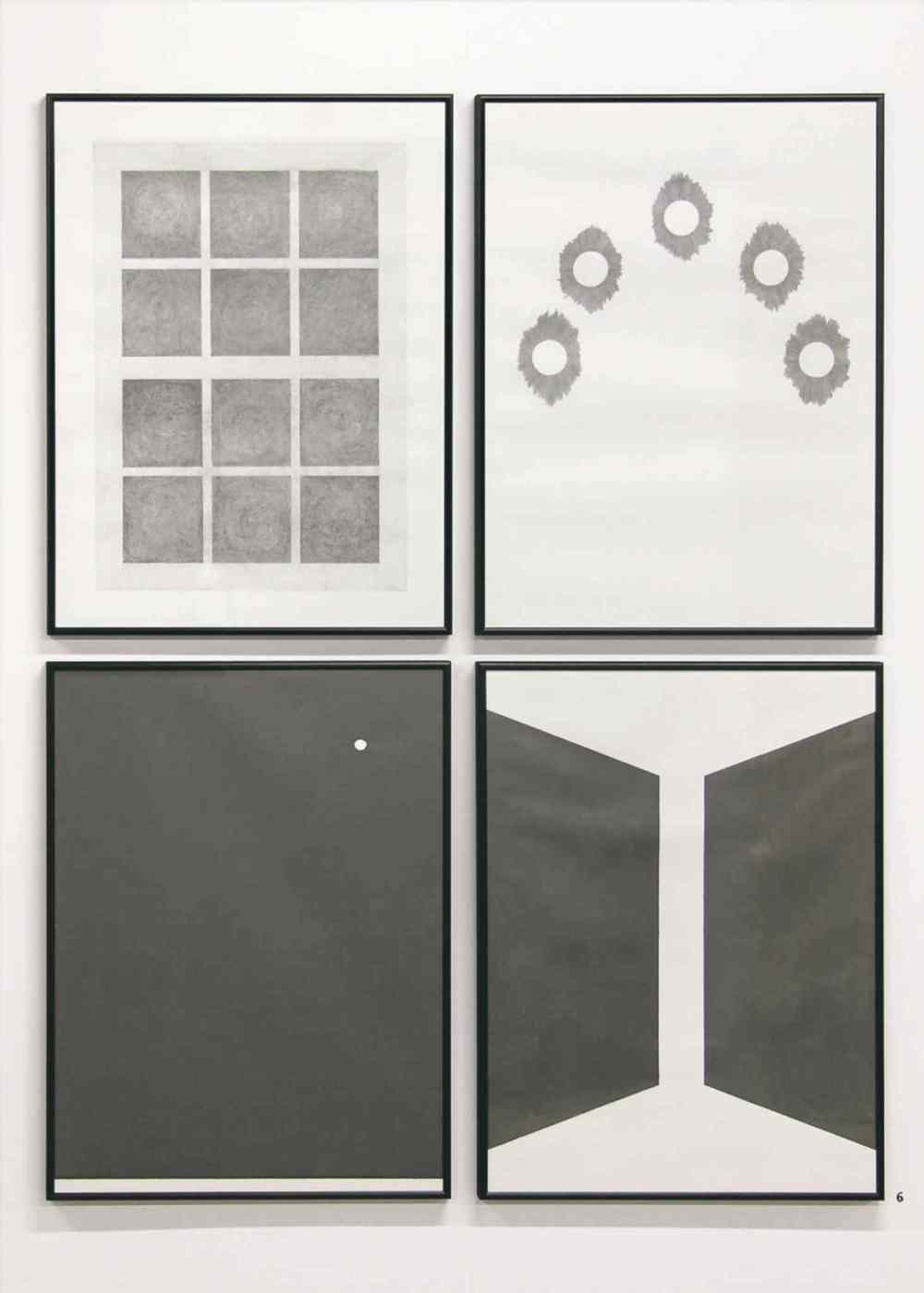
Matas has spent years mapping relative distances with varying degrees of certainty, but this exhibition represents a newly forthright attempt to communicate what it’s like to occupy those distances as a thinking, feeling person. The space she pictures is both thrilling and terrifying, lovely and deceptively calm.
Steven Leyden Cochrane is a Winnipeg-based artist and writer.
History
Updated on Thursday, August 6, 2015 8:56 AM CDT: Replaces photo, changes headline