Artists must battle inner, outer critics
Tough to balance risks, satisfaction
Advertisement
Read this article for free:
or
Already have an account? Log in here »
To continue reading, please subscribe:

Digital Subscription
One year of digital access for only $205*
- Enjoy unlimited reading on winnipegfreepress.com
- Read the E-Edition, our digital replica newspaper
- Access News Break, our award-winning app
- Play interactive puzzles
*First annual payment billed as $205.00 + GST for one year. This annual subscription will automatically renew at $233.00 + GST every 52 weeks (10% off the regular annual price of $259.35). Offer available to new and qualified returning subscribers only. Cancel any time.
To continue reading, please subscribe:
Add Free Press access to your Brandon Sun subscription for only an additional
$1 for the first 4 weeks*
- Enjoy unlimited reading on winnipegfreepress.com
- Read the E-Edition, our digital replica newspaper
- Access News Break, our award-winning app
- Play interactive puzzles
*Your next Brandon Sun subscription payment will increase by $1.00 and you will be charged $17.95 plus GST for four weeks. After four weeks, your payment will increase to $24.95 plus GST every four weeks.
Read unlimited articles for free today:
or
Already have an account? Log in here »
Hey there, time traveller!
This article was published 03/05/2016 (3806 days ago), so information in it may no longer be current.
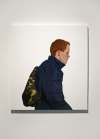
You have probably noticed the new giant banner hanging on the outside of the Winnipeg Art Gallery. It depicts a painting, a portrait of a man in a brilliant blue hood, by the artist Karel Funk. The gallery is mounting an exhibition of Funk’s realistic paintings — and to me, the banner seems celebratory. Spring is here, and paintings by a world-class artist, who happens to be from Winnipeg, will soon be on display.
This Friday, Funk will join artist Elvira Finnigan at the Winnipeg Free Press News Café. Both artists will speak about their work, but more than that, they will discuss the various pressures — both internal and external — that shape their professional lives.
Doubt and uncertainty, for example, are never far off — even when a giant banner with your name on it is flapping in the breeze. The spectre of failure haunts every new effort. And the art world, for all its efforts to help artists succeed, can be a real source of anxiety. Really, it is something of a miracle most art even gets made.

Finnigan works with salt, purposely employing the mineral’s metaphors. She stages elaborate meals, and drowns the leftovers in a warm salt brine to preserve and memorialize the occasion. As days and weeks pass, the brine’s water evaporates. Lacy white patterns form on the tablecloth. Serving dishes and goblets transform into strangely beautiful crystalline sculptures. The table settings become otherworldly, seeming to pause time.
Her latest show took place last winter at the University of Winnipeg’s Gallery 1C03. For the show, Finnigan took a risk — choosing to memorialize not another decadent meal but the casual eating experience of the university’s cafeteria. For her, french fries, plastic forks and aluminum cans were new terrain.
“There was the real chance of absolute failure,” says Finnigan, “and I was really apprehensive about letting go of the specific kinds of beauty I was accustomed to creating.”
Funk and Finnigan’s trajectories into the art profession are very different. Finnigan came to art later in life, after raising children and pursuing other careers. Her artistic nature was something she had to learn to take seriously. Making art helped her make sense of life and its losses, both the large and the small.
“Things stay unresolved unless you explore them,” she says.
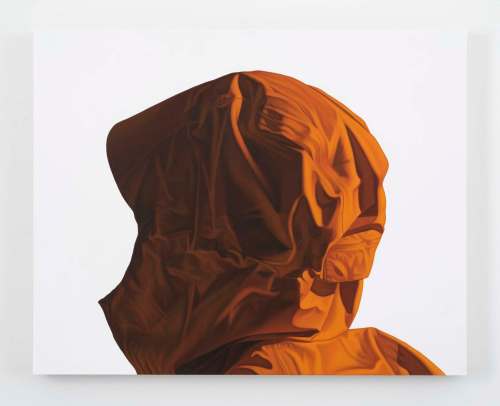
Funk went to art school at the University of Manitoba when he was in his 20s, and went on to obtain his masters degree at Columbia University in New York. His early photo-realistic paintings were accomplished, but he didn’t find his own artistic voice until 2003, when he began to paint what can be called anti-portraits. His mostly male subjects look away, close their eyes, hide under hoods. In his work, hoods and jackets are a recurring motif. At times, he has left out the figure entirely to focus on the hoods themselves. Funk’s uncanny ability to render their folds and creases stems from his study of drapery painted by Renaissance masters. His paintings describe states of being — stillness, quietness — more than they do specific identities.
And yet, they are almost heartbreakingly familiar. We all know someone who has that jacket, that hairline, that slight slouch in their posture.
Within a few years of graduating, Funk had his first solo show at New York’s 303 Gallery, was reviewed by major publications and earned gallery representation — all hallmarks of art-world success.
So does the artist still grapple with fears and uncertainty? “Constantly” says Funk. “Self-doubt has always been there. I am my own worst critic. Every time I begin a new painting I think I am going to do better, going to paint better, but every time it’s this terrible struggle.”
“Maybe artists really are dramatic,” Funk says with a laugh, after acknowledging many artists have trouble weathering the emotional storms and requisite highs and lows of the ego.
“It can be so deflating,” says Finnigan, about navigating the art world. “You can spend months writing grants, spend so much time and energy, and have it go nowhere. But ultimately there is such satisfaction making art, in giving the internal life an external form.”
Art is made when the artist’s hand works in concert with the brain. It is made when ability, intellect and the mind’s less rational regions — feeling, intuition, responsiveness — somehow come together. Certain artists, Funk and Finnigan among them, know how to move past the safety of that “coming together” to see what else is possible.
When I say art is a miracle, I think this is what I mean: artists must face, on a daily basis, the fact both their own, inner critics and the entire too-sensible world might call what they are doing ridiculous. And yet they continue on anyway.
Sarah Swan has loved co-ordinating Art Talk/Art Walk and writing this column, but Friday’s event will be her last. To reserve tickets, please call 204-697-7069.
Say what?
If you’ve ever visited a contemporary art gallery, you will be familiar with the feelings of befuddlement, exhaustion or annoyance that a lot of gallery writing provokes. In the interest of actually helping people learn about art, we thought we’d offer two descriptions of the same piece of art; one in gallery “art speak,” and one in “plain speak.”
Art speak
Untitled #75 consists of abstracted dimensionality and layered opacity, containing the same dramatics and material specificity of the Dutch masters. The orange hood has an enigmatic, expansive presence — evidence of Funk’s ability to elevate the mundane via introspective detailing and photo-direct technique.
Plain speak
Untitled #75 is a hood, yes, but the creases, shadow, and light make an abstract painting. Funk paints nylon and Gore-Tex the same way the Dutch masters painted silk drapery. Using the photo-realist style to great effect, Funk allows ordinary subjects to take on an almost glowing importance.
Advertisement Advertise With Us
Advertisement Advertise With Us