Uneasy truce
Artist initially cringed at idea of retrospective exhibit, but is satisfied how it turned out

Advertisement
Read this article for free:
or
Already have an account? Log in here »
To continue reading, please subscribe:

Digital Subscription
One year of digital access for only $205*
- Enjoy unlimited reading on winnipegfreepress.com
- Read the E-Edition, our digital replica newspaper
- Access News Break, our award-winning app
- Play interactive puzzles
*First annual payment billed as $205.00 + GST for one year. This annual subscription will automatically renew at $233.00 + GST every 52 weeks (10% off the regular annual price of $259.35). Offer available to new and qualified returning subscribers only. Cancel any time.
To continue reading, please subscribe:
Add Free Press access to your Brandon Sun subscription for only an additional
$1 for the first 4 weeks*
- Enjoy unlimited reading on winnipegfreepress.com
- Read the E-Edition, our digital replica newspaper
- Access News Break, our award-winning app
- Play interactive puzzles
*Your next Brandon Sun subscription payment will increase by $1.00 and you will be charged $17.95 plus GST for four weeks. After four weeks, your payment will increase to $24.95 plus GST every four weeks.
Read unlimited articles for free today:
or
Already have an account? Log in here »
Hey there, time traveller!
This article was published 07/06/2016 (3695 days ago), so information in it may no longer be current.
Esther Warkov shows a mixture of uneasiness and satisfaction when touring through the latest exhibition of her works that just opened at the Winnipeg Art Gallery.
The satisfaction should be obvious; not all Winnipeg artists have their works chosen to hang in the city’s biggest gallery, much less alongside the colourful prints from 20th-century master Marc Chagall, whose works are on display just down the hall.
The uneasiness comes from the era of works the gallery has chosen for Warkov’s exhibition. Instead of showing what she’s created lately, the gallery has dipped into its permanent collection and unveiled Esther Warkov: Paintings 1960s-1980s. She doesn’t appear ready to accept a career retrospective and makes wisecracks when a reporter describes it as a greatest hits collection.
“Like Prince?” she said jokingly. “No, I don’t take fentanyl.”
The WAG showed Warkov’s first exhibition, back in 1964, at a time when it was difficult for local artists anywhere to get shown in art galleries. Things have changed since then, she says, and she’s had several other exhibitions at the WAG, the National Gallery of Canada and most recently at Winnipeg’s Plug-In Gallery.
Warkov found out in February the WAG was planning the retrospective for this summer, and her trepidation began to build until the show opened in late May. She hadn’t seen some of these paintings in years. Many of them are part of the Winnipeg Art Gallery’s permanent collection while others were purchased by private buyers and either donated to the gallery or loaned for the exhibition.
“I was in the vault and I’d seen them, and I quickly averted my eyes when I walked by,” she said.
There was no relief in sight until she finally saw her works hung for display.
“I got more fear, and then I came and saw it and it wasn’t as bad as I thought, because I was quite worried,” she said. “It actually looks a lot better on the wall than in the basement in the vault.”
The exhibition has allowed her to take a look at her own work from a more objective perspective, she says. In many ways the exhibition is symbolic of her previous artistic life. She no longer paints, instead she creates art with three-dimensional drawings.
“You know how it is when you look at your past sometimes, you say, ‘Oh, dear.’
“I think actually I could have done somewhat better, but they’re not too bad. That’s what I say about all my art. Time gives you a chance to judge, in a way. I liked the idea of them more than the execution. Perhaps now if I redid them, they’d have a bit more depth.”
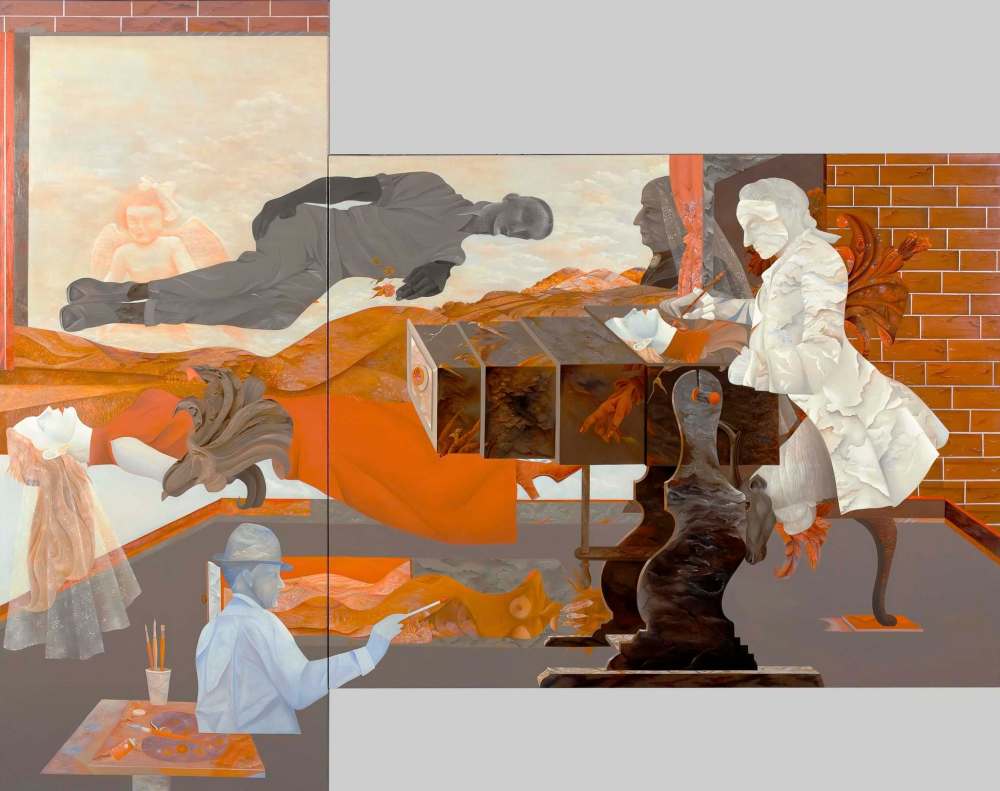
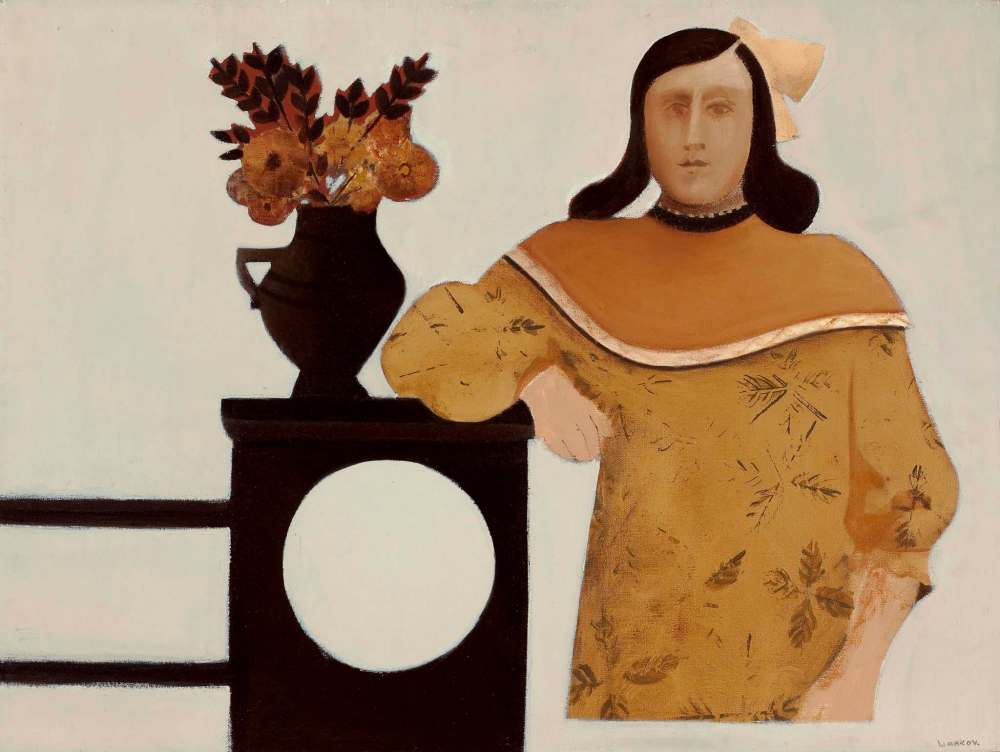
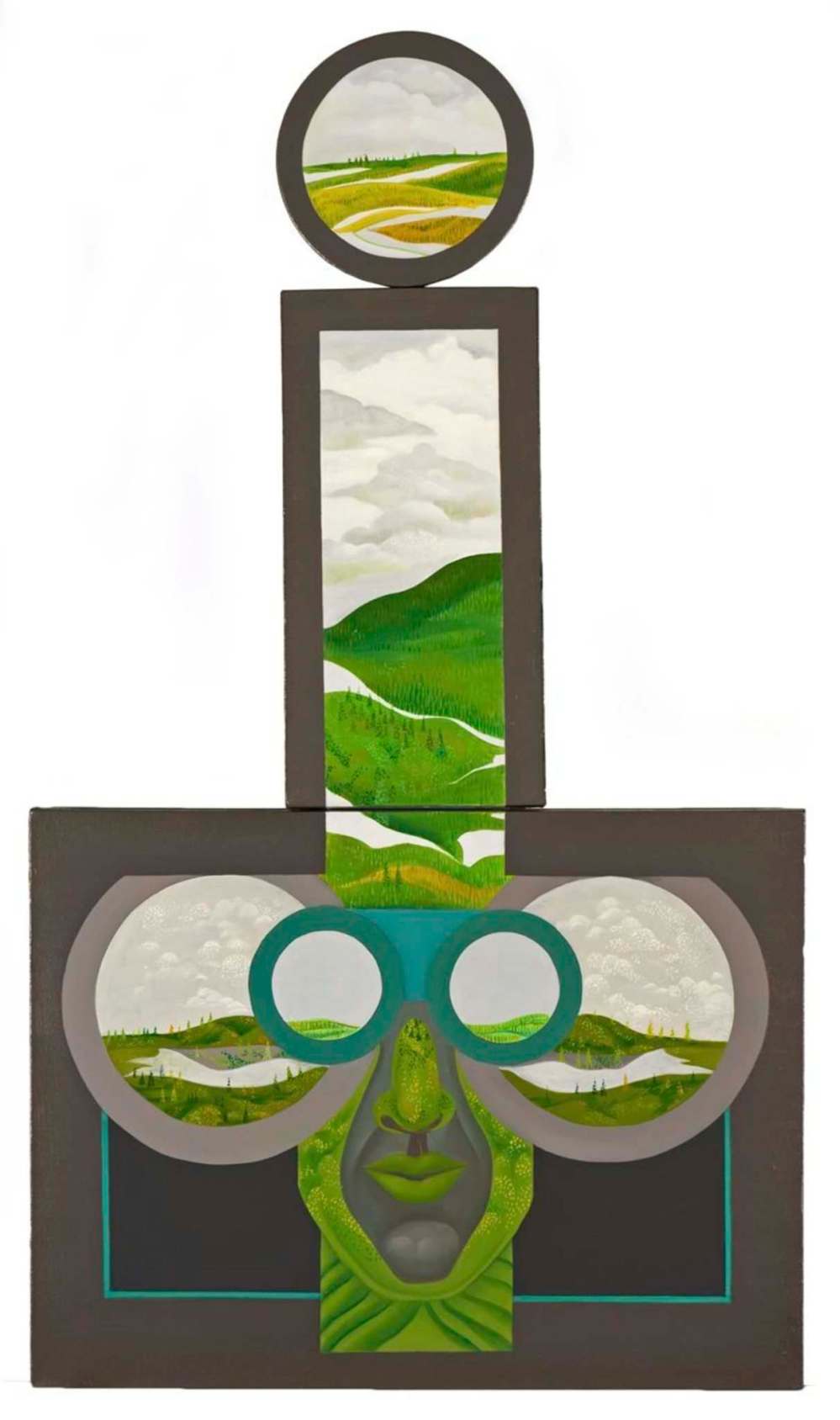
The exhibition focuses on her multi-panelled paintings that are filled with observations about society. Instead of painting portraits of models, her subjects come from magazine advertisements, department-store catalogues and photographs. During a tour of the exhibition, we drift towards Rolling Home to Moses, a large 1979 work that depicts several people from differing backgrounds, from a Victorian-era man riding a pedal-cart to a rabbi and a survivor from a concentration camp.
The cart comes from an advertisement, which initially had a stack of Smirnoff vodka on it, she says. But she transformed it over time, adding two more panels that extend the painting beyond its initial canvas. Gravitating away from the traditional four-sided painting gives the work a surrealistic quality.
The painting hints at Warkov’s North End background. She grew up on Charles Street and her family moved to a house on Matheson Avenue when she was nine. She remembers playing amid the construction sites when the neighbourhood was being developed during the post-Second World War years, lamenting that kids today don’t get the same experiences.

She continues to live and work in the house to this day. In a 1977 interview with the Free Press, she says of the North End, “born here, lived here, died here.”
She ventured out to Stonewall and some of its churches are the backdrop for 1972’s Small Scream, which includes portraits of a community of 12 different people — a surrealistic, yet wholesome, vision that perhaps is a mirror image to the lurid imagery of noted surrealists such as Salvador Dalí.
Her focus on Jewish people and themes has brought about a comparison to Chagall, another Jewish artist. When asked about the gallery’s attempts at linking the two of them together — they’re both Jewish artists of the 20th century with very distinctive styles with exhibitions opening on the very same day — she cracks wise once again.
“I was his illegitimate daughter,” she jokes of Chagall. “And I want a big inheritance.”
alan.small@freepress.mb.caTwitter: @AlanDSmall
Alan Small
Reporter
Alan Small was a journalist at the Free Press for more than 22 years in a variety of roles, the last being a reporter in the Arts and Life section.
Our newsroom depends on a growing audience of readers to power our journalism. If you are not a paid reader, please consider becoming a subscriber.
Our newsroom depends on its audience of readers to power our journalism. Thank you for your support.
Alan Small
Reporter
Alan Small was a journalist at the Free Press for more than 22 years in a variety of roles, the last being a reporter in the Arts and Life section.
Our newsroom depends on a growing audience of readers to power our journalism. If you are not a paid reader, please consider becoming a subscriber.
Our newsroom depends on its audience of readers to power our journalism. Thank you for your support.
Advertisement Advertise With Us
Advertisement Advertise With Us