

Colour visions
Maegan Hill-Carroll tries to communicate the things a photograph can't show
Advertisement
Read this article for free:
or
Already have an account? Log in here »
To continue reading, please subscribe:
Monthly Digital Subscription
$1 per week for 24 weeks*
- Enjoy unlimited reading on winnipegfreepress.com
- Read the E-Edition, our digital replica newspaper
- Access News Break, our award-winning app
- Play interactive puzzles
*Billed as $4.00 plus GST every four weeks. After 24 weeks, price increases to the regular rate of $19.95 plus GST every four weeks. Offer available to new and qualified returning subscribers only. Cancel any time.
Monthly Digital Subscription
$4.99/week*
- Enjoy unlimited reading on winnipegfreepress.com
- Read the E-Edition, our digital replica newspaper
- Access News Break, our award-winning app
- Play interactive puzzles
*Billed as $19.95 plus GST every four weeks. Cancel any time.
To continue reading, please subscribe:
Add Free Press access to your Brandon Sun subscription for only an additional
$1 for the first 4 weeks*
*Your next subscription payment will increase by $1.00 and you will be charged $16.99 plus GST for four weeks. After four weeks, your payment will increase to $23.99 plus GST every four weeks.
Read unlimited articles for free today:
or
Already have an account? Log in here »
Hey there, time traveller!
This article was published 26/01/2017 (3343 days ago), so information in it may no longer be current.
I graduated from art school not knowing what the colour “puce” was supposed to be. This might have something to do with our colour-theory prof scrapping the curriculum, partly to save us from buying the $150 box of specially calibrated Color-Aid papers we’d need to do the exercises.
Conflating “puce” with “pus” or “puke,” I guess, I always imagined a sickly green, something closer to “chartreuse.” The phrase “puce green” dates at least to 1810, so apparently I wasn’t alone.
“Puce is the French word for ‘flea,’ ”Maegan Hill-Carroll offers in the voiceover to her video Color-Aid, “said to be the colour of bloodstained bedsheets, still stained after laundry.” A ruddy brownish-purple, “puce” is a useful word, specific and evocative. But what good is it if half the people you talk to hear (and see, if only in the mind’s eye) something else entirely?
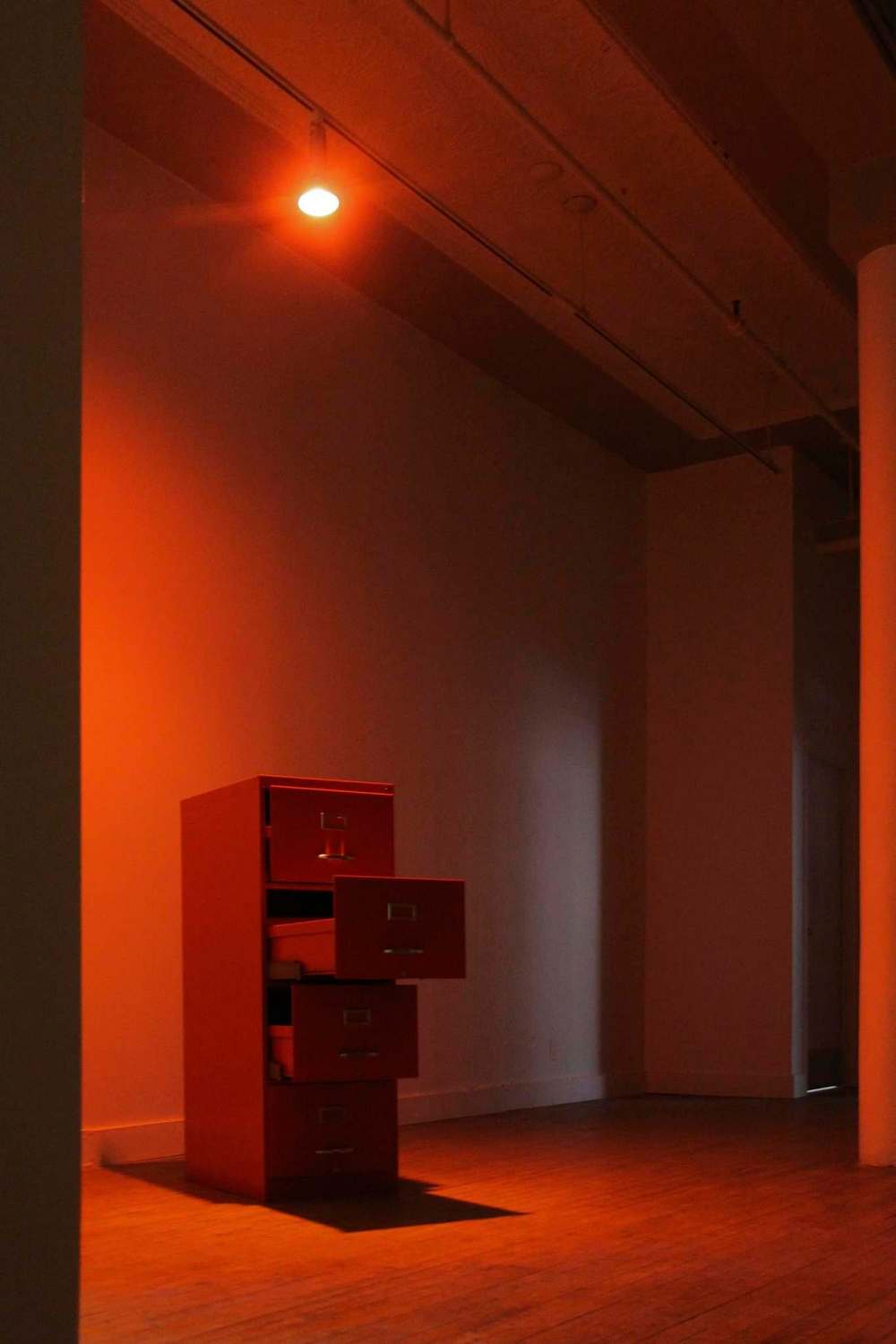
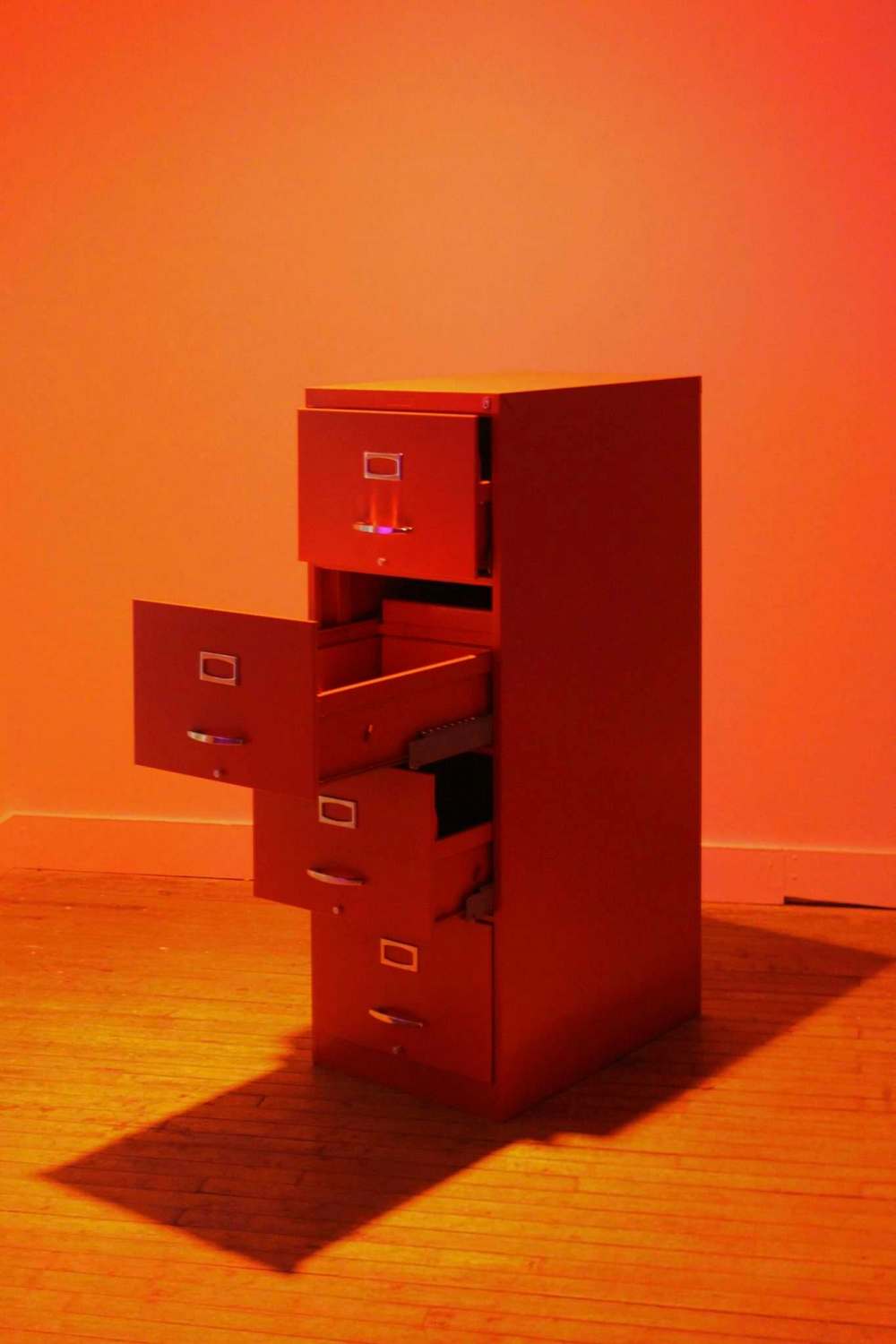
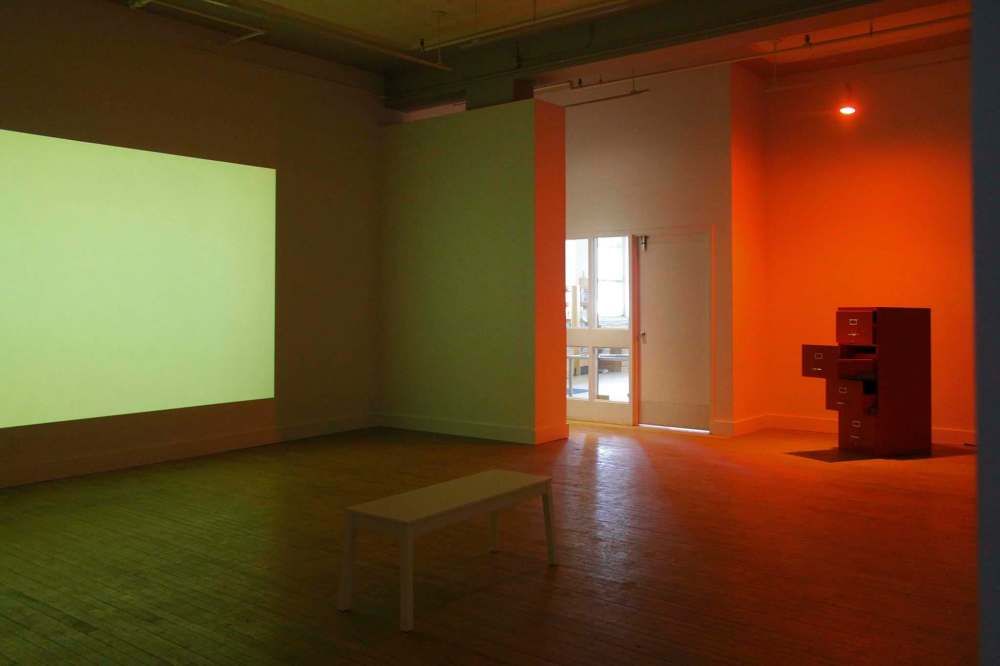
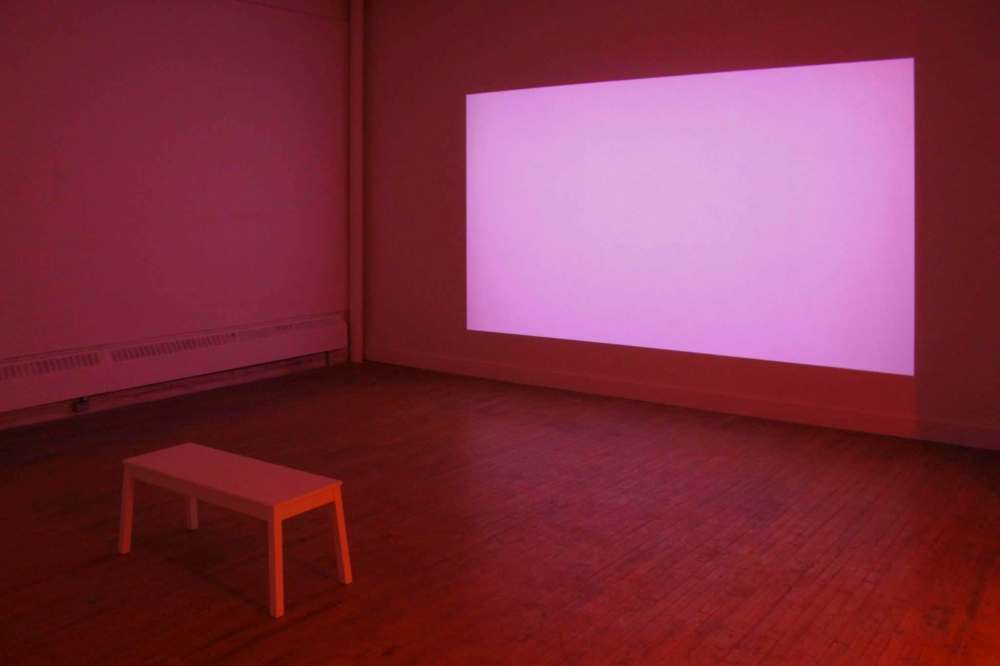
Green Puce, the Winnipeg-born, Vancouver-based artist’s exhibition at Platform Centre, seems at first an odd fit for the “photo gallery.” The show features just two works: Color-Aid, a projected sequence of single-colour frames synced to Hill-Carroll’s crisp narration, and Blue Hell — a likely corruption of the German hellblau, “bright blue” or “sky blue” — a nearly empty filing cabinet, drawers half-open and lit by a single, ominous red bulb. The show’s only proper photograph sits in the top drawer, a blurry black-and-white shot of the artist’s legs, the kind of picture you take by accident or to see if the film is engaged.
If there’s not much to see, as such, the voiceover gives a sense of what we’re missing. “The word of the day is ‘maunder,’ “ she quotes from somewhere, near the middle — “to ramble on or babble”; I looked it up. Over an elliptical half-hour or so, a slideshow of photographs we never see starts taking shape. They’re images Hill-Carroll took 15 years ago while living in Otse, a village in southeastern Botswana.
Amid fragments of other people’s poetry, snippets of Ulysses and Maurice Merleau-Ponty’s Phenomenology of Perception, and other, later recollections, Hill-Carroll gives a disjointed account of a troubled love affair and the “voodoo witchcraft crack-eating break with reality” that it occasioned. Experiential musings and isolated sense-memories lap up against concrete images of guns buried in the yard, condoms kept in a Pringles can next to John Donne’s collected poems, cross-border shopping in Zimbabwe, and disappearances into Kalahari.

She’s shown the photos before but, in her talk at Platform, Hill-Carroll voiced doubt in their value as either art or documentary, as if the parts of the story that were hers to tell lay elsewhere.
The filing cabinet alerts us to the absent archive, its particular failings and those of photography and memory themselves. Just as she redacts the images, we hear Hill-Carroll pulling back from the narrative in various acts of dissociation, changing the subject, slipping out of the first person, recounting others’ out-of-body hallucinations. We’re left with pristine, pricey Color-Aid pages, mnemonics whose relationships, if any, to the photographs we have no basis for knowing. Even those are marked by pits and scratches on the scanner glass.
“Does he ever read to his other the John Donne from the bureau bookcase?” Hill-Carroll wonders aloud, thinking of his poem, The Flea. What can its conceit of bloods blending in the belly of one flea mean in a place where one in four live with HIV? Three lives in one puce bloodstain, four if you count “the girl he’d been f—ing with the spot on her back and no, it was not a spot from the sun.”
Green Puce withholds at least as much as it confesses, which is its central tension, and it demands still more. Its problems are rewarding if intractable, though, like a striking colour whose name escapes you.
Steven Leyden Cochrane is a Winnipeg-based artist, writer and educator.
Art review

Maegan Hill-Carroll: Green Puce
Platform Centre for Photographic + Digital Arts (121-100 Arthur St.)
To Feb. 18
Advertisement Advertise With Us
Advertisement Advertise With Us