Abundance of Hart and soul in RWB’s stunning, boundary-blurring Vespers
Advertisement
Read this article for free:
or
Already have an account? Log in here »
To continue reading, please subscribe:

Digital Subscription
One year of digital access for only $205*
- Enjoy unlimited reading on winnipegfreepress.com
- Read the E-Edition, our digital replica newspaper
- Access News Break, our award-winning app
- Play interactive puzzles
*First annual payment billed as $205.00 + GST for one year. This annual subscription will automatically renew at $233.00 + GST every 52 weeks (10% off the regular annual price of $259.35). Offer available to new and qualified returning subscribers only. Cancel any time.
To continue reading, please subscribe:
Add Free Press access to your Brandon Sun subscription for only an additional
$1 for the first 4 weeks*
- Enjoy unlimited reading on winnipegfreepress.com
- Read the E-Edition, our digital replica newspaper
- Access News Break, our award-winning app
- Play interactive puzzles
*Your next Brandon Sun subscription payment will increase by $1.00 and you will be charged $17.95 plus GST for four weeks. After four weeks, your payment will increase to $24.95 plus GST every four weeks.
Read unlimited articles for free today:
or
Already have an account? Log in here »
Hey there, time traveller!
This article was published 11/05/2017 (3444 days ago), so information in it may no longer be current.
To step into James Kudelka’s mythology-infused world of Vespers is to wonder, wide-eyed, at the power of ballet to weave stories and evoke potent images that could be expressed only through the medium of dance itself.
The Royal Winnipeg Ballet presented the world première Wednesday of the Canadian choreographer’s latest creation that also serves as a testament to the spirit of bold risk-taking that has been this company’s backbone for 77 years.
The production, which runs through Sunday at the Centennial Concert Hall, is at once mesmerizing, inspiring, perplexing, puzzling and, frequently, jaw-dropping brilliant.
The nearly two-hour evening (including one intermission) notably features a guest appearance of legendary prima ballerina Evelyn Hart, the RWB’s former principal dancer. Now in her early 60s, the ethereal dancer’s transcendent artistry has never burned more brightly, able to rivet attention the moment she sets foot onstage, and her first appearance after intermission drew immediate applause.
Inspired partially by a collection of essays written by 16th-century French philosopher Michel de Montaigne, Kudelka creates a fantastical, otherworldly kingdom where humans and beasts leap, love, mate with each other and spar as equals. Following a suggested, apocalyptic fall, their two worlds splinter apart, until Hart’s Everywoman, joined by principal dancer Dmitri Dovgoselets’ male figure akin to a husband, seeks reconciliation — or, at least, peace.
Another inspiration is Monteverdi’s 1610 choral masterpiece, Vespro Della Beata Vergine 1610, or Vespers, based on liturgical text signifying evening prayers. The flowing, Baroque polyphonic score, including its idiosyncratic “goat trills” is flawlessly performed by Winnipeg’s 17-member Camerata Nova led by Mel Braun and accompanied by a scaled-down Winnipeg Symphony Orchestra conducted by Tadeusz Biernacki.

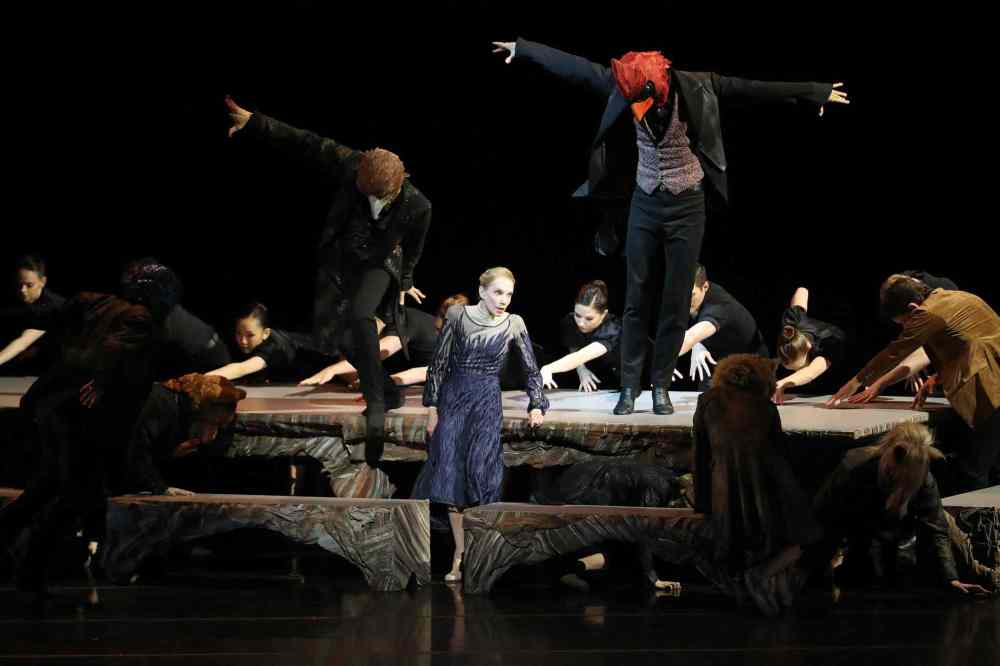
The two halves of the ballet are distinctly different. In the first, 10 animals — ram, bear, horse, cardinal, hawk, duck, pig, porcupine, fox and rabbit — are introduced, as surrealistic as a Salvador Dalí painting. It’s startling seeing dancers wearing Torontonian Karen Rodd’s sculptural animal masks covering their entire heads, which forces the emotional expression to be conveyed through the body alone. Denis Lavoie’s costumes range from sartorial vests and tailcoats for the beasts and birds, to neutral black shirts and trousers for the company of mortals.
The second act begins more intimately, locating the action in a domestic scene that includes an oversized farm table — created by set and prop designer Nick Blais — in the looming shadow of an overhanging, gnarly tree branch, augmented by more grounded, cave-like recesses for dancers to suddenly appear and vanish.
Kudelka imbues his ballet with ritualistic purpose, his innovative movement vocabulary ranging from rustic, folk dance-flavoured steps and stomps to courtly promenades.
His eye for architecture also includes his trademark patterning, with groups of dancers seamlessly morphing into other configurations in a kaleidoscopic tapestry of movement, as well as breaking into smaller solos, duets, trios and quartets. A series of tableaux are wisely embedded into the overall choreographic texture that provides momentary repose from the larger ensemble sections, where the stage fills with 20 whirling dancers.
What becomes fascinating is how individual animals begin to reveal their personalities. Corps de ballet member Liam Caines as the Horse — arguably the animal protagonist — creates a majestic creature to be both feared and admired, who shakes his mane and trots and canters about the stage. One particular section, where the humans fall into rank and file behind him, dutifully imitating his high kicks with poker-straight legs as he tames them into obedient (read: submissive) dressage-like patterns, is compelling.
His counterfoil, Ram, performed with muscular verve by Yosuke Mino, asserts his own dominance throughout the show, including volatile kicks and athletic leaps during the first act, and his threatening omnipresence in the second that stokes fear into a trembling Hart.
.jpg?w=1000)
We also see the soaring elegance of principal dancer Liang Xing as Cardinal, who soars through the air with full wingspan during his graceful duet with Chenxin Liu’s hopping Rabbit, her hands held like paws. One of the first, more intricate solos is given to Pig, performed by corps de ballet dancer Yoshiko Kamikusa, whose suspended turns in relevé executed with ease creates her own care-free soliloquy. There’s even a love scene where humans couple with animals, blurring boundaries while representing equality as its earthiest best.
There’s palpable anticipation for Hart’s first sighting, and once she appears after intermission, it bears mentioning that she never leaves the stage, with as much dancing as we’ve seen her perform in many years. This is no mere character role for her, but a pivotal presence that steers the loosely based narrative toward its ultimate resolution. Hart fully inhabits her character with an utter commitment to her stage persona, with the slightest and subtlest emotional response resonating throughout her face and body. Her magical performance only left one hungry for more.
One of the show’s most tender moments comes as she first encounters the Horse as her benevolent protector. Her quicksilver reaction as Ram suddenly emerges from the shadows before taking refuge in Dovgoselets’ arms suddenly injects the ballet with dramatic tension. Her pas de deux with Caines is deeply poignant, while speaking to the deeply rooted connection between humankind and nature. Kudos to both men for fearlessly lifting Hart sky-high multiple times, as well as being fully supportive partners to this iconic ballerina.
As expected, the audience rose to its feet with a standing ovation at the end, cries of “bravo!” growing stronger for Hart as she took her own bow.
holly.harris@shaw.ca
Holly Harris writes about music for the Free Press Arts & Life department.
Our newsroom depends on a growing audience of readers to power our journalism. If you are not a paid reader, please consider becoming a subscriber.
Our newsroom depends on its audience of readers to power our journalism. Thank you for your support.
Dance review

Vespers
Royal Winnipeg Ballet
Centennial Concert Hall
To May 14
Four and a half stars out of five
Holly Harris writes about music for the Free Press Arts & Life department.
Our newsroom depends on a growing audience of readers to power our journalism. If you are not a paid reader, please consider becoming a subscriber.
Our newsroom depends on its audience of readers to power our journalism. Thank you for your support.
Related Articles
Celebrated ballerina Evelyn Hart gets key to city

Advertisement Advertise With Us
Advertisement Advertise With Us
History
Updated on Thursday, May 11, 2017 1:07 PM CDT: Formatted, photos added.