Berlin museum presents 100 works by artist Gerhard Richter
Advertisement
Read this article for free:
or
Already have an account? Log in here »
To continue reading, please subscribe:

Digital Subscription
One year of digital access for only $205*
- Enjoy unlimited reading on winnipegfreepress.com
- Read the E-Edition, our digital replica newspaper
- Access News Break, our award-winning app
- Play interactive puzzles
*First annual payment billed as $205.00 + GST for one year. This annual subscription will automatically renew at $233.00 + GST every 52 weeks (10% off the regular annual price of $259.35). Offer available to new and qualified returning subscribers only. Cancel any time.
To continue reading, please subscribe:
Add Free Press access to your Brandon Sun subscription for only an additional
$1 for the first 4 weeks*
- Enjoy unlimited reading on winnipegfreepress.com
- Read the E-Edition, our digital replica newspaper
- Access News Break, our award-winning app
- Play interactive puzzles
*Your next Brandon Sun subscription payment will increase by $1.00 and you will be charged $17.95 plus GST for four weeks. After four weeks, your payment will increase to $24.95 plus GST every four weeks.
Read unlimited articles for free today:
or
Already have an account? Log in here »
Hey there, time traveller!
This article was published 31/03/2023 (1288 days ago), so information in it may no longer be current.
BERLIN (AP) — A new show of works by one of Germany’s most famous living artists, Gerhard Richter, opened at Berlin’s Neue Nationalgalerie museum on Friday.
“Gerhard Richter. 100 Works for Berlin” shows for the first time the long-term loan from the artist’s foundation. At the center of the exhibition is Richter’s 2014 series “Birkenau,” the result of the artist’s decades-long engagement with Germany’s Nazi past and the Holocaust.
The four large canvases of the Birkenau series are abstract paintings with many gray and black surfaces, but also some red and green dashes.
The basis of the paintings are four photos secretly taken in 1944 by Jewish prisoners at the Auschwitz-Birkenau extermination camp, who risked their lives doing so. Richter transferred the four photographs with charcoal and oil onto the canvas and then gradually painted over them with oil paint until their content was no longer visible.
Richter’s process of abstraction was based on his conviction that he could not do justice to the incomprehensible horror of the Holocaust with direct depiction.
During the Holocaust, the Nazis and their henchmen murdered 6 million European Jews.
In the gallery across from the Birkenau paintings is a large mirror which not only reflects the four works, but also visitors who thus become part of the installation.
“I think that is what makes this work so central and so intense, that you as a visitor are really questioned about your responsibility during the time of Nazis and your position on the Holocaust,” said Maike Steinkamp, the curator of the exhibition.
“Richter doesn’t give us an analysis, but allows us as viewers to form our own opinion,” Steinkamp added.
Richter, who is 91, lives in the western city of Cologne. His oeuvre spans six decades in which he has repeatedly explored the possibilities and limits of painting as well as the tension between abstraction and figuration.
In 2021, the Gerhard Richter Foundation committed a total of 100 artworks to the collection of the Nationalgalerie as a permanent loan which will be transferred to the Museum of the 20th Century that is currently being build next door and set to be completed in 2026.
“We’re building a special exhibition room for the long term loan for Gerhard Richter in the new building,” said Klaus Biesenbach, the director of the Neue Nationalgalerie.
Biesenbach added that the current gallery is “a bit smaller than it will be in the new building, but it’s as complex and as multi-faceted.”
Until the opening of the new museum, the works will be presented at the Neue Nationalgalerie. Not all 100 will be on display at the same time, they will be rotated.
Alongside the “Birkenau” series, there are currently several other works from various phases of Richter’s career including a large group of overpainted photographs.
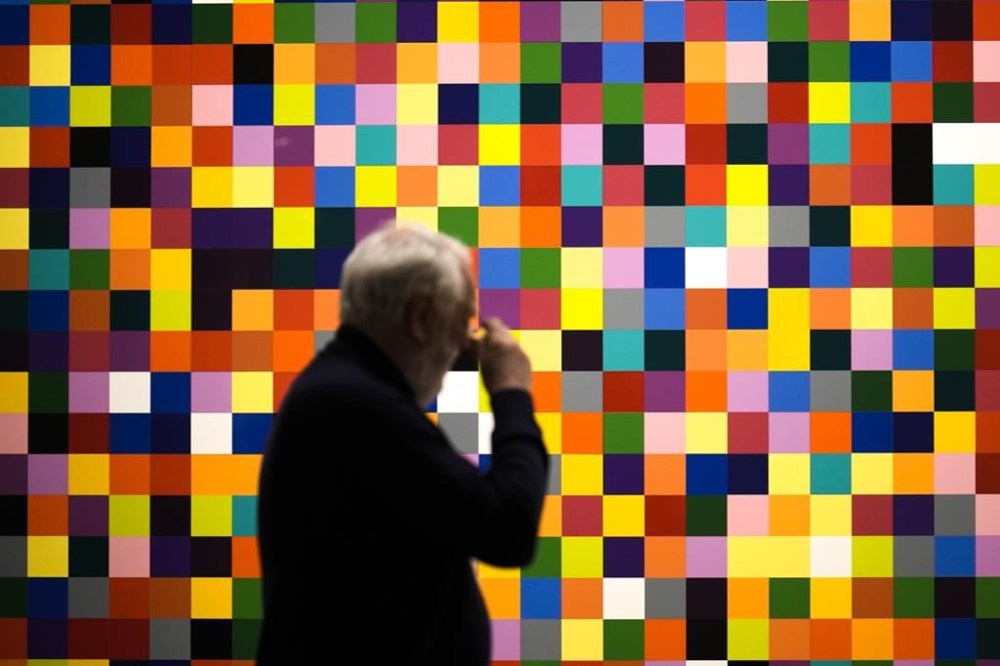
There’s also “4900 Colours” from 2007, which is composed of 196 individual square panels, each of which is subdivided into 25 color squares.
The exhibition was realized in close collaboration with the artist, the museum said.