The power and glory in a new story Rising again, Hudson’s Bay building is six storeys of potential in the hands of Southern Chiefs’ Organization
Read this article for free:
or
Already have an account? Log in here »
To continue reading, please subscribe:

Digital Subscription
One year of digital access for only $205*
- Enjoy unlimited reading on winnipegfreepress.com
- Read the E-Edition, our digital replica newspaper
- Access News Break, our award-winning app
- Play interactive puzzles
*First annual payment billed as $205.00 + GST for one year. This annual subscription will automatically renew at $233.00 + GST every 52 weeks (10% off the regular annual price of $259.35). Offer available to new and qualified returning subscribers only. Cancel any time.
To continue reading, please subscribe:
Add Free Press access to your Brandon Sun subscription for only an additional
$1 for the first 4 weeks*
- Enjoy unlimited reading on winnipegfreepress.com
- Read the E-Edition, our digital replica newspaper
- Access News Break, our award-winning app
- Play interactive puzzles
*Your next Brandon Sun subscription payment will increase by $1.00 and you will be charged $17.95 plus GST for four weeks. After four weeks, your payment will increase to $24.95 plus GST every four weeks.
Read unlimited articles for free today:
or
Already have an account? Log in here »
Hey there, time traveller!
This article was published 27/08/2023 (1140 days ago), so information in it may no longer be current.
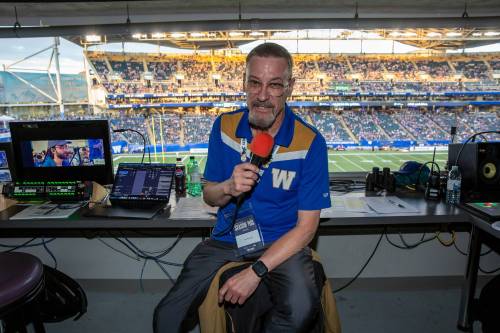
Greg Agnew, board president at Heritage Winnipeg and a retired historian, says he has always been interested in “the stories buildings tell.”
Landmarks
A monthly series that looks at the structure and spaces that shape Winnipeg. Read more of Alison Gillmor’s Landmarks features here.
Over the decades, the Hudson’s Bay store building on Portage Avenue has told many stories — of the historic Hudson’s Bay Company’s influence and power, of a growing Prairie city’s ambition and optimism, of the fate of the big downtown department store, from its grand ascendancy to its slow, sad decline.
Now, with the six-storey, 655,000 square-foot structure beginning a years-long transformation into a multiuse facility under the auspices of the Southern Chiefs’ Organization, the Hudson’s Bay building is telling a new Indigenous narrative — a story of historic and economic reconciliation that reckons with a complicated colonial past and looks to a better future for all Winnipeggers.
The Hudson’s Bay Company’s roots in Winnipeg go very deep, back to its trading post at Upper Fort Garry, and then to an 1881 store at the corner of Main and York.
As the city entered the 20th century with a booming population and increasing prosperity, and as the golden age of the department store offered new ways of thinking about leisure and consumption, the venerable company needed to adapt.
SUPPLIED The SCO plan is a story of historic and economic reconciliation that reckons with a complicated colonial past and looks to a better future for all Winnipeggers.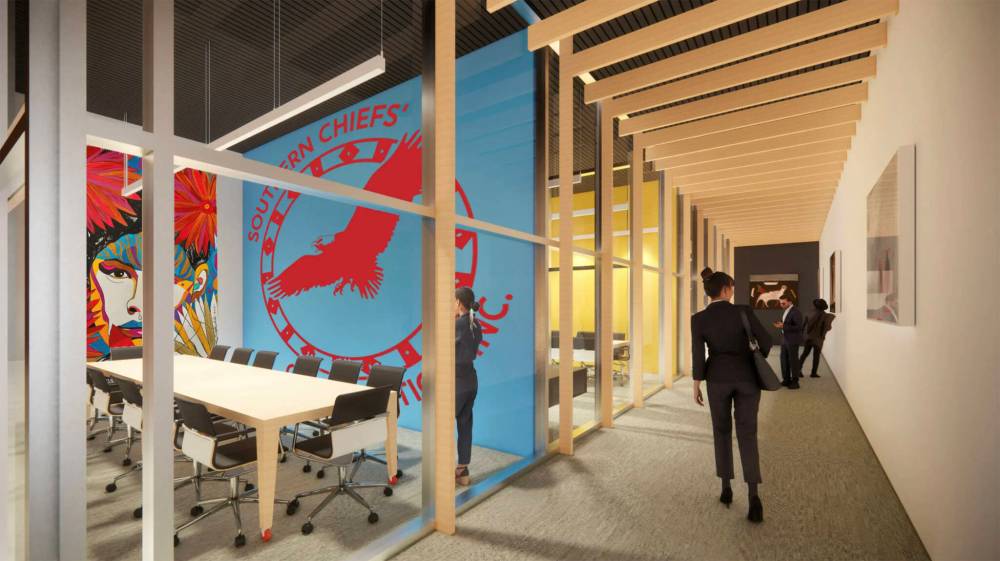
“They had problems when Mr. Eaton came along and planted his building on Portage Avenue,” Agnew says.
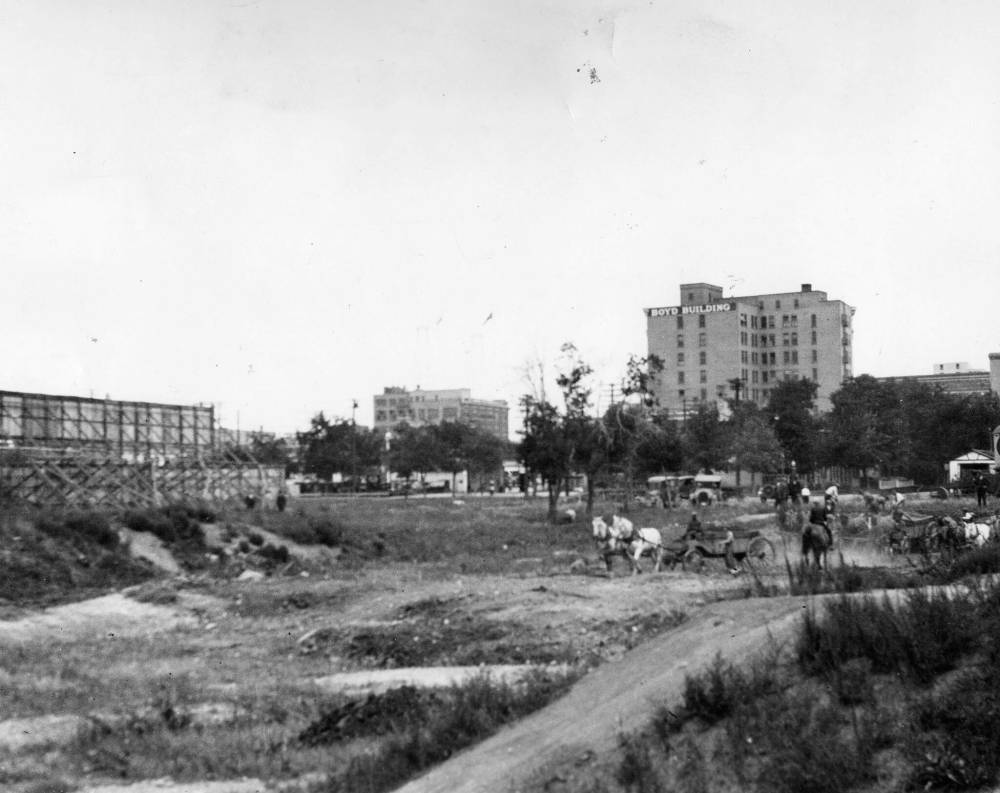
“And Portage Avenue became popular and everyone wanted to be there. The Hudson’s Bay Company had to do something, and so in 1925 they bought some property on Portage. At that time, it was just an empty lot with billboard signs on it.”
If HBC arrived on Portage a little late — there had been several delays in the planning phase — it more than compensated with the massive magnificence of its new flagship store. Designed by Ernest Isbell Barott of the Montreal firm Barott and Blackader, the structure’s muscular feel and clearly defined window grid referenced the Chicago School approach seen in the Eaton’s building down the street. But the Bay building retained ties to the past with its classical Beaux Arts flourishes, such as the elegant pilasters topped with elaborate Corinthian capitals on the Tyndall stone façade. Until 1936, there was also a beautiful interior arcade, with marble floors and vaulted ceilings, that drew shoppers in through the Portage Avenue doors.
According to architect Robert Eastwood, “It was an enormous building. It’s still an enormous building. The scale and the materials speak to the history of the company in Winnipeg.
“The strength of the columns, the symmetry, the simplicity, its scale and boldness and strength — the architects would have seen that grandeur as something that reflected the company at that time,” Eastwood says. “And this incredible investment also spoke to the character of the city.”
“It was an enormous building. It’s still an enormous building. The scale and the materials speak to the history of the company in Winnipeg.”–Robert Eastwood, architect
Eastwood, a retired partner with Winnipeg’s Number TEN who worked as an adviser on several proposals to adapt the building, is in awe of its construction, starting with the extraordinary excavation project required to dig its deep foundations.
“It’s a staggering scale and an incredibly robust concrete-frame building. At the time of its construction, it was the largest poured reinforced-concrete building in Canada,” Eastwood continues. It’s particularly impressive “that such a huge structure was built in slightly under a year and a half. It speaks to the skill of the trades at the time.”
As with so many department stores of that era, Hudson’s Bay was a kind of self-enclosed world. “It was a fascinating building in its day,” Eastwood says. “It was self-sustaining in some ways. It had its own central power plant and heating system. It had water storage tanks where it stored rainwater, and that rainwater was used to flush all the toilets in the building.
“It was very thoughtfully designed.”
When the building finally had its grand opening in November 1926, “the crowds were lining up around the block on the sidewalks,” Agnew says.
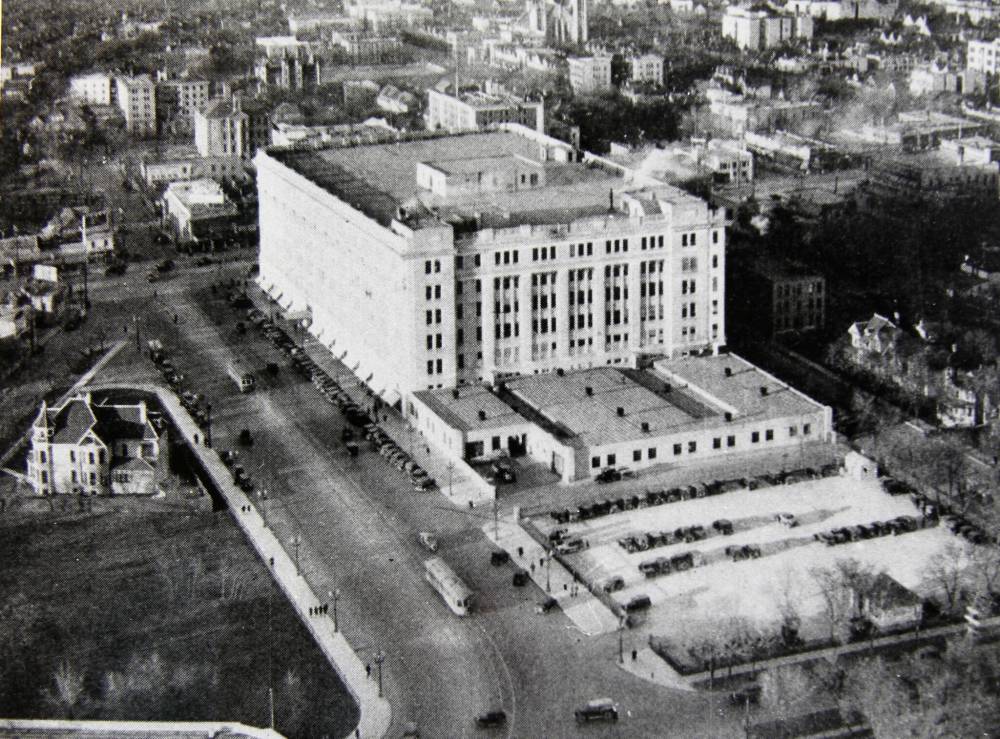
There was a lot to be excited about. Department stores of the time featured an unprecedented range of goods for sale, from buttons to canoes. But these elaborate emporiums, geared toward middle and upper-middle-class women, were about more than just shopping. They also promised leisure and a little bit of luxury. The new Hudson’s Bay store offered a library, a beauty parlour, a ladies’ lounge and banks of public telephones.
And of course, there were the restaurants.
Over the years, the store’s eateries ranged from the modest basement Malt Stop, where teenagers would often arrange to meet up in the pre-cellphone days, to the posh Georgian Room.
But the most popular – and memorable — venue had to be The Paddlewheel cafeteria. In My Winnipeg, Guy Maddin’s 2007 “docu-fantasia,” the filmmaker transformed the resto into a site of vaguely illicit pleasures, from the luridly jiggling Jell-O to the (completely made-up) Golden Boy “man pageants,” in which the mayor would judge a parade of young men for health, hygiene and “humid torsos.”
While the real Paddlewheel never reached these mythic, Maddinesque heights, it was, in fact, kind of kooky. At one point, the mixed-up dining space featured pictures depicting the Red River, a mod ceiling, a turning paddlewheel and a shallow pool of water where you could throw pennies for luck.
There was a general seating area but also two gendered enclaves — the Gentlemen’s Saloon, where an advertisement promised “a quiet, masculine atmosphere,” and the Crinoline Court, reserved for women and children and billed as “delightfully restful.”
Agnew recalls Neil Young and Burton Cummings doing a book signing there. There were fashions shows, he says, “showing off the latest fur coats, the latest swimwear,” and Santa Claus breakfasts.
In 2017, Agnew recounts, Heritage Winnipeg got the Bay to commit to participating in the annual Doors Open program, in which buildings and neighbourhoods around the city offer public tours. At this point, the retail store was downsized but still operating, but the Paddlewheel had been closed since 2013, “and we really wanted to open it up again.”
On the day of the event, the volunteers were so busy prepping they didn’t realize it was getting close to the opening. “And the elevator doors opened up, and there were crowds of people, and I said, ‘I’m sorry, we don’t open until noon,’ and they all pointed at their watches,” Agnew says.
“It was a scramble. We were only open for four hours, and we had over 1,500 people come through there.”
(And yes, there was Jell-O.)
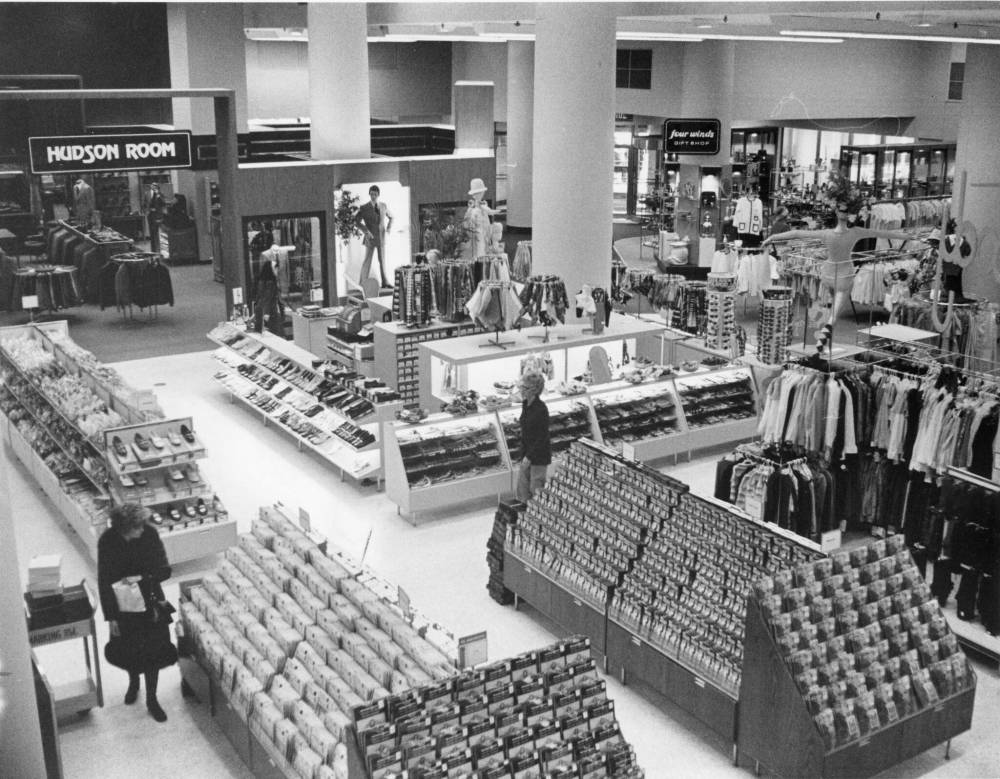
While the Hudson’s Bay Company goes back to the 17th century, it always wanted to be seen as up to date.
“In the ‘30s, air traffic was just starting, the Stevenson Field was just being built by Mr. Richardson, and they put a two-million candlelight-power light on the top of the Bay that could be seen a hundred miles away,” Agnew says. “There would be this great big beam of light showing the pilots the way.”
The Bay also built the first large parkade on the Prairies in 1954, which was a novel modern amenity but simultaneously a symbol of the downtown store’s doom, since those automobiles would soon be carrying shoppers farther afield to suburban shopping malls.
At some point, as demographics shifted and shopping patterns changed, the Bay started shrinking its retail spaces. Even after things started to get a little empty and eerie, and scenes on the upper floors resembled outtakes from The Shining, the structure still hung on to a faded majesty. There were callbacks to another time, such as the vast women’s washroom on the second floor, with its armchairs and vanity tables with lit-up mirrors to check your makeup.
As the store dwindled, declined and finally closed in 2020, the Bay demonstrated — by its absence — what had been its crucial role in the larger city fabric.
JOHN WOODS / WINNIPEG FREE PRESS FILES Way back, when Portage Avenue was the new retail frontier, ‘The Hudson’s Bay Company had to do something, and so in 1925 they bought some property on Portage,’ Greg Agnew of Heritage Winnipeg says of the building seen here in 2021.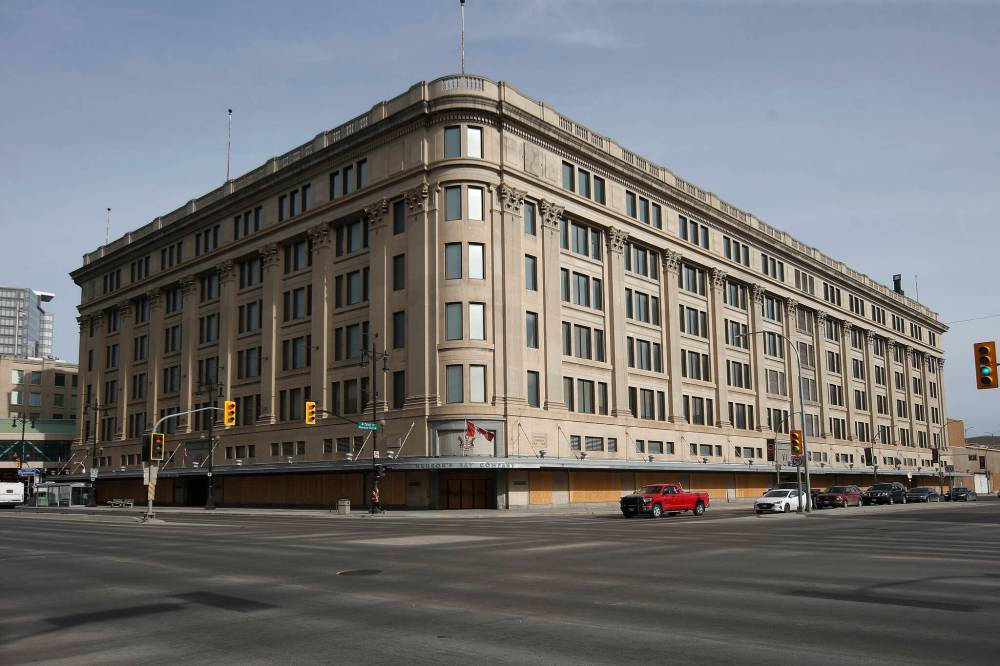
During the department store heyday, many Winnipeggers declared for either Eaton’s or The Bay, and could argue passionately for the merits of their favourite. (My bargain-hunting grandmother, for example, was totally Team Eaton.) But other people liked to visit both, and the promenade from one store to the other helped to drive downtown foot traffic — and also assisted the small independent stores along the way.
“In its day, Portage Avenue was this incredible place,” Eastwood says. “The crowds who walked from Eaton’s to the Bay enlivened it.”
He’s hoping the current adaptive re-use of the structure, which will include a large central atrium and a large main-floor public space, will bring back some of that energy. “What the city needs to re-create are public spaces like that, of which we have far too few right now,” Eastwood suggests. “These spaces will actually provide the kind of urban gathering place the city really needs — that draw people to live and to gather downtown.”
The multi-year transformation could be challenging, Eastwood admits. “It’s always a struggle with a building this big, with this massive floor plan, a full block deep,” he suggests. “The only way to insert housing is to create a large atrium in the middle. Fortunately, the building has this incredibly robust concrete frame, which allows them to do that — to actually cut out portions of the concrete frame while the building remains stable and capable of carrying that atrium structure.”
“In its day, Portage Avenue was this incredible place… The crowds who walked from Eaton’s to the Bay enlivened it.”–Robert Eastwood, architect
But beyond the daunting physical transformation is the incredibly important symbolic shift. “The significance of what is being undertaken today — it’s an incredibly courageous and difficult thing to do,” Eastwood says. “To take on that scale, to take on a building of that size and significance, with the context of the historic relationship between Hudson’s Bay and First Nations.
“It’s a tremendous undertaking, that the building can maintain that urban presence but tell an entirely new story. It’s phenomenal that this gets to happen.”

Studying at the University of Winnipeg and later Toronto’s York University, Alison Gillmor planned to become an art historian. She ended up catching the journalism bug when she started as visual arts reviewer at the Winnipeg Free Press in 1992.
Our newsroom depends on a growing audience of readers to power our journalism. If you are not a paid reader, please consider becoming a subscriber.
Our newsroom depends on its audience of readers to power our journalism. Thank you for your support.
Related Articles
Crew clearing Bay flagship for redevelopment finds army of mannequins, potential path to better future