Punishment for glutton
Nameless protagonist bites off more than he can chew in PTE season opener

Advertisement
Read this article for free:
or
Already have an account? Log in here »
To continue reading, please subscribe:

Digital Subscription
One year of digital access for only $205*
- Enjoy unlimited reading on winnipegfreepress.com
- Read the E-Edition, our digital replica newspaper
- Access News Break, our award-winning app
- Play interactive puzzles
*First annual payment billed as $205.00 + GST for one year. This annual subscription will automatically renew at $233.00 + GST every 52 weeks (10% off the regular annual price of $259.35). Offer available to new and qualified returning subscribers only. Cancel any time.
To continue reading, please subscribe:
Add Free Press access to your Brandon Sun subscription for only an additional
$1 for the first 4 weeks*
- Enjoy unlimited reading on winnipegfreepress.com
- Read the E-Edition, our digital replica newspaper
- Access News Break, our award-winning app
- Play interactive puzzles
*Your next Brandon Sun subscription payment will increase by $1.00 and you will be charged $17.95 plus GST for four weeks. After four weeks, your payment will increase to $24.95 plus GST every four weeks.
Read unlimited articles for free today:
or
Already have an account? Log in here »
Hey there, time traveller!
This article was published 14/10/2023 (1080 days ago), so information in it may no longer be current.
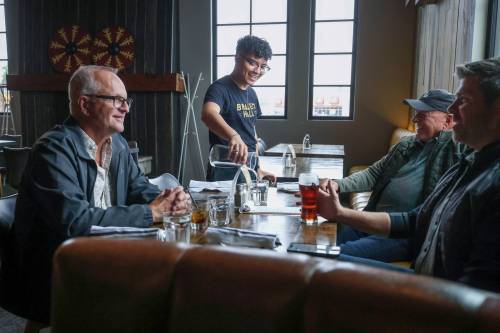
Whenever he goes on a business trip, the nameless, colourless man (Arne MacPherson) who lives at the centre of playwright Guillermo Verdecchia’s Feast tucks an unseen photograph into his carry-on bag as a totem of nostalgia.
Each night, the man, known in Verdecchia’s script by a single initial, M., peers at his night table to catch a glimpse of that snapshot, taken during a vacation with his wife, Julia, and their two children, Isabel and Xavi.
That way, he says, “even if I don’t know where I am, I’ll know who I am.”
RUTH BONNEVILLE / WINNIPEG FREE PRESS
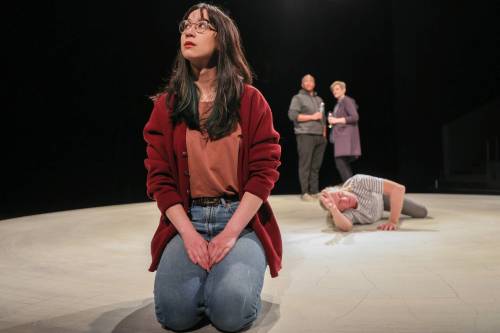
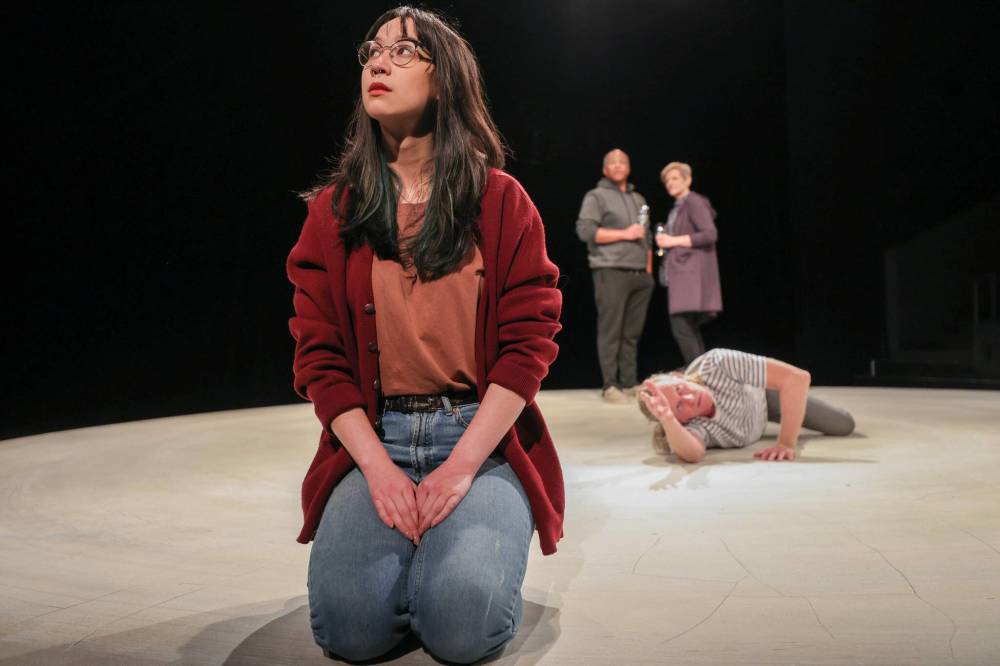
Budding environmentalist Isabel (Bailey Chin) tries warning her parents about climate change in Feast.
The man-bunned M. is a nomad by profession, a merchant of something, working for someone, in order to sustain a life of more in a world where less is the norm. Isabel (Bailey Chin) attends an elite university and is a member of its first-rate swim team. Julia (Melanie Whyte) wonders if they’ve failed as parents by not sending their daughter to a far-off school, making her world too small. At one point, Julia actually laments that the sky has gotten too blue.
Rich people problems.
During a brief reprieve from his own travel schedule, M. and Julia discuss plans for a family vacation. When Julia suggests a trip to “Kithaeron,” harkening back to the mountain where Oedipus was left to die, it’s a quiet hint that tragic consequences lie ahead for these characters, who roam outward against all better judgment, even as the world is burning.
Feast is a challenging, gripping exploration of transience and the malleability of place on an increasingly unbalanced planet, directed with keen restraint and an eye for imagination by Thomas Morgan Jones in its world première.
Morgan Jones’ vision of the Governor General’s Award winner’s maximal script is purposefully minimal, setting the action on a revolving platform — a cracked tectonic plate designed by David Oro.
In a thrust staging, with the audience on three sides of the platform at the Cherry Karpyshin Mainstage, the constant rotation creates a hypnotic aura of nausea, unease and global amnesia. With sparse set decoration, all the audience is given to work with when M. is in Beirut or Tunis is its own conception of what those places should look and feel like, based on cultural understanding and expectation.
This is a wise approach. Verdecchia is acutely focused on the effects of so-called globalization, making the case through his characters that the technological advances and economic largesse that have brought the world “closer” together haven’t given most of North American society any greater insight into those far-off places or the inverse effects of global connectivity. We also haven’t become any less self-centred.
This is best typified in Feast when the conversation shifts to the alimentary.
RUTH BONNEVILLE / WINNIPEG FREE PRESS
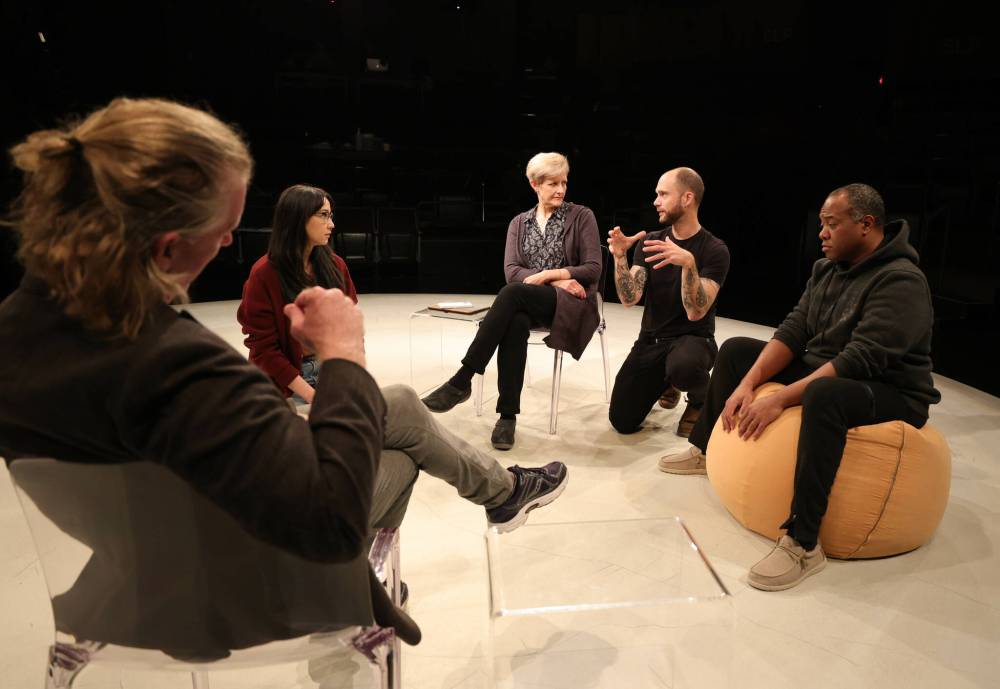
Director Thomas Morgan Jones (second from right) goes over scenes with actors during rehearsal of Prairie Theatre Exchange’s Feast.
Isabel, a budding environmentalist, lambastes her father for his daily banana intake, suggesting he’s complicit in an extractive industry by eating a foreign fruit instead of what grows around him. He’s making a deal with the devil, she says, but M. admits he would sell his soul for a nanner.
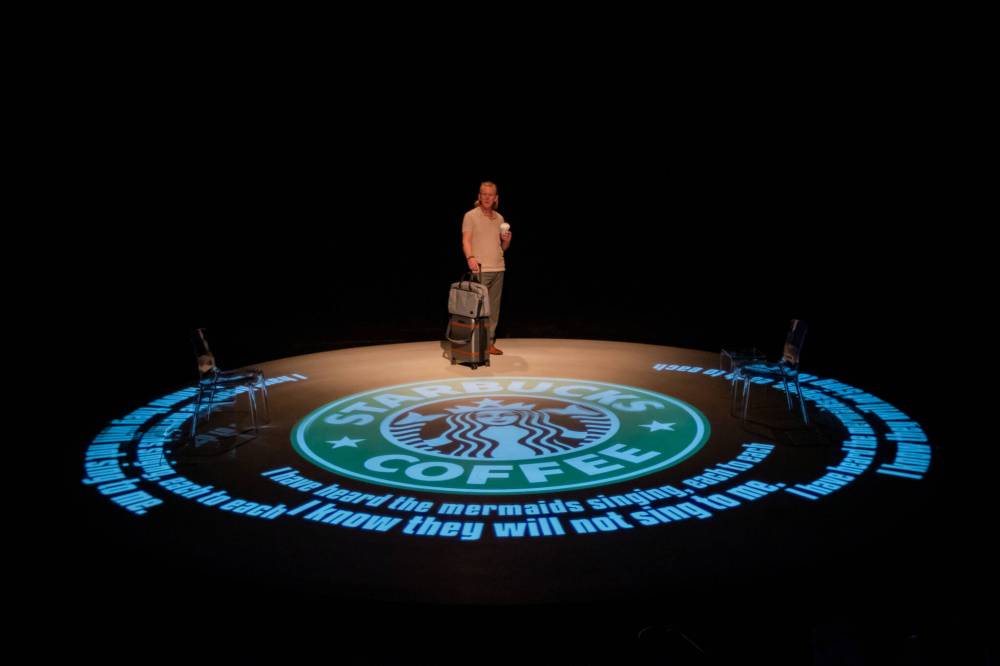
He essentially does when he and Julia agree to go on a global food tour, with M. inspired by a barista at Starbucks that one can “taste a place.” But when Julia heads home early, M.’s insatiable appetite for elsewhere takes him to uncomfortable and irrational places, called by the siren song of the unfamiliar before inevitably and horrifically biting off more than he can legally chew.
As Julia, Whyte is at her most relatable when leaning into her character’s instability and fallibility; she begins as a typical member of the upper class, but as soon as she sees Isabel wasn’t wrong about the climate crisis, she tries to insulate herself from the consequences, reinforcing the walls of her home.
Similarly, as soon as his character loses his footing, MacPherson imbues M. with a doomed naiveté.
Both characters, who begin in an Edenic setting, are victims of entropy and poor decision-making.
The play, which runs for slightly more than two hours without an intermission, receives a much-needed jolt of energy upon the arrival of Emeka, a Nigerian fixer living in Kenya, played by Ray Strachan with looseness and charm.

Living and working in a broken-down bar, Emeka is a businessman working hard to transcend his environment, clearly for different reasons than his guest. M. is extremely trusting of Emeka, who sets up intricate and increasingly dangerous meals for the man he calls Mzungu.
Joey Senft photo
Arne MacPherson plays M. in Prairie Theatre Exchange's Feast by Guillermo Verdecchia, playing until Oct. 22.
That word, meaning “foreigner” in a number of Bantu dialects, is used cheekily by Emeka, delivered on its face as a term of endearment and in its shadow as a warning that M. has gone too far.
To wander freely is a privilege, and in Verdecchia’s universe, as in ours, it’s a form of lust that has never been without casualty.
Don’t underestimate the security of a home-cooked meal.
ben.waldman@winnipegfreepress.con
Ben Waldman is a National Newspaper Award-nominated reporter on the Arts & Life desk at the Free Press. Born and raised in Winnipeg, Ben completed three internships with the Free Press while earning his degree at Ryerson University’s (now Toronto Metropolitan University’s) School of Journalism before joining the newsroom full-time in 2019. Read more about Ben.
Every piece of reporting Ben produces is reviewed by an editing team before it is posted online or published in print — part of the Free Press‘s tradition, since 1872, of producing reliable independent journalism. Read more about Free Press’s history and mandate, and learn how our newsroom operates.
Our newsroom depends on a growing audience of readers to power our journalism. If you are not a paid reader, please consider becoming a subscriber.
Our newsroom depends on its audience of readers to power our journalism. Thank you for your support.
Theatre review
Feast
● Prairie Theatre Exchange
● To Oct. 22
★★★1/2 out of five
Ben Waldman is a National Newspaper Award-nominated reporter on the Arts & Life desk at the Free Press. Born and raised in Winnipeg, Ben completed three internships with the Free Press while earning his degree at Ryerson University’s (now Toronto Metropolitan University’s) School of Journalism before joining the newsroom full-time in 2019. Read more about Ben.
Every piece of reporting Ben produces is reviewed by an editing team before it is posted online or published in print — part of the Free Press‘s tradition, since 1872, of producing reliable independent journalism. Read more about Free Press’s history and mandate, and learn how our newsroom operates.
Our newsroom depends on a growing audience of readers to power our journalism. If you are not a paid reader, please consider becoming a subscriber.
Our newsroom depends on its audience of readers to power our journalism. Thank you for your support.
Advertisement Advertise With Us
Advertisement Advertise With Us