In ‘Janet Planet,’ playwright Annie Baker explores a new dramatic world
Advertisement
Read this article for free:
or
Already have an account? Log in here »
To continue reading, please subscribe:

Digital Subscription
One year of digital access for only $205*
- Enjoy unlimited reading on winnipegfreepress.com
- Read the E-Edition, our digital replica newspaper
- Access News Break, our award-winning app
- Play interactive puzzles
*First annual payment billed as $205.00 + GST for one year. This annual subscription will automatically renew at $233.00 + GST every 52 weeks (10% off the regular annual price of $259.35). Offer available to new and qualified returning subscribers only. Cancel any time.
To continue reading, please subscribe:
Add Free Press access to your Brandon Sun subscription for only an additional
$1 for the first 4 weeks*
- Enjoy unlimited reading on winnipegfreepress.com
- Read the E-Edition, our digital replica newspaper
- Access News Break, our award-winning app
- Play interactive puzzles
*Your next Brandon Sun subscription payment will increase by $1.00 and you will be charged $17.95 plus GST for four weeks. After four weeks, your payment will increase to $24.95 plus GST every four weeks.
Read unlimited articles for free today:
or
Already have an account? Log in here »
Hey there, time traveller!
This article was published 19/06/2024 (801 days ago), so information in it may no longer be current.
NEW YORK (AP) — The Pulitzer Prize-winning playwright Annie Baker has been hailed as one of the preeminent voices of her generation, but the movies have long lingered in her mind and in her work.
In her play, “The Flick,” a trio of workers clean up between showings at a smalltown arthouse theater. In “The Antipodes,” a writers room brainstorming session grows increasingly abstract but has the conference-room shape and mostly male composition of a Hollywood pitch meeting.
Now, Baker, 43, has made a film. It’s a first-time feature but, thrillingly, the evident product of a masterful dramatic veteran. For Baker, it’s less a new beginning than the realization of a long deferred dream. When Baker moved to New York to attend college, she did it, she says, “to be as near as many movie theaters as possible.”
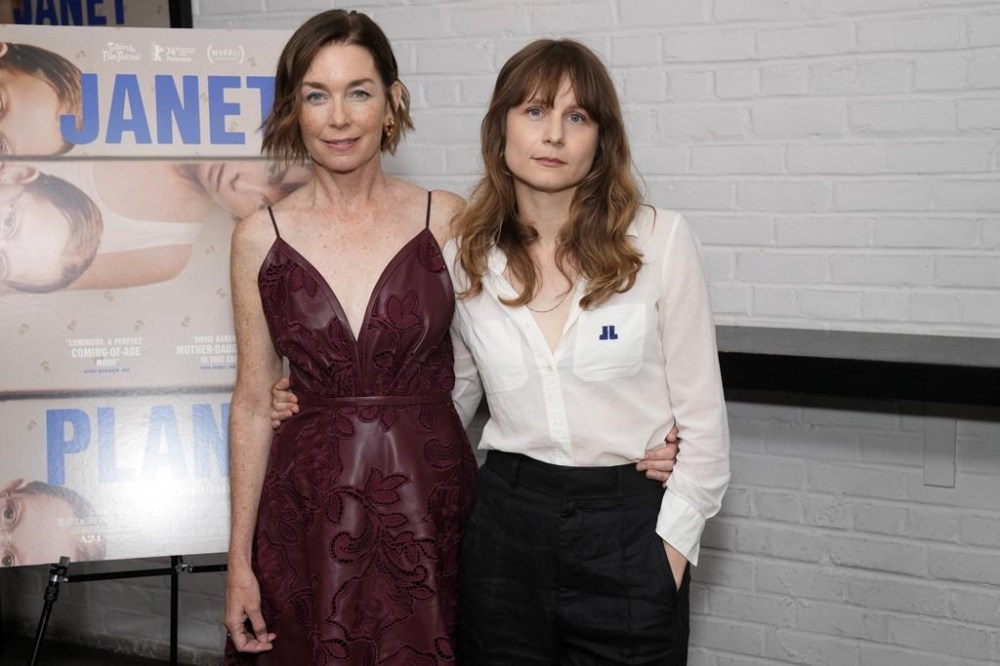
She nearly applied to film school but opted instead to study dramatic writing. Her career as a playwright took off. Her first play, “Body Awareness,” won an Obie Award in 2009, as did her follow-up, “The Aliens.” Baker adapted “Uncle Vanya” in 2012 and, in 2014, won the Pulitzer for “The Flick.” In 2017, she was named a MacArthur Fellow.
Occasionally, Baker tried her hand at screenwriting. But being a celebrated American playwright tends to be a full-time gig. Movies faded as a possibility.
“I decided around 38 or 39 that it was never going to happen and I was going to be OK with it,” Baker said in a recent interview over lunch at the Chelsea Hotel in Manhattan. “I remember saying it out loud to someone. I think I said: ‘I’m just not going to get to direct a movie in this life.’”
But almost as soon as Baker made that pronouncement, fate intervened. On Friday, A24 will release Baker’s debut, “Janet Planet,” about a single mother named Janet (Julianne Nicholson) living in 1990s Western Massachusetts with her 11-year-old daughter, Lacy (Zoe Ziegler).
“It’s been a lesson throughout my whole career. You just have to let go of ambition and start working from another place inside of yourself,” Baker says. “I do wonder if saying it out loud enabled me to do it.”
“Janet Planet” is a cinematic experience as precisely attuned to daily rhythms as Baker’s stage work is. The film’s perspective is largely from that of Lacy, whose watchful eyes follow a string of her mother’s relationships as they pass through their home. As in Baker’s plays, little may be appearing to happen but the sense that something profound is transpiring under the surface is palpable. In an unspoken coming of age, Lacy begins to see her mom less as a lofty parental figure and more as a regular person.
“I don’t have nostalgia for that time period. I find it aesthetically interesting, but I don’t have a romantic take on it,” says Baker. “I feel like the movie has a lot of mild dread in it.”
“Janet Planet” isn’t strictly autobiographical but it draws heavily from Baker’s own childhood growing up with her divorced mother in Amherst. Baker’s film, shot in Western Massachusetts, is also authentically woodsy. Just as several of her plays — including the Vermont-set “Body Awareness” — have sought to capture quotidian lives and subtle social shifts in smalltown New England, Baker resolved that she would make “Janet Planet” in rural Massachusetts — or she wouldn’t make it, at all.
Drawing such a line, when it’s typically cheaper to shoot closer to New York City, can be risky. But just as Baker writes plays with specific actors in mind, like Matthew Maher for “The Flick,” she figured she would do the same for movie locations.
“It’s scary when you’re making your first movie to be like, ‘No,’ because the movie might not happen if you say no too much,” says Baker. “Now when you see the movie, you know you couldn’t shoot that in Mamaroneck.”
For Nicholson, the location and subject matter of “Janet Planet” was eerily close to home, too. From the ages of 7 to 11, she lived in nearby Montague. She was a camp counselor in Goshen.
“The whole summer blew my mind,” says Nicholson. “I can’t even go too deep into because I’ll literally burst into tears. It just felt so huge at every turn to be walking these places that were so formative.”
Nicholson, who brings her typically radiant naturalism to the role, found herself thinking less about her mother, a herbalist, than some of the other women in her mother’s life.
“There were people in that world much more lonely or seeking meaning, connection,” says Nicholson. “I remember even as a kid recognizing people who felt lost. And Janet feels a little bit lost.”
In her plays, Baker is renown for exquisite stillness and artfully timed pauses, a sensibility that’s earned her comparisons to Pinter and Chekhov. The script to her play “The Aliens” opens with explicit instructions on the length of silences. “At least a third — if not half — of this play is silence,” she wrote.
Part of the excitement of “Janet Planet” is seeing how Baker’s keen sense of time and rhythm gets applied in a new medium. Baker holds some shots long. To capture the nature sounds around the house they were filming in, Baker and her sound designer kept a microphone recording nonstop for two straight weeks. Nicholson says that stillness and in-between moments were encouraged, but “there isn’t a word or bit of punctuation in the movie that wasn’t in the script.”
“I’m going to make theater for the rest of my life. I love both forms equally and never want to stop making both of them,” says Baker. “Once you really get your hands in both mediums, you can really feel palpably how different they are. It’s not an intellectual thing anymore. Directing a movie made me really excited to write my next play.”
It’s clear speaking to Baker, a passionate cinephile who drew inspiration for “Janet Planet” from the films of Maurice Pialat and Apichatpong Weerasethakul, that she’s galvanized from her first hands-on exploration of a new medium, and eager to go further.
Not that there weren’t challenges. The relentless demands of directing a movie — from preproduction through editing — was a fresh experience for Baker. Not everything could be controlled. A mistake by a 16mm film processing lab ruined a portion of the movie.
“It was the hardest thing I’ve done,” says Baker, sounding more energized by film’s difficulties than lamenting them. “People complain about theater tech and it’s like five days of 10-hour days. I’ll never complain about tech again.”
Baker wasn’t new to film sets. Her husband, the academic Nico Baumbach, is brother to the director Noah Baumbach (Baker appears in his 2014 film “While We’re Young” ). Greta Gerwig is her sister in law. Whether those affiliations leant anything to her experience making “Janet Planet,” Baker declined to say.
Baker recoils, generally, from drawing direct lines between herself and her work. She picked out a hillside for “Janet Planet,” she says, not because she ran down it as a child but for its “witchy” quality. To hear Baker discuss it, writing a play or making “Janet Planet” is more about the evolution she undergoes in transforming memory into something outside of her, into something else.
“I do have some selective amnesia with everything I write where I can’t quite remember why I wrote it or who I was when I wrote it,” Baker explains. “There’s some sort of way I work through things through my work – my own crises and questioning. And when I’m done, I never think about it again.
“Whatever I wrote the play about is a skin I get to shed,” Baker says just before she departs. “Maybe that’s why I do it.”
___
Follow AP Film Writer Jake Coyle at: http://x.com/jakecoyleAP