Play and unpredictability Artist-mother collaborates with children
Read this article for free:
or
Already have an account? Log in here »
To continue reading, please subscribe:

Digital Subscription
One year of digital access for only $205*
- Enjoy unlimited reading on winnipegfreepress.com
- Read the E-Edition, our digital replica newspaper
- Access News Break, our award-winning app
- Play interactive puzzles
*First annual payment billed as $205.00 + GST for one year. This annual subscription will automatically renew at $233.00 + GST every 52 weeks (10% off the regular annual price of $259.35). Offer available to new and qualified returning subscribers only. Cancel any time.
To continue reading, please subscribe:
Add Free Press access to your Brandon Sun subscription for only an additional
$1 for the first 4 weeks*
- Enjoy unlimited reading on winnipegfreepress.com
- Read the E-Edition, our digital replica newspaper
- Access News Break, our award-winning app
- Play interactive puzzles
*Your next Brandon Sun subscription payment will increase by $1.00 and you will be charged $17.95 plus GST for four weeks. After four weeks, your payment will increase to $24.95 plus GST every four weeks.
Read unlimited articles for free today:
or
Already have an account? Log in here »
Hey there, time traveller!
This article was published 10/10/2024 (709 days ago), so information in it may no longer be current.
Mothers are often not featured in family photos.
They are the takers of the photos, the documentarians of their children’s lives. In Victorian-era photographs of toddlers, there are invisible mothers, propping up their children and keeping them still while disguised as pieces of furniture — or daubed out in black paint post-production — in what is now known as the hidden mother phenomenon.
Ruth Bonneville / Free Press Franco-Manitoban artist Dominique Rey at the entry doors to her major new exhibition at the WAG called Motherground, before the opening Friday. 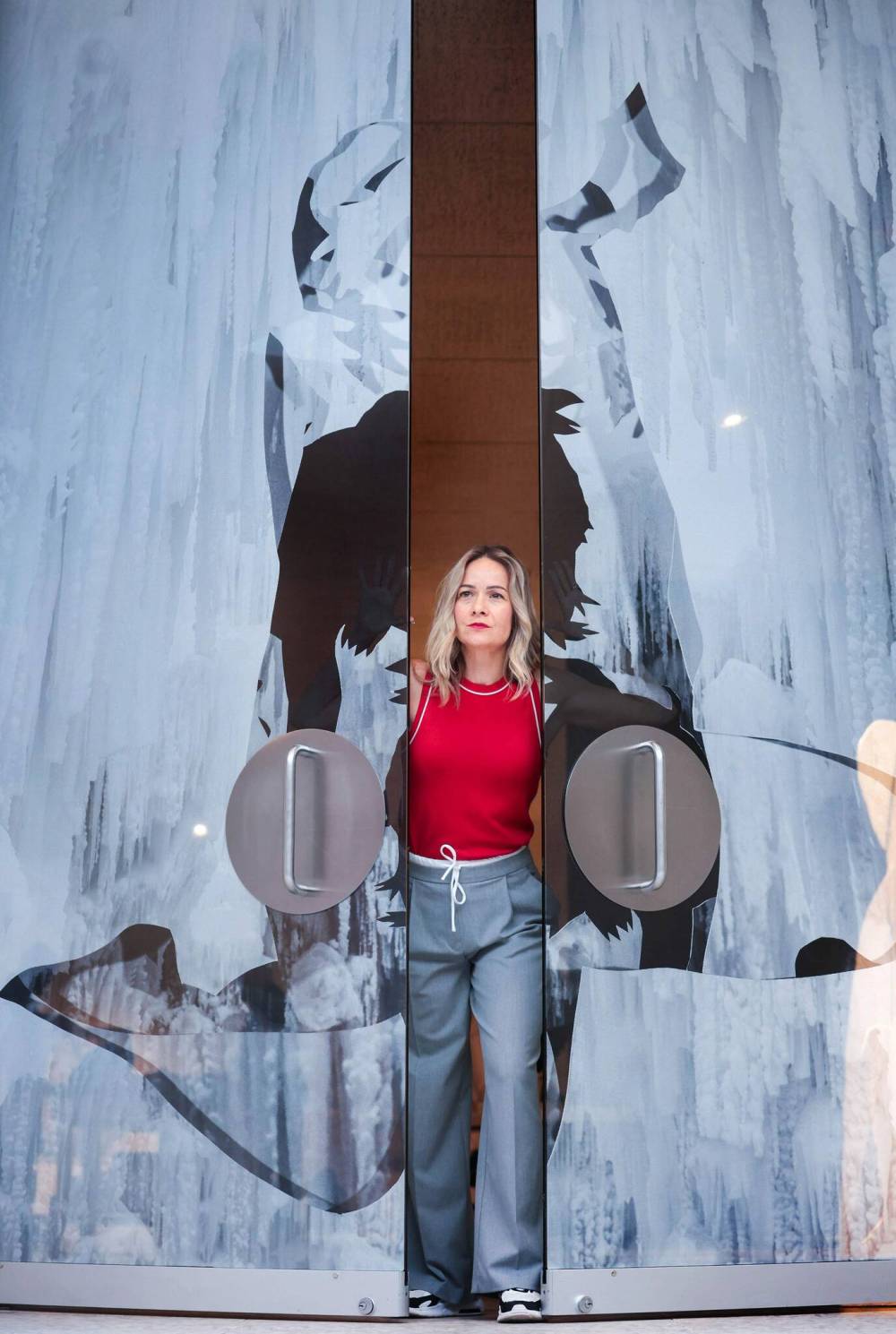
Eight years ago, when Franco-Manitoban contemporary artist Dominique Rey was in Europe for an artist residency, her husband captured an indelible image of her playing with their daughter, Madeleine Coar, who was one and a half at the time.
They were in a dark tunnel in Brussels, golden-hour sunlight streaming in behind them, creating a backlit effect. But while both mother and daughter were cast as shadowy figures, Rey wasn’t a hidden mother. In that moment, she felt seen.
“When I saw that documentation, I was spellbound,” says Rey, 48. “It was one of those lightbulb moments where you’re like, ‘Wow, this is achieving exactly what I’ve been thinking about for so long,’ which is that our sense of self, our identity, is something that is in perpetual transformation — it’s not a fixed thing.
“And here was this moment, because of the lighting, our bodies would merge together and pull apart and it became just so representative of the day-to-day reality of being a mom, being a parent.”
That image also became the visual inspiration for eight years of experimentation and creativity culminating in Motherground, Rey’s first solo exhibition at WAG-Qaumajuq, opening Friday.
Art preview
Motherground: Dominique Rey with Madeleine and Auguste Coar
Opening celebration October 11, 7 p.m.
WAG-Qaumajuq
Free
The works on view — which include photo collage, small and large-scale photographs, human-scale sculpture and video installation — are a meditation on the many contrasts of motherhood. Rey works with the bodies of mother and child as one and distinct from each other; presence and absence; joy and grief.
That push-pull is evident in a series of photo collages in which the mother’s body is replaced by photographs of thawing Red River ice.
“So she’s just this icy, silhouetted form and you see this child that’s in movement around her, twirling in all of these different poses. I think it stands for all of these possibilities — what looks so solid is actually liquid. What can appear to be cold and cool and almost stone-like is thriving with life just underneath,” Rey says
Women’s identities and women’s lives have long influenced Rey’s work, which has been exhibited in solo and group shows throughout Europe and North America — including seven group shows at WAG-Qaumajuq.
Rey has always wanted to highlight and validate the stories that are so often pushed to the periphery.
Ruth Bonneville / Free Press Domestic Frieze wrestles with the moments when mother and child’s bodies merge and pull apart, morphing into altered shapes. 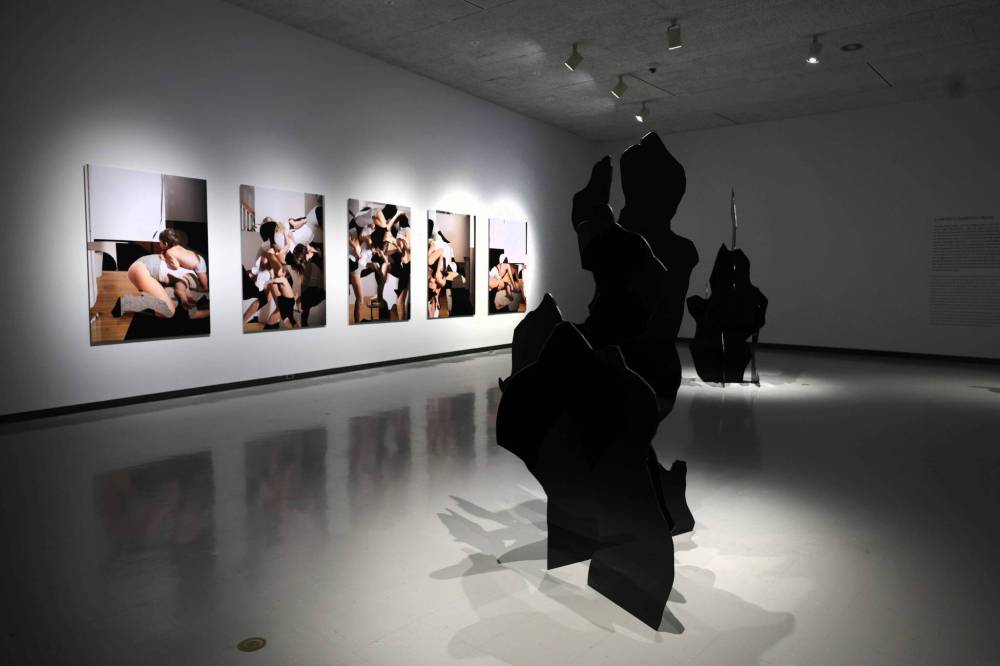
“When I became pregnant, there was that moment of, can I make art about this? I think there was a push-pull for a period of time because of this implicit bias that exists in the art world that women artists should not make art about their personal lives or about their experiences as mothers. That was the critic in the back of my head,” she says.
That critic was silenced as soon as she saw the Brussels capture of her and Madeleine.
Rey’s daughter, now 9, and her son, Auguste, now 6, figure prominently in the exhibition. They are not subjects but co-collaborators.
They even get billing in the show’s full title, Motherground: Dominique Rey with Madeleine and Auguste Coar.
Working with her kids was both instructional and transformative for the artist.
“I think I learned early on that they’re not on the job. This has to be fun for them,” she says.
Rey remembers working on an early series of photos with her daughter when she was about three years old and Rey was pregnant with her son.

“We started to perform in this improvised, playful manner — all of the photographs are based on this improvisation of movement. And at some point she was done. She was like, ‘I want to run through the hallway. I want to do other things now.’ I was like, ‘Oh, but … we could do just one more minute or five more minutes,’” Rey recalls.
“And I realized, that’s not a thing. Like, if I need to twist your arm to make art with me, I think I’ve lost the thread. It can’t be about that. And so, not only in the making of the art have I realized that they’re the directors and I need to follow their lead and support their artistic vision, I thought it made for much more interesting art.”
Indeed, that sense of play and unpredictability hums throughout the works in Motherground. There are photo collages of Rey and her children in which it’s hard to tell where one begins and another ends, the puzzle of their bodies creating angular, sculptural shapes.
In the video installation, Rey and her kids are almost subsumed in stretchy red-and-white striped fabric — a far cry from the heavy brocade disguises of Victorian hidden mothers — and often move as one, a roving, multi-limbed human play structure.
Ruth Bonneville / Free Press In Case of Storms, Rey has cut, collaged, then re-photographed melting Red River Ice onto full-length images of herself improvising movements with her daughter, Madeleine Coar.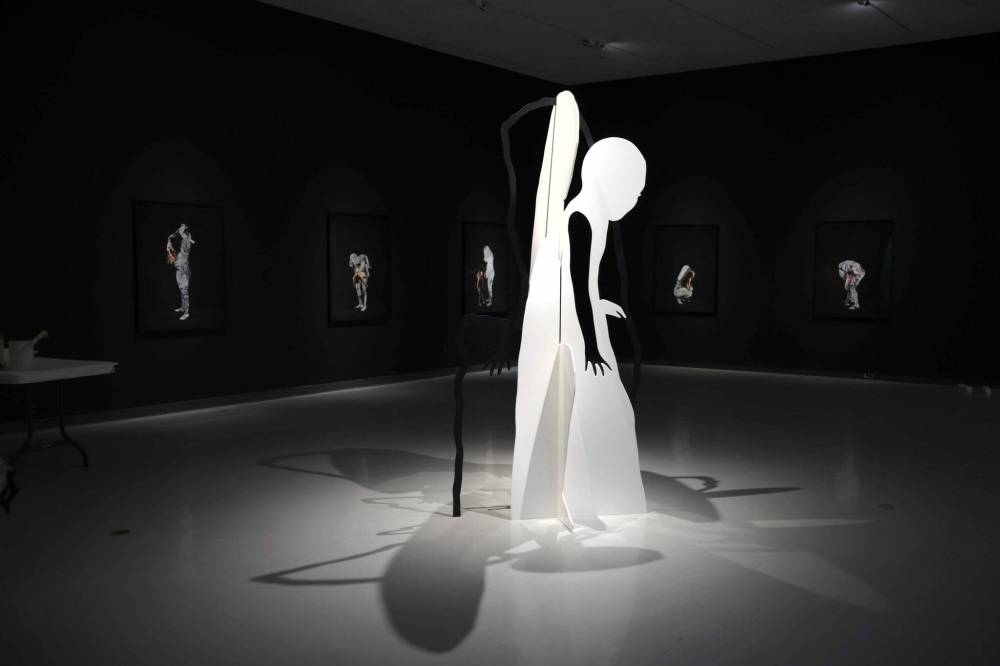
The exhibition was also designed with little gallery-goers in mind. There’s a secret child-sized entrance to the video installation and an activity area that invites kids and kids-at-heart to contribute their own creations to the show.
“I’m really happy about the fact that there’s a children’s area, a family area,” says Riva Symko, WAG-Qaumajuq’s head of collections and exhibitions and curator of Motherground.
“There’s space for them to figure out how these images work in a material way and add to the exhibition in their own way. I just want people to have fun and interact — but not touch the sculptures — and feel relaxed and like they have something here for them.”
With Motherground, Rey wants to put motherhood in the centre of the frame, instead of just outside of it.
“I think we’ve got to make space to have those conversations and talk about those real, lived experiences,” Rey says. “Because when I talk just one on one with other parents it’s still, nonetheless, such an isolating experience, and that’s right at the heart of what’s hardest about all of that.”
Motherground is on view until March 31, 2025.
jen.zoratti@winnipegfreepress.com

Jen Zoratti is a columnist and feature writer working in the Arts & Life department, as well as the author of the weekly newsletter NEXT. A National Newspaper Award finalist for arts and entertainment writing, Jen is a graduate of the Creative Communications program at RRC Polytech and was a music writer before joining the Free Press in 2013. Read more about Jen.
Every piece of reporting Jen produces is reviewed by an editing team before it is posted online or published in print – part of the Free Press‘s tradition, since 1872, of producing reliable independent journalism. Read more about Free Press’s history and mandate, and learn how our newsroom operates.
Our newsroom depends on a growing audience of readers to power our journalism. If you are not a paid reader, please consider becoming a subscriber.
Our newsroom depends on its audience of readers to power our journalism. Thank you for your support.