Rescuing grub from the garbage
Winnipeggers work to cut down on food waste, which costs Canada billions each year
Advertisement
Read this article for free:
or
Already have an account? Log in here »
To continue reading, please subscribe:

Digital Subscription
One year of digital access for only $205*
- Enjoy unlimited reading on winnipegfreepress.com
- Read the E-Edition, our digital replica newspaper
- Access News Break, our award-winning app
- Play interactive puzzles
*First annual payment billed as $205.00 + GST for one year. This annual subscription will automatically renew at $233.00 + GST every 52 weeks (10% off the regular annual price of $259.35). Offer available to new and qualified returning subscribers only. Cancel any time.
To continue reading, please subscribe:
Add Free Press access to your Brandon Sun subscription for only an additional
$1 for the first 4 weeks*
- Enjoy unlimited reading on winnipegfreepress.com
- Read the E-Edition, our digital replica newspaper
- Access News Break, our award-winning app
- Play interactive puzzles
*Your next Brandon Sun subscription payment will increase by $1.00 and you will be charged $17.95 plus GST for four weeks. After four weeks, your payment will increase to $24.95 plus GST every four weeks.
Read unlimited articles for free today:
or
Already have an account? Log in here »
Hey there, time traveller!
This article was published 21/12/2024 (635 days ago), so information in it may no longer be current.
Food waste continues to mount despite growing public awareness about it and opposition to it.
The National Zero Waste Council says more than half of all food produced and distributed in Canada never gets eaten, resulting in significant environmental, economic and social consequences.
The average Canadian household produces 79 kilograms of food waste annually, states the UN Food Waste Index.

BROOK JONES/FREE PRESS
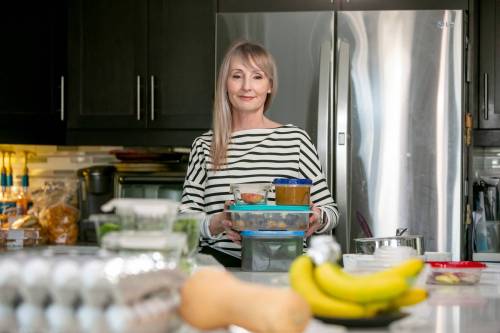
Anne Dubouloz-Lodge, 55, is dedicated to reducing food waste by putting leftovers in reusable containers.
Love Food Hate Waste Canada estimates that about 2.2 million tons of edible food is wasted each year in Canada, costing in excess of $17 billion.
A report presented at city hall last year using statistics from 2019 showed food waste from single-family households made up about 44 per cent of Winnipeg’s waste stream.
These shocking findings have some Winnipeggers doing all they can to ensure they’re not part of the problem.
Martha McIntosh is a Winnipeg mother to a blended family with five children, and grandmother of four. As a teen, she lived in Malawi, one of the poorest countries in the world, when her father was working there on a foreign aid project.
“We had no garbage. We shopped using a basket, so no bags,” she recalled. “A few things like meat and fish were wrapped in paper. There were few consumer goods available and very little was packaged. Any waste was reused. Our gardener made compost. Absolutely nothing went to waste.”
With no garbage pickup, even the rare can, bottle or plastic container would be reused.
“Seeing this level of poverty, resilience and resourcefulness — and yet, general happiness — among the people was such a lifelong blessing to me, and has absolutely helped me to be appreciative every single day of how very fortunate I am and many Canadians are.
“This was pretty much a zero-waste society. We could learn so many lessons.”
When the COVID-19 pandemic struck in 2020, McIntosh started learning about mutual aid, although she’d always practised it before knowing the name for it.
“At that time the needs were so great — and then we had shopping restrictions at Christmas time. Having raised five kids, we had a houseful of stuff I started giving away, and then realized the needs for food and started giving that away too,” said McIntosh, who is the volunteer administrator for several Facebook groups, including MAS (Mutual Aid Society) and Everything Free Winnipeg.
“Every single day I approve dozens of posts from people in need of food, generally desperate need. People don’t go requesting help from strangers on Facebook for fun; they are usually desperate and humiliated, although there should be no shame in asking for help. It’s so hard to get past that stigma,” she said.
“We can’t count on governments or charities; we can only count on ourselves. We need to help each other. That’s the only way we can survive. ‘Be the change you want to see’ type thing.”
McIntosh has made it a habit to offer what she has in local groups by means of easily manageable contactless pickups.
“Clearly, needs are great, because even when I offer tiny bits of food, even leftovers, someone usually responds in moments. I post as often as I have anything that might go to waste.

BROOK JONES/FREE PRESS
Anne Dubouloz-Lodge, who grew up in a large family in the south of France: ‘I loathe food waste, so while I cook large quantities because of the large crowds around our table, we always endeavour to minimize waste’
She encourages everyone who is able to do the same thing.
“Our neighbours are actually in need of food. That’s tragic and I wish everyone would understand this before dumping leftovers in the garbage. It’s food and someone would be happy to have it.”
● ● ●
Anne Dubouloz-Lodge grew up in a large family in the south of France, where fresh food was an essential feature of all meals. So, when it comes to cooking for large gatherings in her Winnipeg home, she’s the one doing it.
She and her husband are parents to a blended family of four children, meaning mealtime can involve cooking for six to 10 people, when partners and others are included.
“I loathe food waste, so while I cook large quantities because of the large crowds around our table, we always endeavour to minimize waste,” she said. “We have leftover night at least once a week, when all the leftovers are spread on the kitchen counter and people make their own plate to reheat.”

Dubouloz-Lodge says she and her husband encourage our guests to take home leftovers; most of their friends know to bring a container when they come over, but she also keeps some on hand.
“We tend to avoid blended dishes: we keep meats separate from vegetables and carbs — sauces and spices separate — in order to respect everyone’s dietary preferences,” she said, explaining that all salad and other meal ingredients are set in separate bowls on the table, and that fresh food keeps longer in the fridge when not blended.
“I wish more people realized how consumerist our society has become (for everything including food), how avoidable that is and how important for our planet it is that we become better stewards of the resources at our disposal,” Dubouloz-Lodge said. “There is no Planet B, as the saying goes.
“And it starts with small steps; every little action will help. Our family is far from having a perfect track record, and we’re not militantly defending anything, but we do believe that small changes can add up to big changes eventually — so we all try to do our part.”
fpcity@freepress.mb.ca