

World-famous German “nail artist” Günther Uecker dies at 95
Advertisement
Read this article for free:
or
Already have an account? Log in here »
To continue reading, please subscribe:
Monthly Digital Subscription
$1 per week for 24 weeks*
- Enjoy unlimited reading on winnipegfreepress.com
- Read the E-Edition, our digital replica newspaper
- Access News Break, our award-winning app
- Play interactive puzzles
*Billed as $4.00 plus GST every four weeks. After 24 weeks, price increases to the regular rate of $19.95 plus GST every four weeks. Offer available to new and qualified returning subscribers only. Cancel any time.
Monthly Digital Subscription
$4.99/week*
- Enjoy unlimited reading on winnipegfreepress.com
- Read the E-Edition, our digital replica newspaper
- Access News Break, our award-winning app
- Play interactive puzzles
*Billed as $19.95 plus GST every four weeks. Cancel any time.
To continue reading, please subscribe:
Add Free Press access to your Brandon Sun subscription for only an additional
$1 for the first 4 weeks*
*Your next subscription payment will increase by $1.00 and you will be charged $16.99 plus GST for four weeks. After four weeks, your payment will increase to $23.99 plus GST every four weeks.
Read unlimited articles for free today:
or
Already have an account? Log in here »
Hey there, time traveller!
This article was published 11/06/2025 (292 days ago), so information in it may no longer be current.
BERLIN (AP) — German artist Günther Uecker, one of the country’s most important post-war artists who was world-famous for his large-format nail reliefs, has died. He was 95.
German news agency dpa reported that his family confirmed he died at the university hospital in his hometown of Düsseldorf in western Germany Tuesday night. They did not give a cause of death.
For decades, Uecker, who was often dubbed “the nail artist,” created art by hammering carpenter’s nails into chairs, pianos, sewing machines and canvases. His works can be found in museums and collections across the globe.
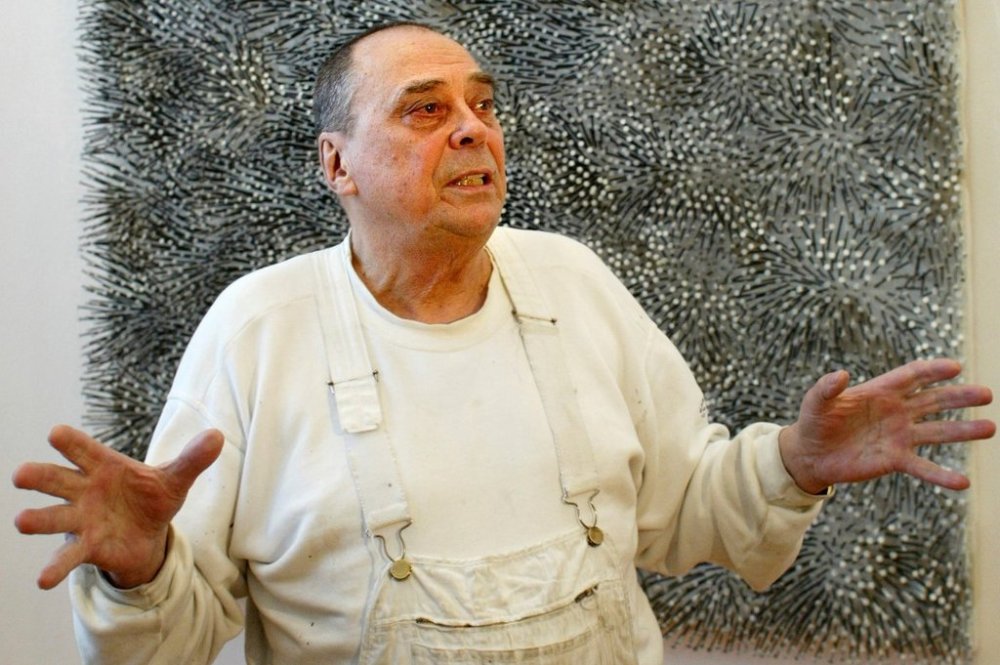
In his art work, seemingly endless numbers of nails, which would by themselves perhaps be perceived as potentially aggressive and hurtful, turned into harmonic, almost organic creations. His reliefs with the tightly hewn nails are reminiscent of waving grasses or fields of algae in a marine landscape.
Uecker himself described his nail art as diary-like landscapes of the soul, which he called an “expression of the poetic power of man,” dpa reported.
Hendrik Wüst, the governor of North Rhine-Westphalia which includes state capital Düsseldorf, called Uecker “one of the most important and influential artists in German post-war history” and said that with his life’s work, he influenced generations of young artists and “contributed to an open and dynamic society.”

Born on March 13, 1930, in the village of Wendorf on the Baltic Sea, Uecker moved to Düsseldorf in the mid-1950s, where he studied and later also taught at the city’s prestigious art academy.
In one of his most spectacular appearances or art happenings, he rode on the back of a camel through the hallways of the venerable academy in 1978. Together with fellow artist Gerhard Richter, he “occupied” the Kunsthalle Baden-Baden museum in 1968, with both kissing in front of the cameras.
The son of a farmer, he traveled the world with a humanitarian message of peace and exhibited in countless countries, including dictatorships and totalitarian states. He painted ash pictures after the Chernobyl nuclear disaster in Ukraine in 1986, and exhibited human rights messages painted on fabric in Beijing.
He also painted “Verletzungswörter,” or words of violence, killing and torment in many languages and foreign scripts on large canvases. In 2023, Uecker erected a stone memorial in Weimar in memory of the victims of the Nazi concentration camp Buchenwald.
“The theme of my artistic work is the vulnerability of man by man,” he said.