Mass tourism a modern ill

Advertisement
Read this article for free:
or
Already have an account? Log in here »
To continue reading, please subscribe:
Digital Subscription
One year of digital access for only $1.44 a week*
- Enjoy unlimited reading on winnipegfreepress.com
- Read the E-Edition, our digital replica newspaper
- Access News Break, our award-winning app
- Play interactive puzzles
*Billed as $5.77 plus GST every four weeks. After 52 weeks, price increases to the regular rate of $19.95 plus GST every four weeks. Offer available to new and qualified returning subscribers only. Cancel any time.
To continue reading, please subscribe:
Add Free Press access to your Brandon Sun subscription for only an additional
$1 for the first 4 weeks*
- Enjoy unlimited reading on winnipegfreepress.com
- Read the E-Edition, our digital replica newspaper
- Access News Break, our award-winning app
- Play interactive puzzles
*Your next Brandon Sun subscription payment will increase by $1.00 and you will be charged $17.95 plus GST for four weeks. After four weeks, your payment will increase to $24.95 plus GST every four weeks.
Read unlimited articles for free today:
or
Already have an account? Log in here »
Hey there, time traveller!
This article was published 21/06/2025 (486 days ago), so information in it may no longer be current.
When I went to Paris in 2012, I skipped the Louvre. Sacré bleu!
Don’t get me wrong: I notably love an art museum and try to go to one in every city I visit. From the Tate Modern in London to the Art Institute of Chicago to the Rijksmuseum in Amsterdam to the Metropolitan Museum of Art in New York City to the Denver Art Museum, I’ve had the absolute privilege — and it is that — to have seen many amazing works by incredible artists at world-class institutions.
But the Louvre gave me a particular kind of crowd anxiety. I’d seen the photos of sweaty throngs of people jockeying to get a glimpse of the Mona Lisa which, in addition to being famous, is famously not a large painting; Leonardo da Vinci’s Renassiance-era portrait is 77 by 53 centimetres.
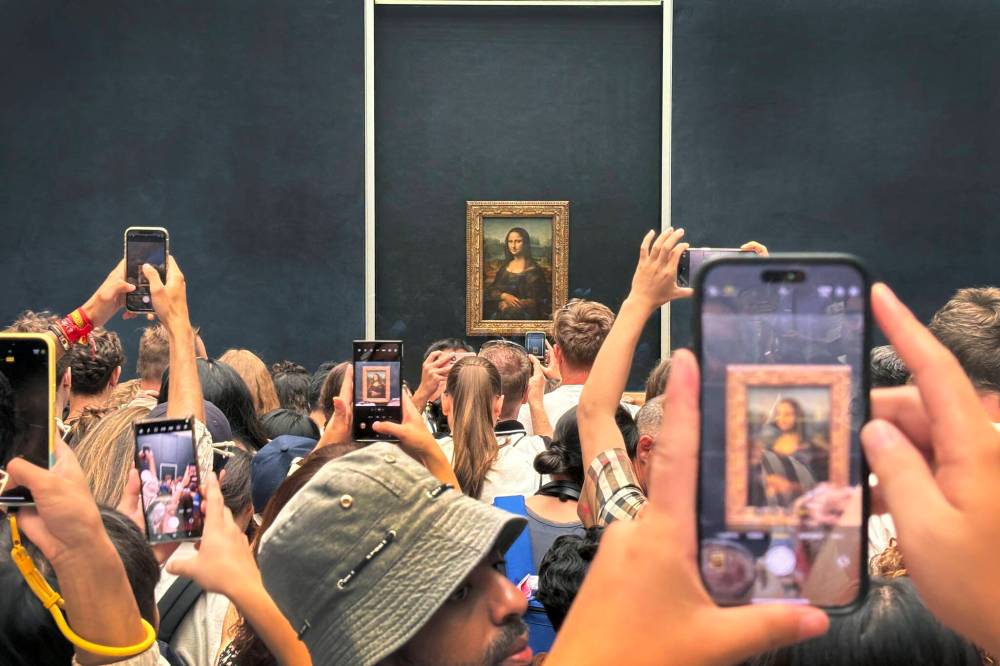
Thibault Camus / The Associated Press
Seeing Leonardo da Vinci’s Mona Lisa seems to be on a lot of bucket lists.
Our girl draws 30,000 visitors a day, which means actually getting anywhere close to her is all but impossible, and I’m sure it’s only gotten worse with the advent of selfies and content creators.
I just took an exterior photo of the Louvre Pyramid (itself a cultural landmark) and called it a day.
On Monday, the Louvre, which is the world’s most-visited museum, closed its doors, leaving long lines of tourists stranded outside. The temporary closure was the result of a so-called wildcat strike, an unauthorized work stoppage by unionized employees. Staff are exhausted, trying to work at a crumbling institution that cannot handle the staggering crowds.
And 80 per cent of visitors to the Louvre are there to see the Mona Lisa.
I’ll admit that I don’t quite understand this. I get making a pilgrimage to see a masterpiece — Vermeer’s The Milkmaid, Kent Monkman’s The Scream and Georges Seurat’s A Sunday on La Grande Jatte are all works I’ve written about travelling to have a moment with — and I agree that the Mona Lisa is a masterpiece.
But why this masterpiece — so reproduced, parodied and pop culture-fied — is harder to parse, especially since the gauntlet one must pass through to see it looks so miserable.
The Louvre has what New York Times arts critic Jason Farago dubbed a “Mona Lisa Problem.”
“No other iconic painting — not Botticelli’s Birth of Venus at the Uffizi in Florence, not Klimt’s Kiss at the Belvedere in Vienna, not Starry Night at the Museum of Modern Art in New York — comes anywhere close to monopolizing its institution like she does,” he wrote in 2019.
That one artwork, he argued, eclipses all the others in the museum, including others right near it, and it needs its own dedicated space outside of the Louvre.
I do wonder if the Mona Lisa is, for many people, simply a box to be checked, something people feel they have to do (and I’m using the word “do” intentionally, as though it’s on a list, instead of “see”) because that’s just what you do when you go to Paris.
In other words, you can’t talk about the Mona Lisa without talking about mass tourism, of which this kind of bingo-card box ticking is a symptom.
Also this week, Spaniards in Barcelona and Mallorca sprayed tourists with water pistols to protest an oversaturation of visitors they say is contributing to both an erosion of their communities’ character and a housing shortage.
It’s not just Spain. You don’t have to search far to find similar complaints about overtourism in Japan, Iceland or Switzerland. The advent of Instagram Tourism, where influencers visit places just to take perfect photos for social media — coupled with the proliferation of short-term rentals — only adds to the pressure on these places, many of which hold humanity’s greatest achievements.
People are unlikely to stop visiting these hyper-popular locales, even though I think we can agree that mass tourism, at the level it’s at now, is unsustainable socially, economically and environmentally, which no one likes to talk about because, well, people want to travel.
Travel can be enriching. It can change your perspective. It can give you a better understanding of the world and your place in it.

But is throwing elbows to see the Mona Lisa really a meaningful cultural experience? Does “going for the ’Gram” really allow one to have real interactions with a place where, by the way, actual people live?
The good news is, there’s a whole big globe to explore. Going off the beaten path might yield more discovery of out-of-the-way local economies where you could spend your tourism dollars.
Might I suggest Winnipeg? I realize I am probably mostly preaching to residents, but I’m serious. Maybe not while there are wildfires burning in the province, but any other time. We’ve got history. We’ve got nature. We’ve got A+ restaurants. If it’s art you’re looking for, we’ve got that, too, and it’s not an abject nightmare to go look at it. We’ve even got a Seine.
Just as there are other artworks in the Louvre, there are other cities in the world.
jen.zoratti@freepress.mb.ca
Jen Zoratti is a columnist and feature writer working in the Arts & Life department, as well as the author of the weekly newsletter NEXT. A National Newspaper Award finalist for arts and entertainment writing, Jen is a graduate of the Creative Communications program at RRC Polytech and was a music writer before joining the Free Press in 2013. Read more about Jen.
Every piece of reporting Jen produces is reviewed by an editing team before it is posted online or published in print – part of the Free Press‘s tradition, since 1872, of producing reliable independent journalism. Read more about Free Press’s history and mandate, and learn how our newsroom operates.
Our newsroom depends on a growing audience of readers to power our journalism. If you are not a paid reader, please consider becoming a subscriber.
Our newsroom depends on its audience of readers to power our journalism. Thank you for your support.
Jen Zoratti is a columnist and feature writer working in the Arts & Life department, as well as the author of the weekly newsletter NEXT. A National Newspaper Award finalist for arts and entertainment writing, Jen is a graduate of the Creative Communications program at RRC Polytech and was a music writer before joining the Free Press in 2013. Read more about Jen.
Every piece of reporting Jen produces is reviewed by an editing team before it is posted online or published in print – part of the Free Press‘s tradition, since 1872, of producing reliable independent journalism. Read more about Free Press’s history and mandate, and learn how our newsroom operates.
Our newsroom depends on a growing audience of readers to power our journalism. If you are not a paid reader, please consider becoming a subscriber.
Our newsroom depends on its audience of readers to power our journalism. Thank you for your support.
Advertisement Advertise With Us
Advertisement Advertise With Us