Winnipeg Film Group programmer left no scrap behind

Advertisement
Read this article for free:
or
Already have an account? Log in here »
To continue reading, please subscribe:

Digital Subscription
One year of digital access for only $205*
- Enjoy unlimited reading on winnipegfreepress.com
- Read the E-Edition, our digital replica newspaper
- Access News Break, our award-winning app
- Play interactive puzzles
*First annual payment billed as $205.00 + GST for one year. This annual subscription will automatically renew at $233.00 + GST every 52 weeks (10% off the regular annual price of $259.35). Offer available to new and qualified returning subscribers only. Cancel any time.
To continue reading, please subscribe:
Add Free Press access to your Brandon Sun subscription for only an additional
$1 for the first 4 weeks*
- Enjoy unlimited reading on winnipegfreepress.com
- Read the E-Edition, our digital replica newspaper
- Access News Break, our award-winning app
- Play interactive puzzles
*Your next Brandon Sun subscription payment will increase by $1.00 and you will be charged $17.95 plus GST for four weeks. After four weeks, your payment will increase to $24.95 plus GST every four weeks.
Read unlimited articles for free today:
or
Already have an account? Log in here »
Hey there, time traveller!
This article was published 26/09/2025 (380 days ago), so information in it may no longer be current.
Dave Barber kept nearly everything.
His family, friends and co-workers knew this, but still, when he died in 2021, members of the longtime Winnipeg Film Group programmer’s inner circle were astonished by the variety contained in Barber’s personal archive, which held more than 50 years’ worth of typewritten letters — to Groucho Marx, to George Lucas, to the makers of Hawkins Cheezies — plus hand-designed leaflets, ambulance bills, inane newspaper clippings, Cinematheque programs, nuclear fallout plans, printed-out emails and one-of-a-kind bits of Canadian film arcana.
“Not literally, but sort of literally, a cheese-sandwich recipe was next to the earliest bylaws for the Winnipeg Film Group,” says filmmaker and writer, Clint Enns.
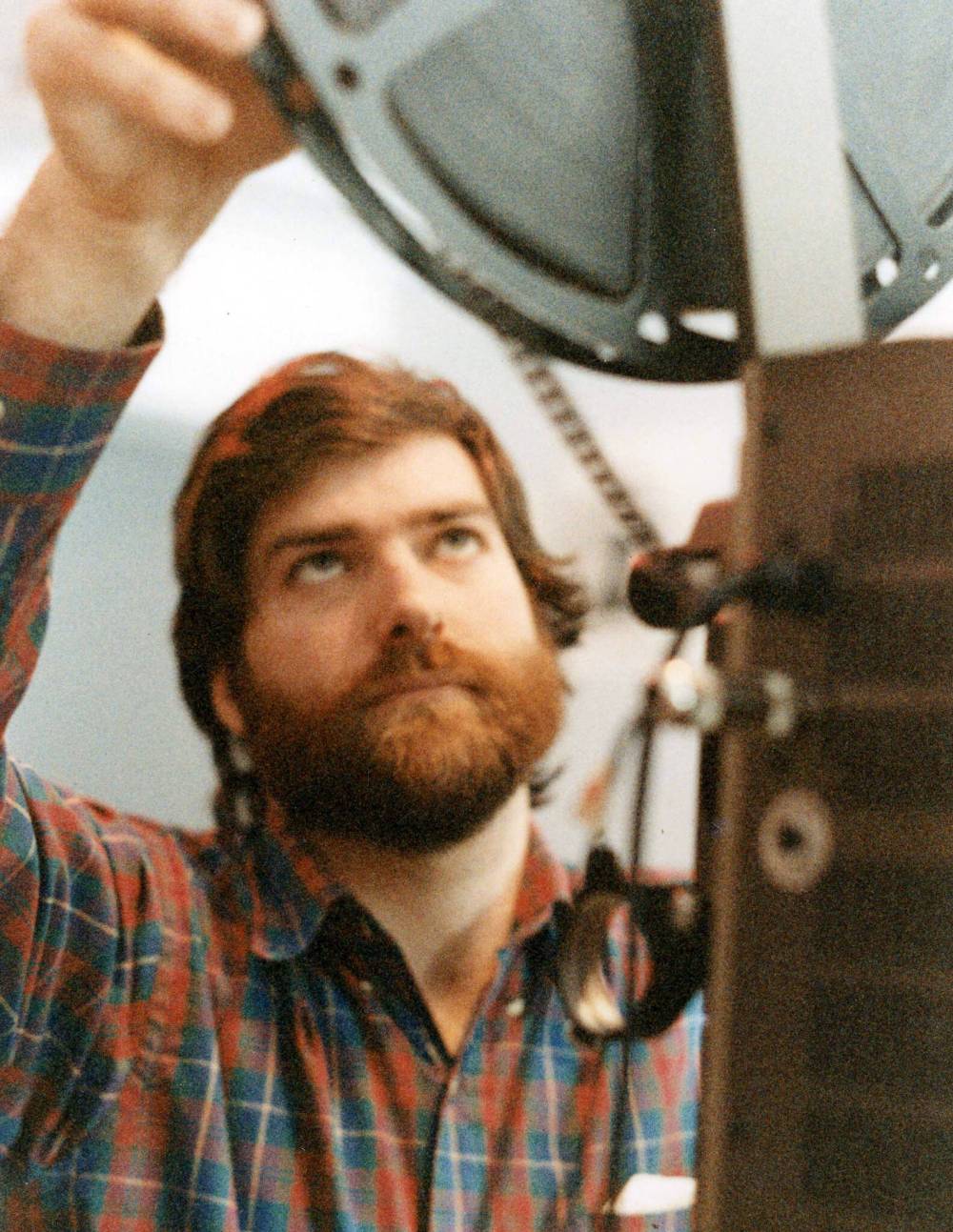
SUPPLED
Dave Barber as a young man: From the Archives of Dave Barber — edited by Andrew Burke and Clint Enns
Over the past three years, Enns and Andrew Burke, a professor at the University of Winnipeg, sifted through 47 banker’s boxes filled with Barber’s personal effects — narrowing the trove down to produce a touching, hilarious and all-encompassing portrait of the city’s most devoted evangelist for independent film, clarifying the enduring vision that underlied his pack-rattish tendencies.
Scrapbook: From the Archives of Dave Barber will have its launch Sunday at 7 p.m. at the Dave Barber Cinematheque as the closing event of We’re Still Here, the film group’s festival celebrating its 50th anniversary.
While Barber is best known for his work with the film group — whose creative output and outlook he nurtured during his 40-year tenure there — Scrapbook gives readers and perusers a more well-rounded depiction across its 288 pages, thoughtfully designed by Mark Remoquillo.
Among its 16 chapters are Dave Barber, Filmmaker; Dave Barber, Juvenile Delinquent; and Dave Barber, Poet.
The book opens with a chapter titled Why Did They Hire Me?, which includes Barber’s resumé, circa 1982; his application to the programming job (“I’m extremely interested in the position and I think I could do a good job especially relating to programming and promotion”); and a list titled “Tasks I would like to do in my future job.”
Those tasks included having an effect, making a mark and making a difference. Among the labour he wouldn’t like? Sales/insurance/banking/real estate; dull, repetitive work; and working with assholes.
No matter the section, Barber’s passion for local art is always matched with an earnest brand of chutzpah mixed with inspiring zeal: if nothing was ventured, nothing could be gained.
In one missive, written in 1987, Barber politely makes suggestions to Piers Handling of the Toronto Film Festival, which had yet to go international.
“I have greatly appreciated the fact that the (Canadian Perspective) program reflects films around the country. The reason I’m writing to you is because I feel this part of the festival is weaker than it was a few years ago. My criticism is twofold …” he wrote.
In a letter to Warner Brothers’ promotion department in Burbank, Calif., Barber goes to bat for Winnipeg band Mood Jga Jga, which had signed to the label but in Barber’s estimation, hadn’t received substantial juice for their self-titled record in 1974.
“I’m probably dreaming but maybe you could fly them down to California to do a few shows. God knows you must make enough money off your Black Sabbaths on the label to afford this,” a 20-year-old Barber wrote.
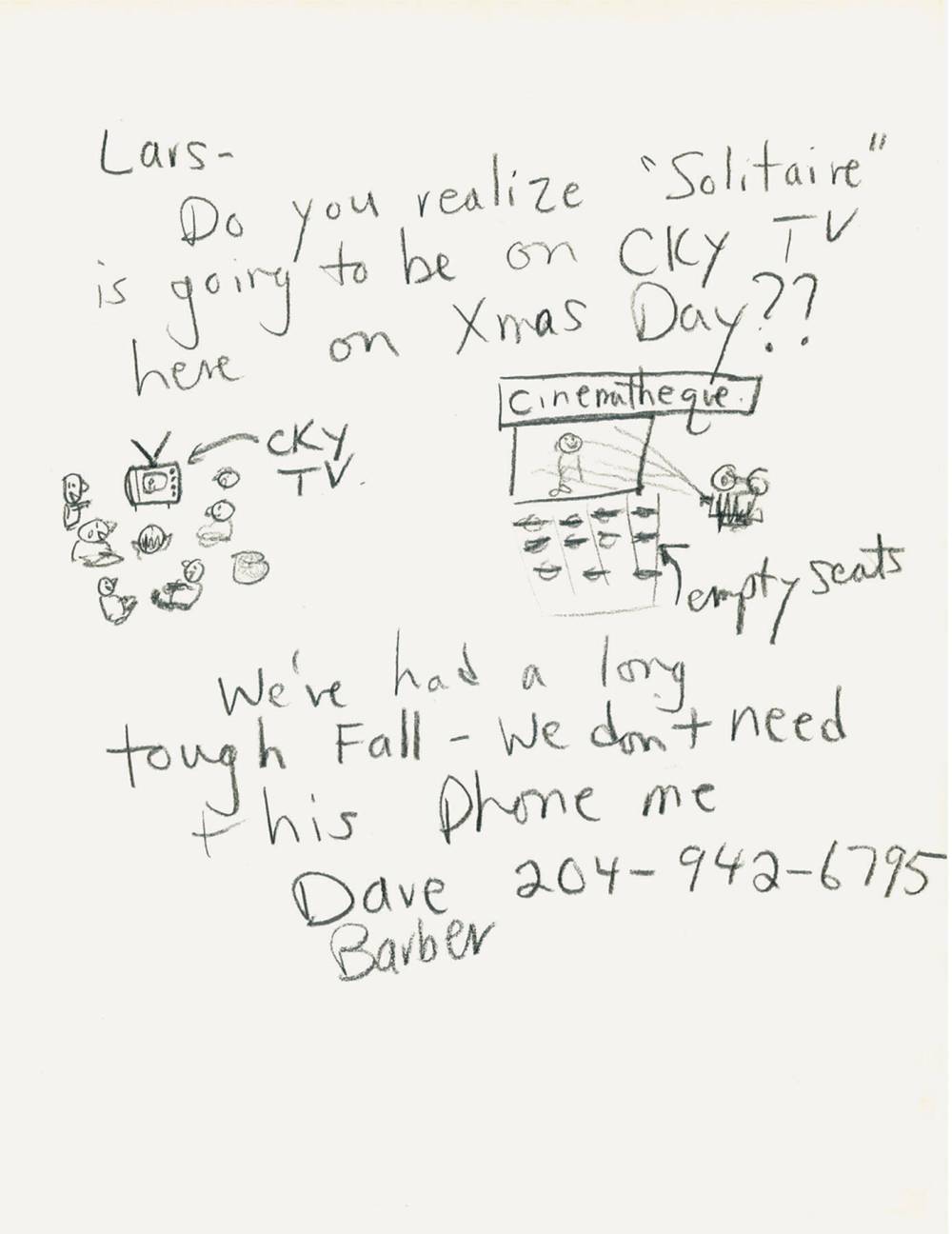
Solitaire from Scrapbook: From the Archives of Dave Barber — edited by Andrew Burke and Clint Enns
“To summarize, Mood Jga Jga is a damn fine band just starting out. Help them out with some promotion before they get discouraged. OK?”
Burke and Enns also republish influential articles written by Barber for the defunct periodical Winnipeg Magazine, including a 1982 piece that popularized and publicized the fact that Groucho Marx first saw Charlie Chaplin perform during a three-hour layover in Winnipeg in August 1913.

Barber made that conclusion through painstaking research of microfilm, cross-referencing four Marx Brothers publications.
“And each time, Groucho was certain of the location,” wrote Barber, who reached out unsuccessfully for confirmation from the mustachioed comedian. “And after all, how could you forget a name like Winnipeg?”
“Part of this book has the self-deprecating streak that Dave himself would have had,” says Burke, who specializes in film, television and cultural studies. “But then we’re also playing this game where we want people to take Dave seriously, because we think Dave gets undervalued as a writer and a thinker.”
Barber kept nearly everything, and Scrapbook is itself worth holding onto.
ben.waldman@freepress.mb.ca
Ben Waldman is a National Newspaper Award-nominated reporter on the Arts & Life desk at the Free Press. Born and raised in Winnipeg, Ben completed three internships with the Free Press while earning his degree at Ryerson University’s (now Toronto Metropolitan University’s) School of Journalism before joining the newsroom full-time in 2019. Read more about Ben.
Every piece of reporting Ben produces is reviewed by an editing team before it is posted online or published in print — part of the Free Press‘s tradition, since 1872, of producing reliable independent journalism. Read more about Free Press’s history and mandate, and learn how our newsroom operates.
Our newsroom depends on a growing audience of readers to power our journalism. If you are not a paid reader, please consider becoming a subscriber.
Our newsroom depends on its audience of readers to power our journalism. Thank you for your support.
Schedule
We’re Still Here continues to roll all weekend at the Exchange District theatre, renamed in 2022 in Barber’s memory. Tickets are available at davebarbercinematheque.com.
Friday
The Short Films of Barry Gibson, with Gibson in conversation with Greg Hanec (5 p.m.)
The Mourning Suit by Leonard Yakir, a founding member of the WFG, with post-screening Q&A between Yakir and Stuart Hands of the Toronto Jewish Film Festival (7 p.m.)
Dracula: Pages from a Virgin’s Diary by Guy Maddin, Deco Dawson and the RWB, with post-screening Q&A between Maddin, Dawson, producer Vonnie Von Helmolt and WFG programmer Olivia Norquay (9 p.m.)
Saturday
50 Years of Solitude: The Winnipeg Film Group and the Experimental Cinema curated by James Pomeroy, featuring work by Leon Johnson, Joanne Jackson Johnson, Mike Maryniuk and more, with post-screening Q&A (2 p.m.)
Valley of Light by Heidi Phillips, with post-screening Q&A (5 p.m.)
You Sorta Know It’s Gonna End by Ryan Steel and Kalil Haddad, with intro and Q&A with Steel (8 p.m.-looped to midnight)
Sunday
Barbara James (35mm) by Winston Washington Moxam, with introduction by Leslie Supnet (2 p.m.)
Early Days curated by WFG founding member Joanne Jackson Johnson, featuring early shorts by John Paisz, Ed Ackerman, Elise Swerhone, Matthew Rankin and more, with post-screening Q&A (5 p.m.)
Scrapbook, 7:30 p.m.
Ben Waldman is a National Newspaper Award-nominated reporter on the Arts & Life desk at the Free Press. Born and raised in Winnipeg, Ben completed three internships with the Free Press while earning his degree at Ryerson University’s (now Toronto Metropolitan University’s) School of Journalism before joining the newsroom full-time in 2019. Read more about Ben.
Every piece of reporting Ben produces is reviewed by an editing team before it is posted online or published in print — part of the Free Press‘s tradition, since 1872, of producing reliable independent journalism. Read more about Free Press’s history and mandate, and learn how our newsroom operates.
Our newsroom depends on a growing audience of readers to power our journalism. If you are not a paid reader, please consider becoming a subscriber.
Our newsroom depends on its audience of readers to power our journalism. Thank you for your support.
Advertisement Advertise With Us
Advertisement Advertise With Us