One Tech Tip: How do you use an f-stop?
Advertisement
Read this article for free:
or
Already have an account? Log in here »
To continue reading, please subscribe:

Digital Subscription
One year of digital access for only $205*
- Enjoy unlimited reading on winnipegfreepress.com
- Read the E-Edition, our digital replica newspaper
- Access News Break, our award-winning app
- Play interactive puzzles
*First annual payment billed as $205.00 + GST for one year. This annual subscription will automatically renew at $233.00 + GST every 52 weeks (10% off the regular annual price of $259.35). Offer available to new and qualified returning subscribers only. Cancel any time.
To continue reading, please subscribe:
Add Free Press access to your Brandon Sun subscription for only an additional
$1 for the first 4 weeks*
- Enjoy unlimited reading on winnipegfreepress.com
- Read the E-Edition, our digital replica newspaper
- Access News Break, our award-winning app
- Play interactive puzzles
*Your next Brandon Sun subscription payment will increase by $1.00 and you will be charged $17.95 plus GST for four weeks. After four weeks, your payment will increase to $24.95 plus GST every four weeks.
Read unlimited articles for free today:
or
Already have an account? Log in here »
Hey there, time traveller!
This article was published 12/03/2026 (215 days ago), so information in it may no longer be current.
Film photography has been undergoing a renaissance, especially with younger people who love its unique look and analog vibe.
But while Gen-Zers and younger Millennials embrace film, analog cameras are not as easy to use as the digital cameras they grew up with. What does ISO mean? What is an f/stop anyway? How do I figure out the right aperture?
George Walker IV, an Associated Press photojournalist based in Nashville, helped outline the basics of film-based photography for this week’s One Tech Tip.
Walker, who joined the AP in 2023 after 30 years as a photographer at The Tennessean newspaper, said shooting on film is a good way to learn the basics of photography because it “forces me to be patient and concentrate to make the pictures that matter.”
“You have a finite number of frames on a roll of 35 mm film, usually 24 or 36. And you should make those pictures count.”
Film and how it works
Before the advent of digital cameras in the early 2000s, photography relied on physical film instead of electronic files stored on memory chips.
Photographic film is a light-sensitive cellulose material used for making images, by exposing the silver-halide coating through the camera lens to create a latent image on the film that’s then used for making photographic prints.
This results in pictures with a distinctive grainy or unfiltered feel that attracts analog fans turned off by digital photos that seem too perfect. Enthusiasts are also drawn to film as an antidote to digital fatigue and the instant gratification of their smartphones. It’s part of a broader revival of old-school hobbies and content that includes vinyl records, knitting and writing letters.
Important things to know about film
There are multiple formats but the type used in most consumer cameras is 35 mm, which comes in little canisters. Buy it at a photo shop or online. Some drugstores also sell film but the selection is often limited.
When buying film, pay attention to the ISO rating, also known as the film speed. The higher the number, the more sensitive the film is to light.
For making photographs in a low-light situation, like a basketball gym or a night football game, photographers might use a film rated at ISO 1600 or higher. To capture a scene in full sun, ISO 400 or less is best.
Beginners should consider black and white film, which is more forgiving than color for exposures and forces you to focus on a shot’s composition and lighting.
You’ll need a film camera
Nowadays, new film cameras are limited to a handful of point-and-shoot, niche or high-end models.
However, there are plenty of secondhand vintage models for sale on eBay and at camera shops. Or try asking around to see if anyone you know has an old camera sitting forgotten in a drawer.
Look for a model from one of the big five camera makers that dominated the pre-digital photo era: Canon, Nikon, Pentax, Olympus and Minolta.
What kind of film camera do you want?
Point and shoot cameras are small, cheap, and easy to carry around and use. They typically don’t have any controls, except for a button to turn the flash on.
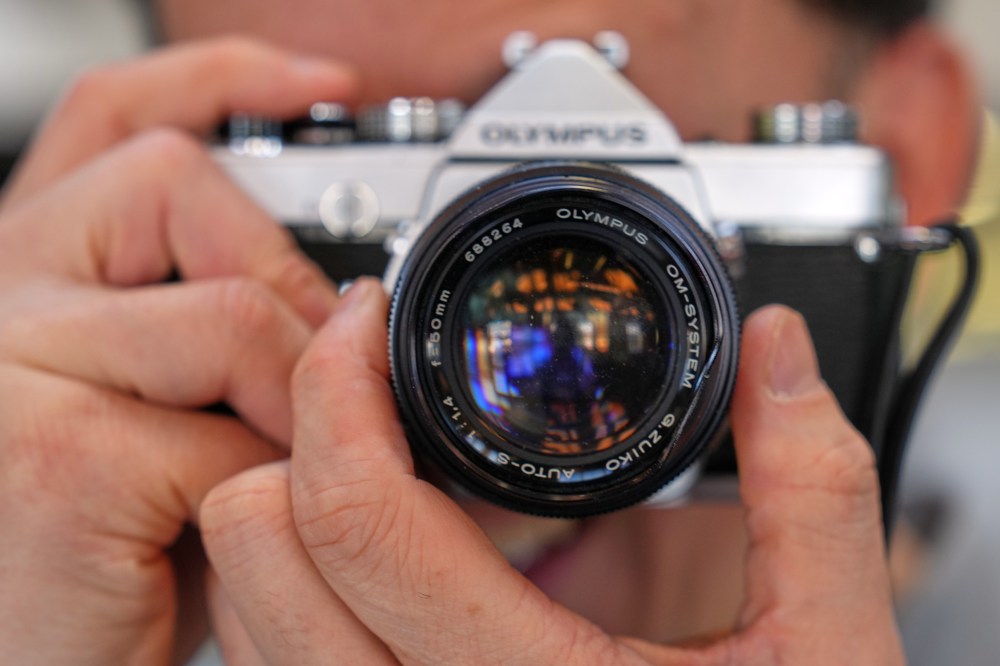
Single-lens reflex, or SLR, cameras, let you go fully manual. They have lots of dials and adjustments, and the ability to swap lenses, so you can make great pictures. If you do want to learn and experiment, a fully manual camera is best. But they’re also bigger and bulkier and can be intimidating for novices.
If you can’t decide, a good rule of thumb is that the best camera is always the one you have with you.
How to load a roll of film
Now that you’ve got film and a camera, it’s time to put them together.
With a manual camera, open the back and feed the film leader, or tip, into a slot on the spool on the right. Use the winding lever to advance the film to make sure it’s latched on properly. Close the camera back. When you wind the film, the rewind knob on the left will turn if the film is loaded correctly.
The process is a little easier with point and shoot cameras, which usually have automatic winding. There should be a label inside indicating where to position the film leader. If not done correctly, you’ll either get an error message or the film counter won’t advance.
Now that the film is loaded, be sure to keep the camera back closed until you’re finished making exposures and the film is fully rewound into the canister, otherwise you’ll ruin the whole roll.
Learn how the camera works and practice focusing
If you’ve decided to get a manual camera but don’t know how to use it, you’ll need to learn how to control the exposure by adjusting the shutter speed and the aperture, also known as the f/stop, and setting the film speed or ISO.
When it comes to exposure, think of a faucet filling a glass. The f/stops control the flow of water — or light hitting the film. So f/16 looks like a trickle while f/2.8 is a fire hose. The shutter speed, meanwhile, controls how long the faucet is open.
F/stops also control depth of field, or how much of the photograph is in focus. The smaller the f/stop, the more will be in focus.
The shutter speed is used to capture action, like a race car or a bird in flight. Exposures made with a fast shutter speed of, say, 1/250 or 1/500 of a second or higher are better at freezing the action.
Manual cameras typically have a light meter visible through the viewfinder that shows whether you’ve got the right exposure.
With a manual camera, you’ll also need to focus the image by hand, which needs practice. When photographing people or animals, concentrate on making sure the eyes are in focus. For still life photographs and landscapes, focus on what you think is important to see, like a flower petal or a mountain peak.
The technology is different, but the principles are the same. The number one rule is to fill the frame with what you want to see. And study the professionals and masters of photography, such as Gordon Parks, Henri Cartier-Bresson and Ansel Adams.
What to do when you’ve shot a roll of film
You can get film processed at a drug store or photo shop, or mail it to an online lab. Some cities have community darkrooms that photographers can join.
Processing film takes both time and money, which varies according to how soon you want it; whether it’s color or black and white; the number of exposures; and other services.
You can also get back the negatives — those exposed and developed film strips. In the old days, it was important to keep them in case you wanted to print additional copies later. Now, with photo labs offering digital files as well as physical prints, many people don’t bother collecting them, though most experienced photographers prefer to hang on to them.
___
Is there a tech topic that you think needs explaining? Write to us at onetechtip@ap.org with your suggestions for future editions of One Tech Tip.