Once punished for weaving, this Mexican artisan uses her loom for LGBTQ+ resistance
Advertisement
Read this article for free:
or
Already have an account? Log in here »
To continue reading, please subscribe:

Digital Subscription
One year of digital access for only $205*
- Enjoy unlimited reading on winnipegfreepress.com
- Read the E-Edition, our digital replica newspaper
- Access News Break, our award-winning app
- Play interactive puzzles
*First annual payment billed as $205.00 + GST for one year. This annual subscription will automatically renew at $233.00 + GST every 52 weeks (10% off the regular annual price of $259.35). Offer available to new and qualified returning subscribers only. Cancel any time.
To continue reading, please subscribe:
Add Free Press access to your Brandon Sun subscription for only an additional
$1 for the first 4 weeks*
- Enjoy unlimited reading on winnipegfreepress.com
- Read the E-Edition, our digital replica newspaper
- Access News Break, our award-winning app
- Play interactive puzzles
*Your next Brandon Sun subscription payment will increase by $1.00 and you will be charged $17.95 plus GST for four weeks. After four weeks, your payment will increase to $24.95 plus GST every four weeks.
Read unlimited articles for free today:
or
Already have an account? Log in here »
MEXICO CITY (AP) — Xaneri Merino wasn’t meant to follow in her grandmother’s footsteps.
Now a transgender woman, she was identified at birth as a boy in San Pedro Jicayán, an Indigenous community in southern Mexico where men are largely barred from becoming weavers.
Merino was expected to tend cattle or work in the fields. Yet her grandmother defied those rigid gender norms, passing on to her the ancestral practice of the backstrap loom — an ancient, portable device operated using a strap secured around the weaver’s waist.
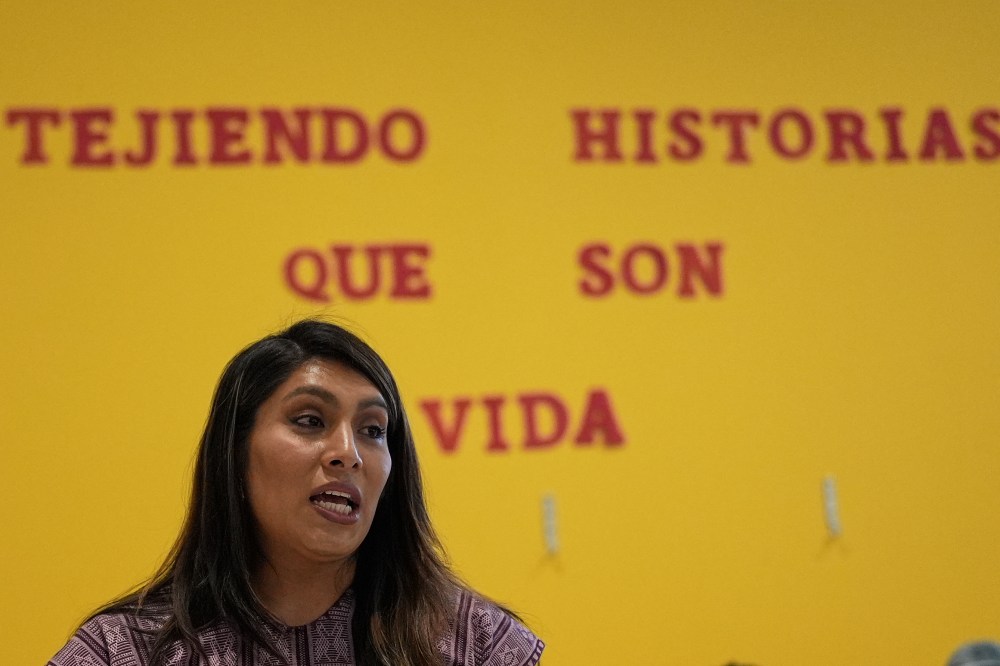
“She began sharing her knowledge with me in secret,” said Merino, who used to hide in her grandmother’s adobe home to weave at age 13. “She taught me how to make the thread from scratch, to feel the textures and respect nature.”
Merino’s maternal lineage comes from the Mixtec people, where origin stories trace the birth of gods and dynasties to sacred landscapes. Her paternal ancestry is Zapotec, where religious life remains woven into everyday moments, from harvest to marriage and death.
Giving back to the land
One of her grandmother’s most cherished lessons was to give back to the land whatever you take from it. Weavers in her community, Merino said, make the rods that they use to control thread tension out of branches from tamarind trees and find ways to restore what they borrow.
“To care for nature is part of our worldview,” Merino said. “Because it provides us with what we need to walk this world.”
Both her ancestral legacy and her gender identity now play a decisive role in her life. In addition to being a trans woman, Merino identifies as a “muxe.” The term is rooted in Zapotec culture and refers to Indigenous people identified at birth as male who take on women’s roles. It can also be regarded as a third gender.
Merino makes a living as a weaver and instructor, hosting workshops on how the backstrap loom can serve as a craft and an act of resistance.
“Everyone is capable of learning how to weave, and it’s not just about creating a piece,” she said during a recent class she led in Mexico City for LGBTQ+ people. “It’s also about weaving our own stories, as we can come to know ourselves through the loom.”
Defiance bears a cost
Merino was once punished for weaving. She was around 15 when neighbors spotted her kneeling, threads in her hands, on their way to a patron saint feast.
That afternoon went by without incident. Parishioners prayed, laughed and shared a meal. But the following morning, through loudspeakers across the community, a voice called on all men to gather and discuss an urgent matter: There was a boy who dared to weave.
The men sat in a circle while Merino was commanded to stand in the middle, next to her mother and her grandmother.
As Merino recalls, one of the men asked her grandmother, “Why would you allow him to weave, if it’s not something boys are supposed to do? Do you realize what kind of example you’re setting for other children?”
Merino said that her grandmother’s answer was simple: She was merely teaching a child how to be creative, to find a path to keep her culture alive through clothing.
A punishment that lingered
Merino’s punishment for her defiance was sweeping the local church. She occasionally wove in hiding after that. But the experience cast a shadow over her craft and she practically abandoned her loom.
“I developed a deep resentment toward textiles and the customs around them,” Merino said. “Having the ability to create and not being allowed to use it was like having eyes and having them taken away — I could no longer see.”
Reconciliation came a few years later, when she moved from her hometown to Mexico City for college. She majored in communications; her coursework included cultural management, textile studies and postcolonial perspectives on Indigenous resistance.
“That made me see how I could use my reality for a greater good,” she said. “My loom became a means to healing.”
A space to be seen
During her latest workshop, one of Merino’s students who had previously taken another course with her told her classmates that a loom mirrors oneself. The joy and the calmness — as much as the anger and stress, she said — are passed on to the threads.
“I love Xan’s way of teaching because she is very human and patient,” Emilia Freire, a trans woman like Merino, told The Associated Press. “She made me realize that once I had my weaving set up and began to work, everything I carried with me through the week would come out.”
Another student, Kristhian Cravioto, said that this was his first backstrap loom workshop. He celebrated finding a safe space for LGBTQ+ people interested in crafts, and also Merino’s defiance against the preconception that men shouldn’t weave.
“This is very important for us dissidents,” said Cravioto, a designer and enthusiast of Mexico’s Indigenous crafts. “To know that no matter whether you are a man or a woman, what you do matters.”
Threads that endure
A traditional backstrap loom is made up of cords, threads and wooden rods assembled into a portable frame. Women often work seated on the ground, with one end of the loom tied to a tree or post and the other secured around their waist. Leaning back and forward, they control the tension of the threads with their bodies, turning movement into a steady rhythm of weaving.
Crafting each piece takes time. Merino often weaves for about a month, eight hours a day, to finish a short “huipil,” a tunic traditionally worn by Indigenous women in Mexico.
Weavers who migrated from their hometowns often employ threads and wood available in the cities where they relocate. But Merino travels back home to procure her raw materials. Among them is a purple dye drawn from a sea snail found along the coast, a resource that has become increasingly difficult to gather as the species declines.
The nostalgia for her hometown never leaves her, but Merino takes comfort in the fact that younger LGBTQ+ people in her community have followed her example and become weavers in San Pedro Jicayán.
“At least five trans women and two men are weaving,” she said. “We have gained visibility through the loom and that’s what this fight has been about.”
___
Associated Press religion coverage receives support through the AP’s collaboration with The Conversation US, with funding from Lilly Endowment Inc. The AP is solely responsible for this content.
The Free Press acknowledges the financial support it receives from members of the city’s faith community, which makes our coverage of religion possible.