A little shmaltz, a lot of heart
So, a bunch of well-known Jews walk into a theatre...

Advertisement
Read this article for free:
or
Already have an account? Log in here »
To continue reading, please subscribe:

Digital Subscription
One year of digital access for only $205*
- Enjoy unlimited reading on winnipegfreepress.com
- Read the E-Edition, our digital replica newspaper
- Access News Break, our award-winning app
- Play interactive puzzles
*First annual payment billed as $205.00 + GST for one year. This annual subscription will automatically renew at $233.00 + GST every 52 weeks (10% off the regular annual price of $259.35). Offer available to new and qualified returning subscribers only. Cancel any time.
To continue reading, please subscribe:
Add Free Press access to your Brandon Sun subscription for only an additional
$1 for the first 4 weeks*
- Enjoy unlimited reading on winnipegfreepress.com
- Read the E-Edition, our digital replica newspaper
- Access News Break, our award-winning app
- Play interactive puzzles
*Your next Brandon Sun subscription payment will increase by $1.00 and you will be charged $17.95 plus GST for four weeks. After four weeks, your payment will increase to $24.95 plus GST every four weeks.
Read unlimited articles for free today:
or
Already have an account? Log in here »
Hey there, time traveller!
This article was published 24/10/2015 (3994 days ago), so information in it may no longer be current.
In her 2005 book Stars of David: Prominent Jews Talk About Being Jewish, American journalist Abigail Pogrebin interviewed 62 famous Jews, from Sarah Jessica Parker to Ruth Bader Ginsburg, about what their faith meant to them.
It’s not an obvious concept to turn into a theatrical work. It’s an even less obvious concept to turn into a musical — although as Kitty Carlisle says in the play, the Italians have opera, but the Jews have American musical theatre.
As you might expect, the 80-minute song cycle (no intermission) that opens the Winnipeg Jewish Theatre season has no plot per se; it’s just a series of songs with snippets of Pogrebin’s interviews interspersed between them.
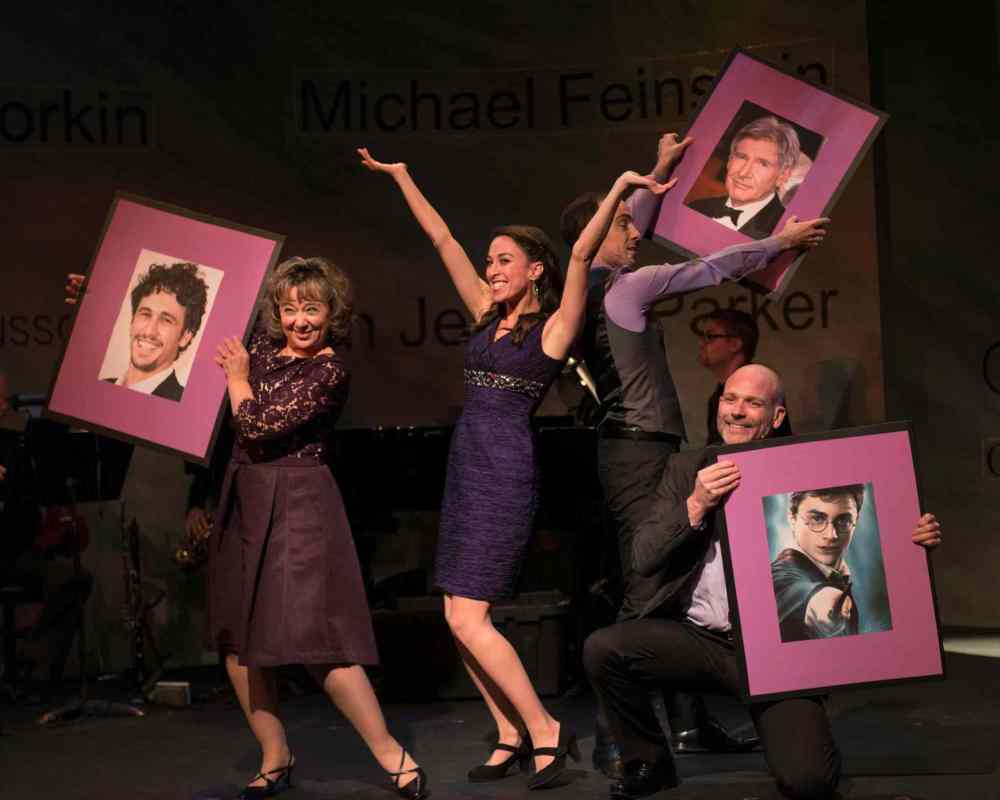
What at first blush seems as if it might be a parade of hoary clichés about Judaism — Jews in Hollywood change their names! Gefilte fish is weird! — turns out to be both a delightful, frothy entertainment and a thoughtful examination of traditions and culture.
Judaism is a religion of questions, and the songs, composed by a who’s who of Broadway luminaries, including Duncan Sheik (Spring Awakening), Marvin Hamlisch (A Chorus Line) and Lisa Lambert (The Drowsy Chaperone) raise a lot of them, touching on everything from anti-Semitism (both veiled and overt) to famous people you didn’t know were members of the Tribe.
They range from silly-smart trifles to deeply moving revelations, and though there’s no real through line, taken together, they tell the story of a diverse people held together by a common thread.
That story is brought to vibrant life through the note-perfect performances of Debbie Maslowsky, Rachel Fischer, Aaron Hutton and Kevin McIntyre, playing a range of characters that includes businessman/philanthropist Edgar Bronfman, feminist icon Gloria Steinem, actress Natalie Portman and Bravo personality Andy Cohen.
These Winnipeg-born singing, dancing dynamos refrain from impersonating their subjects, instead throwing themselves into delivering the wide array of song styles, making sure every word is crystal-clear and every nuance captured.
Whether providing perfect harmonies or a little soft shoe, the cast works beautifully as an ensemble, but each member gets a chance to shine.
Maslowsky hilariously channels bawdy broad Joan Rivers in High Holy Days, in which the comedian gets uncharacteristically soft about the peace she finds through observance.
In the inspired goofiness of Who Knew Jew, Fischer plays Gwyneth Paltrow, who reveals she’s not the patrician shiksa goddess you thought she was — she’s more Grace Adler than Grace Kelly.
Hutton delivers two of the biggest emotional wallops (and a little sleight of hand): in Lenny the Great, his Leonard Nimoy recalls a childhood incident of anti-Semitism that ended his love of magic; in Horrible Seders, his playwright Tony Kushner delivers a touching spoken-sung meditation on being gay and agnostic and Jewish.
In McIntyre’s soul-searching The Deepest Blue, designer Kenneth Cole talks about the regret he felt at letting his wife raise their children as Catholic and how it inspired him to get in touch with his own Judaism. His rendition of Michael Feinstein’s ode to the American Songbook, is utterly sublime. (One wishes the song itself lived up to its inspiration, however; it can’t hold a candle to anything by Gershwin or Berlin.)
The spoken-word portions are the work’s weakest moments. There’s not much distinguishing Fischer’s Parker from her Portman, but when she gets the chance to sink her teeth into Fran Drescher via song, she goes for the gusto, in a gutsy showstopper called What Do They Know, in which the nasal-voiced The Nanny actress recalls refusing to tone down her personality to play the role as “less ethnic.”

The minimalist set is tied together with hints of purple, from the costumes to the curtain, and the choreography is low-key but with enough pop to ensure the work never feels static. And though there are a lot of Passover seder jokes that may fly over the head of non-Jews, it’s probably accessible to anyone who knows what a bar mitzvah is.
The onstage quartet of musicians includes pianist Paul De Gurse, cellist Karin Erhardt, violinist Boyd Mackenzie and woodwind player Sharon Atkinson; under De Gurse’s sensitive direction, they make themselves invisible but essential — never overpowering the singers, but subtly amplifying the play’s heartbreaking moments and boosting the boisterous ones.
And there are plenty of both — director Ari Weinberg, in his WJT debut, delivers a tight, bright production that hits all the right notes.
You’ll laugh, you’ll think… you might even get a bit verklempt.
jill.wilson@freepress.mb.ca
Jill Wilson is the editor of the Arts & Life section. A born and bred Winnipegger, she graduated from the University of Winnipeg and worked at Stylus magazine, the Winnipeg Sun and Uptown before joining the Free Press in 2003. Read more about Jill.
Jill oversees the team that publishes news and analysis about art, entertainment and culture in Manitoba. It’s part of the Free Press‘s tradition, since 1872, of producing reliable independent journalism. Read more about Free Press’s history and mandate, and learn how our newsroom operates.
Our newsroom depends on a growing audience of readers to power our journalism. If you are not a paid reader, please consider becoming a subscriber.
Our newsroom depends on its audience of readers to power our journalism. Thank you for your support.
Theatre Review
- Stars of David
- Winnipeg Jewish Theatre
- Berney Theatre, Rady JCC
- To Nov. 1
- Four stars out of five
Jill Wilson is the editor of the Arts & Life section. A born and bred Winnipegger, she graduated from the University of Winnipeg and worked at Stylus magazine, the Winnipeg Sun and Uptown before joining the Free Press in 2003. Read more about Jill.
Jill oversees the team that publishes news and analysis about art, entertainment and culture in Manitoba. It’s part of the Free Press‘s tradition, since 1872, of producing reliable independent journalism. Read more about Free Press’s history and mandate, and learn how our newsroom operates.
Our newsroom depends on a growing audience of readers to power our journalism. If you are not a paid reader, please consider becoming a subscriber.
Our newsroom depends on its audience of readers to power our journalism. Thank you for your support.
Advertisement Advertise With Us
Advertisement Advertise With Us
History
Updated on Monday, October 26, 2015 11:37 AM CDT: Corrects end date