Artist tackles colonialism with wit
Inflatable installation acquired by National Gallery of Canada

Advertisement
Read this article for free:
or
Already have an account? Log in here »
To continue reading, please subscribe:
Digital Subscription
One year of digital access for only $1.44 a week*
- Enjoy unlimited reading on winnipegfreepress.com
- Read the E-Edition, our digital replica newspaper
- Access News Break, our award-winning app
- Play interactive puzzles
*Billed as $5.77 plus GST every four weeks. After 52 weeks, price increases to the regular rate of $19.95 plus GST every four weeks. Offer available to new and qualified returning subscribers only. Cancel any time.
To continue reading, please subscribe:
Add Free Press access to your Brandon Sun subscription for only an additional
$1 for the first 4 weeks*
- Enjoy unlimited reading on winnipegfreepress.com
- Read the E-Edition, our digital replica newspaper
- Access News Break, our award-winning app
- Play interactive puzzles
*Your next Brandon Sun subscription payment will increase by $1.00 and you will be charged $17.95 plus GST for four weeks. After four weeks, your payment will increase to $24.95 plus GST every four weeks.
Read unlimited articles for free today:
or
Already have an account? Log in here »
Hey there, time traveller!
This article was published 31/08/2019 (2609 days ago), so information in it may no longer be current.
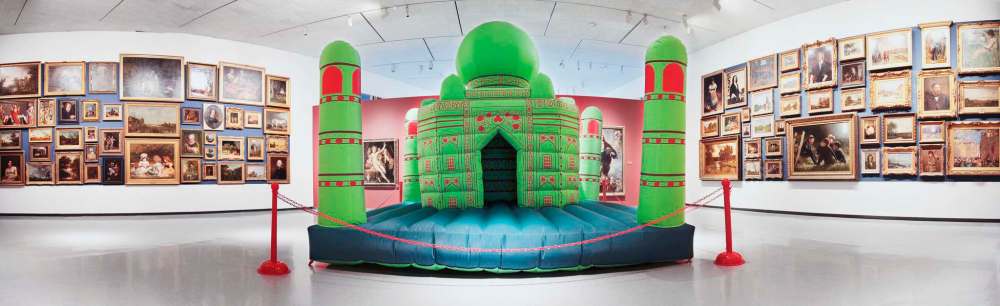
If there’s one person in the world who could transform the Taj Mahal, that grand, 17th-century marble mausoleum in Agra, into a bright green bouncy castle to make a point about the commercialization and reduction of a sacred site, it’s Divya Mehra.
The Winnipeg artist has long used her signature sardonic humour to address colonization, institutional racism, displacement and stereotypes in her medium-spanning works, which have shown all over the world.
Her 4.5-metre tall inflatable Taj Mahal, entitled Afterlife of Colonialism, a reimagining of Power: It’s possible that the Sun has set on your Empire OR Why your voice does not matter: Portrait of an Imbalanced, and yet contemporary diasporic India vis-à-vis Colonial Red, Curry Sauce Yellow, and Paradise Green, placed neatly beneath these revived medieval forms: The Challenges of entering a predominately White space (Can you get this in the gift shop?) where all Women and Magical Elephants may know this work, here in your Winnipeg, among all my Peers, has been the centrepiece of the Winnipeg Art Gallery’s Vision Exchange: Perspectives from India to Canada exhibition since it opened in May.
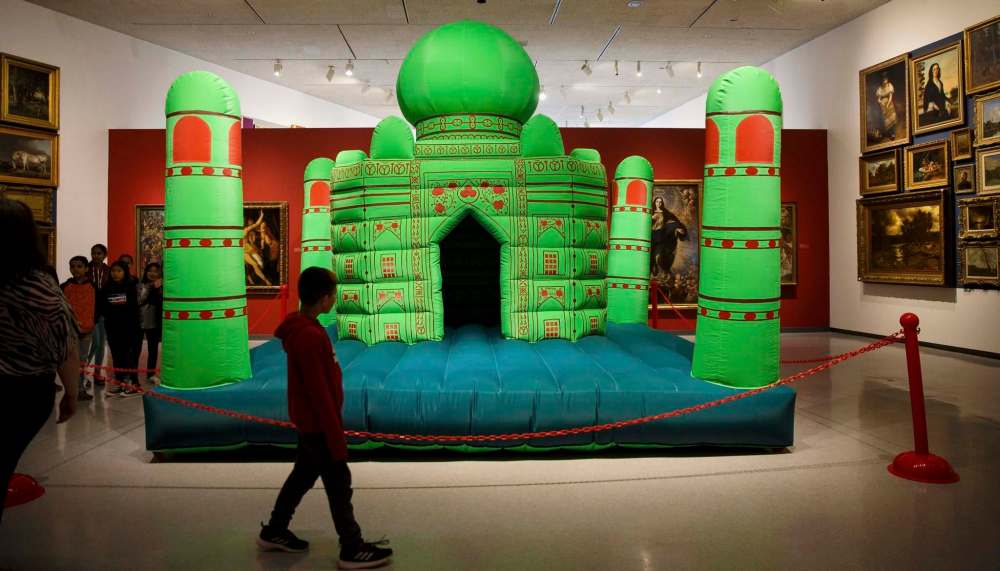
Now, it has been acquired by the National Gallery of Canada in Ottawa for its permanent collection.
The Free Press caught up with Mehra to discuss the Taj Mahal as cultural shorthand, representation in our nation’s arts institutions, and that evocative title.
By the way, this is your last weekend to see it: Vision Exchange is on view at the WAG until Monday, Sept. 2.
FP: First, let’s talk about the work itself. Why the Taj Mahal, and why a bouncy castle?
Divya Mehra: The Taj Mahal in a lot of ways has become one of a few ubiquitous symbols for the South Asian diaspora. For a very long time I’ve been invested in how these types of symbols are read, understood, reduced and finally become stand-ins for our cultural understanding of one another. When I was thinking about the idea of producing the work, I hoped to create something that spoke to just how this particular World Heritage Site was diminished and transformed; and so the absurdity of a green bouncy castle, that you’re actually never allowed to jump on or touch, signalled both this grotesque cultural reduction and refusal to be consumed.
FP: Vision Exchange, of which this piece is a part, is one example of long-overdue spaces dedicated to BIPOC (which stands for black, Indigenous, people of colour) artists at the institutional level. Your work is physically large; was taking up space intentional?
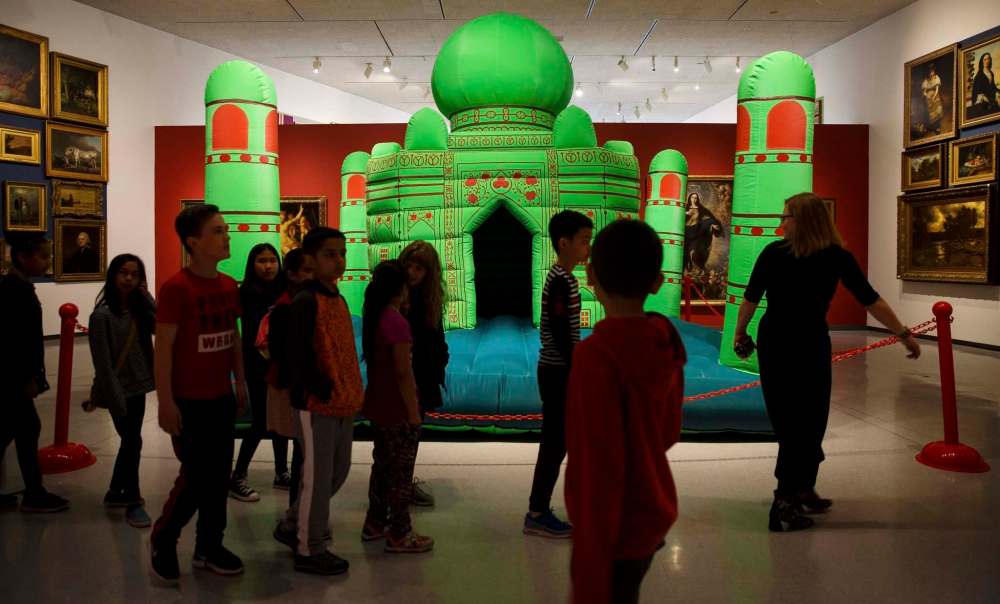
DM: Yes, definitely. When I had a studio visit with the curators of the exhibition about what I imagined this new work to be like, and the space it would specifically need, they were both very receptive. As the exhibition travelled to different institutions in Canada, the work has taken up a larger footprint and evolved with each installation, so its inability to fit with the rest of the exhibition logistically made it necessary that more space was and is given to the work.
FP: What is the significance of the National Gallery acquisition in relation to this work? For me, it feels momentous because when you think about national galleries, you think about white European male artists.

DM: It’s pretty momentous for me, too! I couldn’t have imagined as an undergrad in art school at the University of Manitoba… a space where I didn’t see myself in any capacity, whether through the lack of racialized curriculum or instructors, that one day my work would become part of such a major collection. Anytime we start making space for something different, it signifies a radical shift in terms of the way that we’re thinking, seeing and understanding. A shift to include BIPOC representation in collections, institutional exhibitions, curriculums, and even faculty, means that other people would also finally feel seen, heard, and acknowledged for their ideas, time and labour.
FP: Tell me about how the title of the piece evolved, and why it was important to keep its various iterations?
DM: The first installation of the work at the Art Gallery of Alberta in late 2018 allowed for the entire space to be painted, so the gallery itself became a part of the work. At the Art Museum at the University of Toronto, the work not only didn’t fit inside the gallery with the rest of the exhibition, but the space that was allocated for the work, Hart House, could not be painted to reflect the original title. I decided to rework the title (keeping and slightly obscuring part of the old title on the work’s label) to reflect the new installation. This process continued for the next two installs at both the Royal Ontario Museum and the Winnipeg Art Gallery, where the work was also installed in spaces that could not be physically altered. Ultimately, the work is activated by and reflects on the landscape it’s holding space in.
jen.zoratti@freepress.mb.ca
Twitter: @JenZoratti
Jen Zoratti is a columnist and feature writer working in the Arts & Life department, as well as the author of the weekly newsletter NEXT. A National Newspaper Award finalist for arts and entertainment writing, Jen is a graduate of the Creative Communications program at RRC Polytech and was a music writer before joining the Free Press in 2013. Read more about Jen.
Every piece of reporting Jen produces is reviewed by an editing team before it is posted online or published in print – part of the Free Press‘s tradition, since 1872, of producing reliable independent journalism. Read more about Free Press’s history and mandate, and learn how our newsroom operates.
Our newsroom depends on a growing audience of readers to power our journalism. If you are not a paid reader, please consider becoming a subscriber.
Our newsroom depends on its audience of readers to power our journalism. Thank you for your support.
Jen Zoratti is a columnist and feature writer working in the Arts & Life department, as well as the author of the weekly newsletter NEXT. A National Newspaper Award finalist for arts and entertainment writing, Jen is a graduate of the Creative Communications program at RRC Polytech and was a music writer before joining the Free Press in 2013. Read more about Jen.
Every piece of reporting Jen produces is reviewed by an editing team before it is posted online or published in print – part of the Free Press‘s tradition, since 1872, of producing reliable independent journalism. Read more about Free Press’s history and mandate, and learn how our newsroom operates.
Our newsroom depends on a growing audience of readers to power our journalism. If you are not a paid reader, please consider becoming a subscriber.
Our newsroom depends on its audience of readers to power our journalism. Thank you for your support.
Advertisement Advertise With Us
Advertisement Advertise With Us