Beads, biking & birding
Winnipeg artist takes time to hone craft, connect to the land amid pandemic

Advertisement
Read this article for free:
or
Already have an account? Log in here »
To continue reading, please subscribe:

Digital Subscription
One year of digital access for only $205*
- Enjoy unlimited reading on winnipegfreepress.com
- Read the E-Edition, our digital replica newspaper
- Access News Break, our award-winning app
- Play interactive puzzles
*First annual payment billed as $205.00 + GST for one year. This annual subscription will automatically renew at $233.00 + GST every 52 weeks (10% off the regular annual price of $259.35). Offer available to new and qualified returning subscribers only. Cancel any time.
To continue reading, please subscribe:
Add Free Press access to your Brandon Sun subscription for only an additional
$1 for the first 4 weeks*
- Enjoy unlimited reading on winnipegfreepress.com
- Read the E-Edition, our digital replica newspaper
- Access News Break, our award-winning app
- Play interactive puzzles
*Your next Brandon Sun subscription payment will increase by $1.00 and you will be charged $17.95 plus GST for four weeks. After four weeks, your payment will increase to $24.95 plus GST every four weeks.
Read unlimited articles for free today:
or
Already have an account? Log in here »
Hey there, time traveller!
This article was published 14/08/2020 (2244 days ago), so information in it may no longer be current.
For a happy few people, the pandemic has not only allowed time to focus on what’s important in life, it’s allowed them — in the midst of forced isolation — to discover connection.
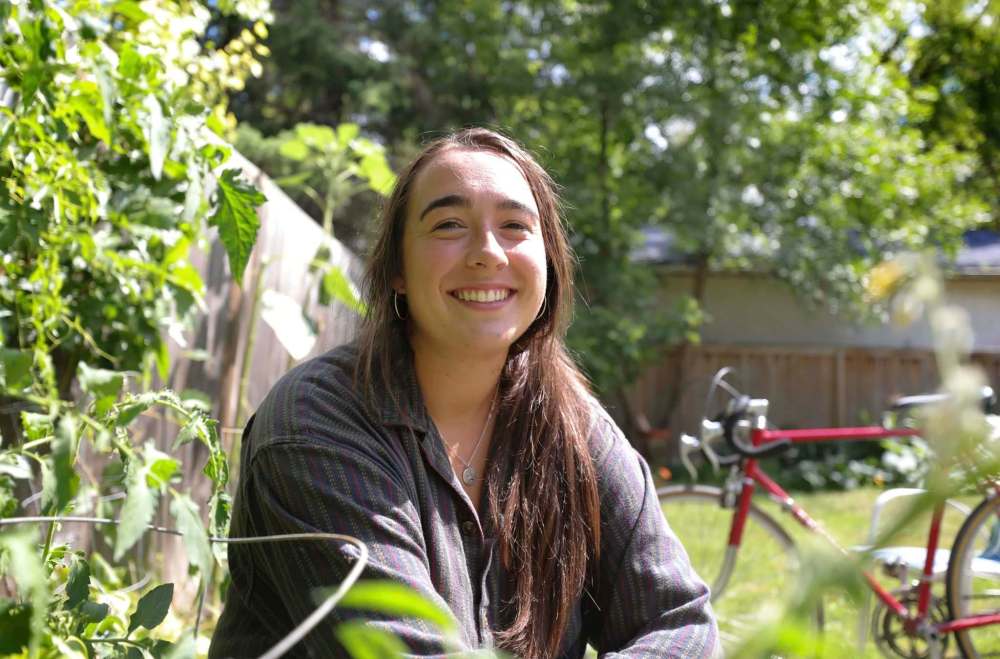
So it is with Bronwyn Butterfield, a 24-year-old Winnipeg artist who, prior to the lockdown in March, was working two jobs after graduating from the University of Winnipeg last year with a degree in human geography.
Art always beckoned for Butterfield, who is “of Cree-Métis descent from Norway House on my dad’s side of the family.” She jokes that it may have been her destiny from an early age.
“I won the Winnipeg Free Press Christmas art contest twice,” she says.
“Art class was my favourite growing up throughout elementary until high school, but I kind of lost sight of it during university when I began to focus on my degree and research interests,” she says.
“My dad is an artist/graphic designer, and he has told me about how his interest in graphic design was inspired by the patterns, colours and intricacy of beadwork, among other things.” Butterfield subsequently explored beadwork on her own.
“My dad actually had a pair of beaded gauntlets that he tragically lost in a fire, which is a story that was kind of pivotal in deciding to try beadwork back in 2018,” she says. “I joined my local beadwork circle and I decided I’d try to make him a pair of gauntlets to replace them. They’re still not done.
“There is a lot of beadwork in my family,” she says. “My great aunties did beadwork and embroidery, made mukluks, mitts and gauntlets and all that.
“Additionally, my grandma passed away when I was seven years old, and growing up I felt this loss deeply,” she says. “So learning beadwork, and learning her language (Cree) have been really grounding processes to allow me to connect with her and who she was, after all these years of her absence.”
That history crystallized for Butterfield when the lockdown left her without either of her two jobs.
“There is a lot of beadwork in my family. My great aunties did beadwork and embroidery, made mukluks, mitts and gauntlets and all that.” – Bronwyn Butterfield
“I guess I always wanted to try beadwork full-time but was timid to do that,” she says “So it kind of forced me to pursue beadwork full time. Being stuck inside, especially during the first couple of cold weeks of the shutdown, I didn’t really have anything else to do. I am so grateful that I had my beads.
“The free time allowed me to create the things I’d always wanted to, to pursue and prototype ideas that had been sitting in my brain over time,” she says. “It gave me time to work on my website (bronwynbutterfield.com) and figure out how to set up an online shop, research packaging and learning how to take care of the business side of things.”
“Of course, the shutdown was very stressful, and the idea of doing beadwork full time was still extremely scary despite the fact that I was finally doing it,” she says. “I was very much worried that no one would buy my work during these times.
“But for whatever reason, I experienced the opposite,” she says. “Folks were very much willing to support my work and I’ve had the most business I’ve ever had.
“I don’t really know if this is because I started to do beadwork full time, or if because everyone was suddenly online all the time, given that was really the only thing we could do to fulfil ourselves socially during the shutdown,” she says. “There was also definitely a big push in the online world to support local artists during the pandemic, so maybe it was that.
“So no, the pandemic didn’t adversely affect my work, it was actually the opposite, which completely caught me off guard,“ she says. “I would have never expected that. Now, I am doing beadwork full time and don’t really plan to change that in the future.”
“It’s very much driven by the ability to connect with yourself, relations, family, culture, and others, who are experiencing a similar journey, through beadwork,” she says. “Lately, I’ve been focusing on beaded earrings but I have also beaded mitts and moccasins.
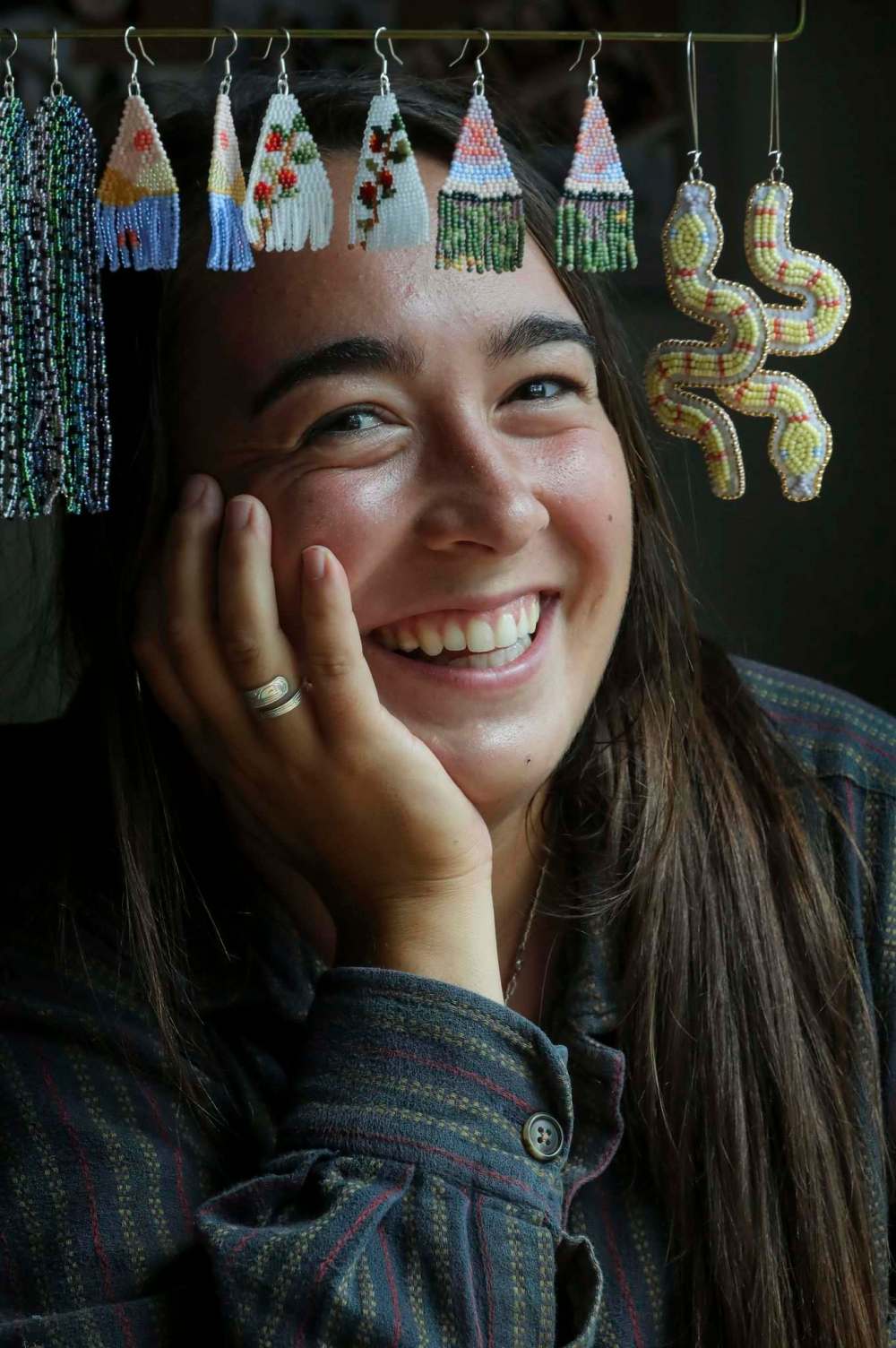
“I like to look at practising beadwork as evidence that we, as Métis people, are still here, and that we are counteracting the settler-colonial goals of assimilation of Indigenous folks.”
Butterfield’s five things helping her survive the pandemic include:
1. Beads and art supplies.
“I don’t think I can stress enough how much beading saved my life during the shutdown,” she says. “I’m lucky that, over time, I’ve grown a pretty big inventory of colours and tools. I only had to order online a couple of times when I ran out of supplies.
“I mostly bead at my dining room table,“ she adds. “I don’t really have a studio space at my place, and being able to sit by the window and watch the seasons change while beading was essential. I am a very land-oriented person and try to spend as much time outside as possible, but of course this was discouraged during the shutdown.
“My memories of beading during the pandemic are fond,” she says. “There is a strong beadwork community online, and many other beadwork artists were connecting through Instagram, and holding beadwork circles through Zoom. I even got the opportunity to ‘travel’ (via Zoom) to Toronto and New York City to talk about my process as a guest artist to a couple of organizations.”
2. Cooking
“I have always loved cooking, but having to decide what groceries I needed weeks in advance made me consciously plan for what I wanted to cook,” she says. “Before the pandemic, I feel like I didn’t have enough time to cook breakfast, lunch and dinner, so it was nice that cooking — and taking the time to enjoy it — was a priority in my schedule.
“I think that my favourite meal that I made was veggie burgers from scratch.”
“I like to look at practising beadwork as evidence that we, as Métis people, are still here, and that we are counteracting the settler-colonial goals of assimilation of Indigenous folks.” – Bronwyn Butterfield
3. My bike
“I thrifted my bike from a friend last year, and I am trying to use it as my primary source of transportation on top of walking,” Butterfield says. “It’s just too nice out to not do that.
“I was supposed to be going on a canoe trip this summer, but it got cancelled because of the pandemic, so biking allows me to get outside every day,” she says. “I live very centrally and most things I need are within close biking distance. I just simply enjoy going on bike rides, with friends or just by myself. I also sprained my ankle at the beginning of the shutdown while skateboarding, and I was unable to walk and put pressure on my foot, but I found biking to be fine.”
4. Gardening
“This is my first summer in my place, and we are so lucky to have a giant garden in our backyard,” she says. “My roommates and I devoted our time to planning the garden, getting it weeded and planted. We have lots of variety — herbs, tomatoes, kale, cauliflower, zucchini, squash, cucumbers, raspberries, blueberries, strawberries… and more.
“Again, this allows me to spend time outside and connect with the land, and to the food it provides,” she says. “I’ve been making lots of pickles, and drying mint and other herbs to make my own tea.”
5. My front window
“This will probably sound silly, but we have this giant front window with a little walkway below it,” Butterfield says. “During the beginning of the shutdown, my roommates and I would talk to our friends through the window. We had so many visitors, at least one person would stop by every day — sometimes planned, sometimes unannounced.
“It was so great and nice to see people when (socializing in person) wasn’t allowed,” she says. “On top of that, we have a bird feeder in the tree right outside the window. I actually started keeping track of all the different birds we’d see.
“We had lots of rabbits eating fallen birdseed too, we even once had a deer eating out of the bird feeder,” she says. “I learnt a lot through the window, having spent months watching the seasons change, watching the world go by in its own ways, despite being stagnant in lockdown.”
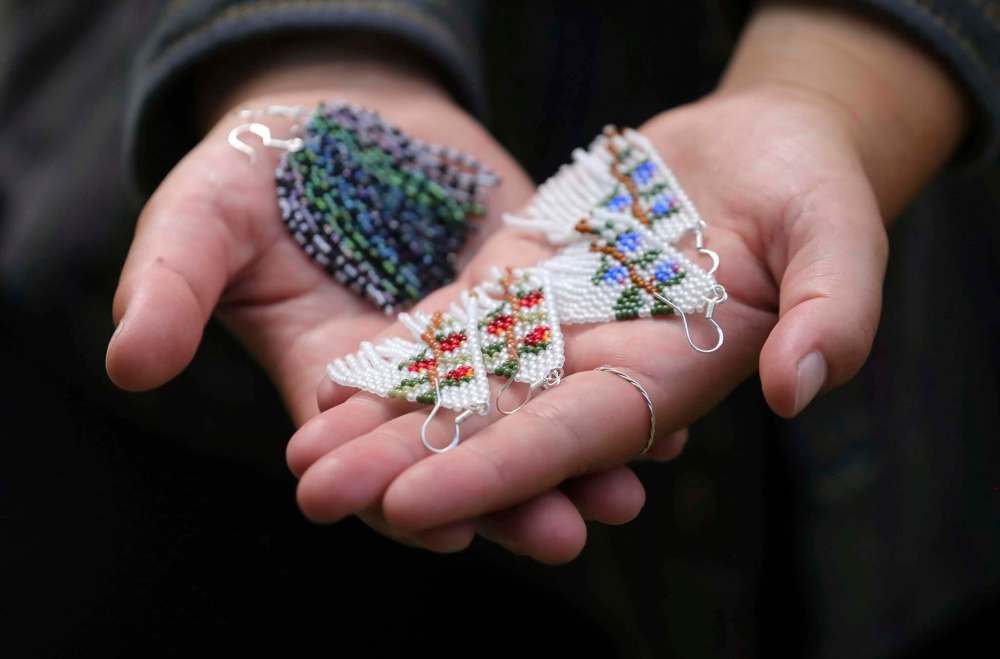
Bronwyn Butterfield’s Instagram is @Bronwynbutterfield.
randall.king@freepress.mb.ca
Twitter: @FreepKing
Our newsroom depends on a growing audience of readers to power our journalism. If you are not a paid reader, please consider becoming a subscriber.
Our newsroom depends on its audience of readers to power our journalism. Thank you for your support.
Our newsroom depends on a growing audience of readers to power our journalism. If you are not a paid reader, please consider becoming a subscriber.
Our newsroom depends on its audience of readers to power our journalism. Thank you for your support.
Advertisement Advertise With Us
Advertisement Advertise With Us