Tony-winning drama presents moving look at troubled family

Advertisement
Read this article for free:
or
Already have an account? Log in here »
To continue reading, please subscribe:
Digital Subscription
One year of digital access for only $1.44 a week*
- Enjoy unlimited reading on winnipegfreepress.com
- Read the E-Edition, our digital replica newspaper
- Access News Break, our award-winning app
- Play interactive puzzles
*Billed as $5.77 plus GST every four weeks. After 52 weeks, price increases to the regular rate of $19.95 plus GST every four weeks. Offer available to new and qualified returning subscribers only. Cancel any time.
To continue reading, please subscribe:
Add Free Press access to your Brandon Sun subscription for only an additional
$1 for the first 4 weeks*
- Enjoy unlimited reading on winnipegfreepress.com
- Read the E-Edition, our digital replica newspaper
- Access News Break, our award-winning app
- Play interactive puzzles
*Your next Brandon Sun subscription payment will increase by $1.00 and you will be charged $17.95 plus GST for four weeks. After four weeks, your payment will increase to $24.95 plus GST every four weeks.
Read unlimited articles for free today:
or
Already have an account? Log in here »
Hey there, time traveller!
This article was published 24/03/2018 (3130 days ago), so information in it may no longer be current.
The premise is the fodder of more than one screen comedy: A family, cracking at its seams, gets together during the Thanksgiving holiday. (Samplers include Pieces of April from 2003 and Home for the Holidays from 1995.)
But Stephen Karam’s comedy-drama The Humans, winner of the best play Tony Award for 2016, takes the premise and not only makes it very specific to this point in history, it adds a sub-layer of significance indicative of an existential threat.
The setting is a two-storey Manhattan apartment, with a spiral staircase connecting a spare upstairs and a windowless downstairs. (The crisp yet striking set design is by Brian Perchaluk.) The apartment is subject to loud thuds and bangs suggestive of a frozen lake issuing warning cracks just before swallowing whole the hapless individuals skating on its surface.
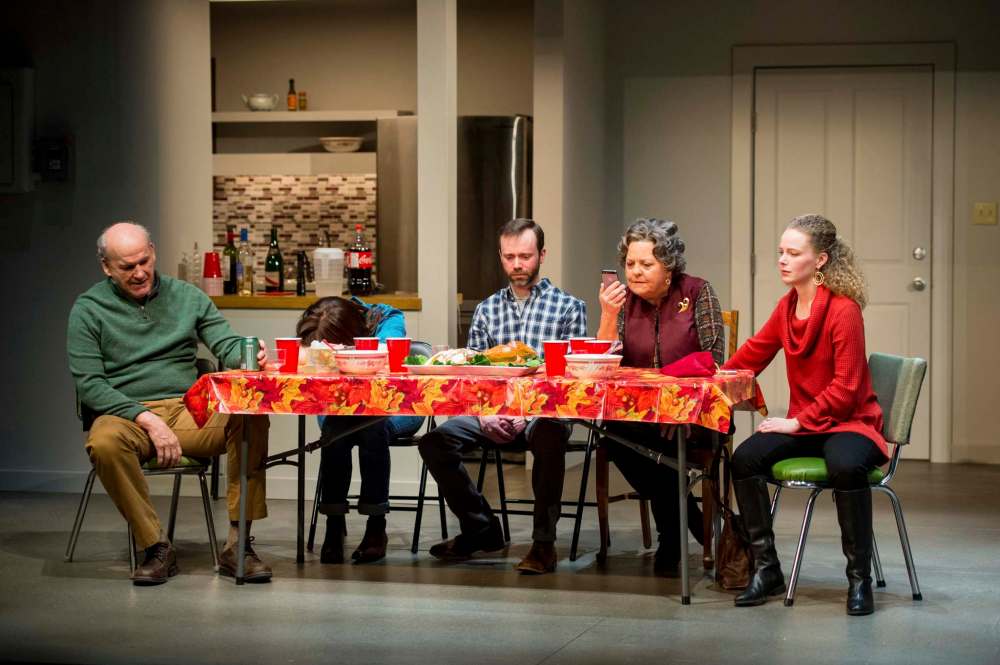
The apartment is a new acquisition of Brigid Blake (Heather Russell) and her older boyfriend Richard (Tom Keenan), who are hosting Brigid’s family, driving in from Scranton for Thanksgiving dinner.
Despite surface jocularity, the situation is rife with thrumming tension. Stolid father Erik (John Bourgeois) acts the responsible patriarch, pointing out the apartment’s flaws and offering up quick fixes to the gaps in the wall trim. But something gnaws at him. His wife Deirdre (Nicola Cavendish) is a Catholic traditionalist given to subtly expressing her disapproval at Brigid’s unmarried state. Yet Deirdre tries to be supportive of her other daughter, lawyer Aimee (Kate Besworth), a lesbian suffering from (a) a crushing recent breakup and (b) a case of ulcerative colitis that has contributed to the impending loss of her job.
All of the family members take turns caring for Erik’s aging mother “Momo” (Jane Burpee), a once-vital woman trapped in the depths of dementia.
It feels like a set-up for a traditional story of family dysfunction. The light moments, as when Deirdre reveals her religious housewarming gift, or when Erik insists on describing his weird dreams, one might be lulled into the feeling we’re lounging in just another zany theatrical sitcom.
But Karam’s script ratchets up the tension with the stark specificity of its setting. Erik worries the lower Manhattan basement abode could be flooded in the event hurricane worse than Sandy should strike. Both Erik and Aimee share traumatic memories in being in New York during 9/11; those banging noises from upstairs start to feel like the ghosts of the impacts made by the bodies crashing into the ground around the World Trade Center.

Over the course of its 100 minutes (without intermission), it will later emerge that economic anxiety runs in this family, and with reason.
Director Philip Akin elicits solid work from this cast, with the understanding that the pillars of the production are the roles of Erik and Deirdre. Bourgeois does beautiful tender work as a father who struggles to be the patriarchal rock, even if that stature has been significantly eroded by his own hand. As for Cavendish, she demonstrates why she continues to be a treasure of the Canadian theatre whether delivering a devastating one-liner on target, or silently suffering as she overhears her daughters making fun of her well-intentioned email missives.
Funny, sad, moving, The Humans distinguishes itself with a closing note of dread, which functions as a warning admonition. In these trying times, it is important to appreciate and protect all we hold dear, even beyond the parameters of that one autumn long weekend.
randall.king@freepress.mb.caTwitter: @FreepKing
Our newsroom depends on a growing audience of readers to power our journalism. If you are not a paid reader, please consider becoming a subscriber.
Our newsroom depends on its audience of readers to power our journalism. Thank you for your support.
THEATRE REVIEW
The Humans
By Stephen Karam
Royal Manitoba Theatre Centre
To Apr. 14
Tickets $27-$100 at royalmtc.ca
★★★★ out of five
Our newsroom depends on a growing audience of readers to power our journalism. If you are not a paid reader, please consider becoming a subscriber.
Our newsroom depends on its audience of readers to power our journalism. Thank you for your support.
Advertisement Advertise With Us
Advertisement Advertise With Us
History
Updated on Saturday, March 24, 2018 7:21 AM CDT: Photo added.