Work explores relationships between violence, masculinity, sport and show business

Advertisement

Advertise with us

Our culture tolerates and even champions male aggression, up to and including physical violence. We relish hockey fights, honour war heroes, and celebrate general pugnacity in everything from the meat-headed, spandex-clad pageantry of pro wrestling to the cutthroat tactics of politicians and businessmen.

Read this article for free:

or

Already have an account? Log in here »

To continue reading, please subscribe:

Subscribe and receive a limited-edition Free Press branded hat or tote.

Digital Subscription

One year of digital access for only $205*

  • Enjoy unlimited reading on winnipegfreepress.com
  • Read the E-Edition, our digital replica newspaper
  • Access News Break, our award-winning app
  • Play interactive puzzles

*First annual payment billed as $205.00 + GST for one year. This annual subscription will automatically renew at $233.00 + GST every 52 weeks (10% off the regular annual price of $259.35). Offer available to new and qualified returning subscribers only. Cancel any time.

To continue reading, please subscribe:

Add Free Press access to your Brandon Sun subscription for only an additional

$1 for the first 4 weeks*

  • Enjoy unlimited reading on winnipegfreepress.com
  • Read the E-Edition, our digital replica newspaper
  • Access News Break, our award-winning app
  • Play interactive puzzles
Start now

*Your next Brandon Sun subscription payment will increase by $1.00 and you will be charged $17.95 plus GST for four weeks. After four weeks, your payment will increase to $24.95 plus GST every four weeks.

Opinion

Hey there, time traveller!
This article was published 18/04/2013 (4851 days ago), so information in it may no longer be current.

Our culture tolerates and even champions male aggression, up to and including physical violence. We relish hockey fights, honour war heroes, and celebrate general pugnacity in everything from the meat-headed, spandex-clad pageantry of pro wrestling to the cutthroat tactics of politicians and businessmen.

The glorification of bellicosity doesn’t, for the most part, extend to bellicose women, however, and in practice it only applies to certain men some of the time. Race and class largely determine which dudes are encouraged to clobber which other dudes, when, and for whose benefit or entertainment, but the ability and willingness to knock the stuffing out of an opponent remains, for many people, central to what it means to “be a man” (if by “man,” I suppose, you mean “prehistoric imbecile”).

Fight, Tom Lovatt’s current show at Gurevich Fine Art, investigates how this perceived link between masculinity and violence plays out in sporting arenas and on television screens. His traditionally-minded depictions of brawling boxers and mixed martial artists, large-scale oil paintings and intimate drawing studies, echo a collective fascination with ritualized hostility and its powerful association with gender identity, inviting consideration and critique.
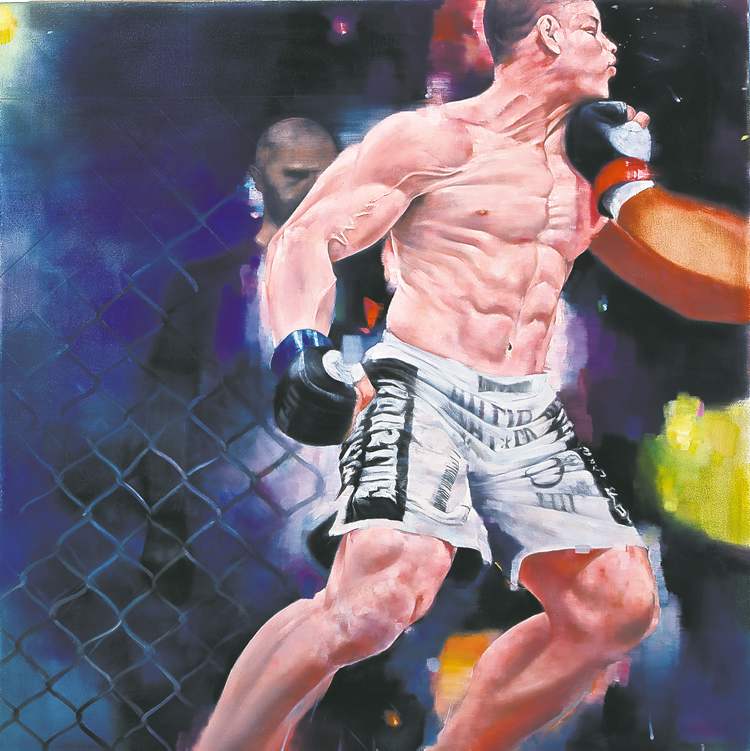
Vicious Left
Vicious Left

Lovatt maintains an ambivalent stance, neither flinching from his subject matter’s disturbing intensity nor denying its spectacular, even seductive appeal, and what viewers take away from the work will largely reflect their existing views and sensibilities. The paintings depict actual matches between historical and contemporary fighters, so a familiarity with combat sports likely adds a layer of interest in this respect. (Coming to the show, I was dimly aware of the career-ending 1951 match between Rocky Marciano and an aging Joe Louis featured in Lovatt’s Do or Die but wasn’t familiar, for instance, with Wanderlei “The Axe Murderer” Silva).

The works frequently reference art history, too. Lovatt clearly aspires to the gritty dynamism of early 20th-century American realist George Bellows’s own boxing pictures, but while Lovatt’s preferred palette skews unexpectedly toward saturated hues and seasick pastels, lending these familiar images a lurid, television-ready sheen, the occasional anatomical issue and a tendency to overwork leave some of them a bit stiff. Bellows also depicted noteworthy real-world fights and fighters, and, like Bellows, Lovatt highlights the jeering faces of spectators who serve as visible reminders of our own complicity in the scenes.

An image of UFC’s Chael Sonnen and Nate Marquardt grappling on the mat overwhelmingly echoes the “Uffizi Wrestlers,” a famous copy of a third-century BC Greek sculpture of a virtually identical scene. In recalling that classical celebration of male beauty, Lovatt touches the issues of submission and homoeroticism that complicate so many displays of male aggression, themes that arguably re-emerge in his series of small, highly realized sketches. Made with sanguine conté (a type of brittle, reddish-brown crayon with a look similar to coloured pencil), the drawings have a delicate quality at radical odds with their brutal imagery, while open, “unfinished” passages and overlapping figures help create a sense of movement and choreographed commotion that the paintings sometimes lack.

Fight may not break new ground as such, but whether one’s inclined to see the images as barbarism or beefcake (or “images of strength and athletic prowess,” I guess), they provide a worthwhile opportunity to reflect on the interrelatedness of violence, spectatorship, gender, and identity. Now pass the peanuts.

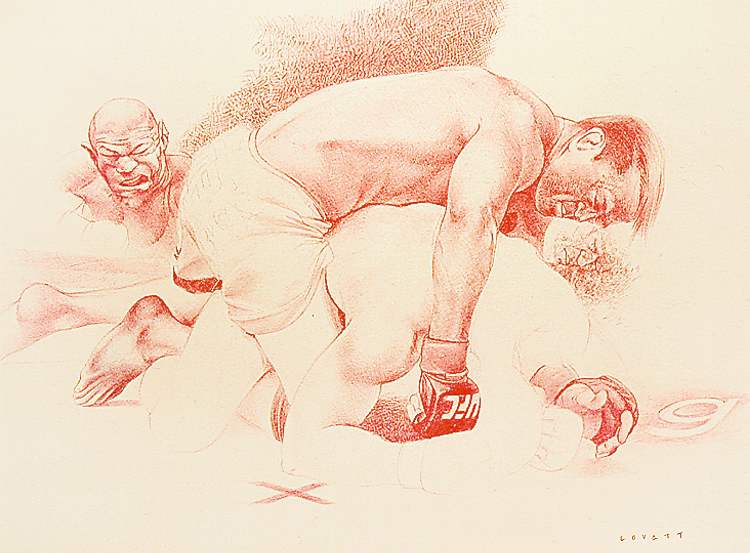
 

Ground and Pound
Ground and Pound

Steven Leyden Cochrane is a Winnipeg-based artist, writer and educator who will never understand the appeal of boxing.
Report Error Submit a Tip

More Stories

Letters, July 29

7 minute read Preview

Letters, July 29

7 minute read Yesterday at 2:00 AM CDT

I was excited to see the cover of (the July 27) Free Press. However, it appears the Canadian Press reporter, Ian Bickis, missed key aspects of the story. Purpose Construction not only bought the lot: they built the home Mr. Bettcher now lives in using labour from the neighbourhood as a part of a trades-training program. And they helped build the financing model.

Read
Yesterday at 2:00 AM CDT

Former teacher would suit up with Bombers in just ninth game of three-down loop career

Taylor Allen 6 minute read Preview

Former teacher would suit up with Bombers in just ninth game of three-down loop career

Taylor Allen 6 minute read Tuesday, Jul. 28, 2026

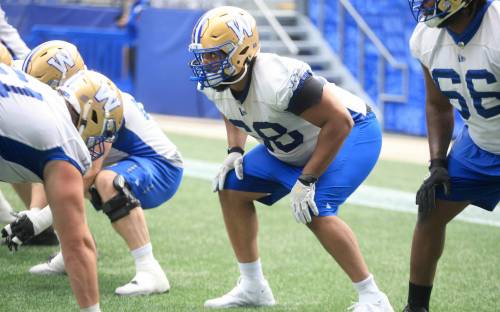
In a way, Micah Vanterpool’s brief stint as a Grade 3 teacher in his hometown of Tulsa, Okla., prepared him for life in the CFL.

The third-year offensive lineman for the Winnipeg Blue Bombers only has eight career games on his resumé as he has bounced around between the practice roster, starting lineup and injury report.

But thanks to his time in the classroom, he’s developed the patience that’s required by a young American trying to make a name for oneself in the three-down loop.

Vanterpool got into teaching after failing to make the New England Patriots in 2023. He said goodbye to the education profession the following year and took his talents up north to Winnipeg.

Read
Tuesday, Jul. 28, 2026

What’s up

5 minute read Preview

What’s up

5 minute read 12:02 AM CDT

Summer Movie Night: JawsBarn Hammer Brewing Co., 595 Wall St.Today, 7 p.m.FreeIt was the first film to be marketed in North America on LaserDisc (in MCA DiscoVision, no less). The main character doesn’t have a name, but was dubbed Bruce by its co-stars. And a prosthetic arm made for the film didn’t look realistic enough, so a cast member was buried in the sand with only her arm sticking out.

Steven Spielberg’s 1975 film Jaws was a sensation upon release, overtaking The Godfather as the highest grossing film at the North American box office (a title it held until Star Wars was released two years later). The film follows the plight of a New England town terrorized by a massive great white shark, and the ragtag trio that set out to take down the beast after a series of attacks.

Tonight at Barn Hammer, you can revisit the film that had so many afraid to go in the water (and spawned Roy Scheider’s infamous line “you’re going to need a bigger boat” which, according to IMDb, he improvised).

The film gets going at 7:30 p.m., but pop by the brewery tap room beforehand for some pre-show trivia (such as the above nuggets). There will be happy hour-priced pints, a themed cocktail and even a candy bar for viewers of all ages to enjoy. Admission is free.

Read
12:02 AM CDT

It isn’t ‘just the weather’

Erna Buffie 5 minute read 2:00 AM CDT

I was reading The Guardian the other day, which is one of the best, if not the best, newspaper for climate change coverage. I say this, despite the fact that it still silos the subject into a special section called “Climate Crisis and Environment.”

And it continues to publish front page headlines like “May and June heatwave kills about 2,700 in England and Wales, data suggests,” with no reference to climate change, until you hit the body of the story.

Which, quite frankly, is better than most newspapers do.

Indeed, in a recent issue of The Guardian, there’s an article about just that — the fact that an analysis of British newspapers revealed that 72 per cent of articles covering the U.K.’s June heatwave failed to even mention the climate crisis.

Bracket creep: A stealthy tax increase

Gage Haubrich 4 minute read Yesterday at 2:00 AM CDT

About $2,100. That’s how much Premier Wab Kinew’s bracket creep tax hike could cost your family by 2030, depending on how much you make.

Bracket creep is an income tax hike that happens when the government stops indexing tax brackets to inflation. That means that after getting a cost-of-living raise, taxpayers can be bumped into a new tax bracket and have their tax bill increased even though they can’t afford to buy more.

Think about it this way: A raise that only covers higher grocery prices isn’t a real raise. You’re not richer. Your cart costs the same. But the bigger number on your paycheque bumps you into a higher bracket. That means higher taxes on a paycheque that buys the exact same number of groceries as last year.

That’s why most provincial governments and the federal government adjust income tax brackets with inflation.

Body of 11-year-old Calgary boy missing for two weeks found in water pipe

Dayne Patterson and Bill Graveland, The Canadian Press 5 minute read Preview

Body of 11-year-old Calgary boy missing for two weeks found in water pipe

Dayne Patterson and Bill Graveland, The Canadian Press 5 minute read Updated: Yesterday at 9:05 PM CDT

CALGARY - An 11-year-old Calgary boy who disappeared two weeks ago has been found dead in a labyrinth of pipes under the city, police announced Wednesday.

Chief Katie McLellan said the boy, named Parker, was discovered in a small water pipe underneath Deerfoot Trail, the city's major north-south expressway.

"For nearly two weeks, so many people woke up hoping it would be the day Parker came home," McLellan told reporters.

"Instead, we are here sharing news that is heartbreaking for his family and for everyone who has been carrying that hope."

Read
Updated: Yesterday at 9:05 PM CDT