Youth being drawn back to poetry

Advertisement

Advertise with us

Poetry is hot — a lot hotter than you might think.

Read this article for free:


or

Already have an account? Log in here »

To continue reading, please subscribe:

Subscribe and receive a limited-edition Free Press branded hat or tote.

Digital Subscription

One year of digital access for only $205*

  • Enjoy unlimited reading on winnipegfreepress.com
  • Read the E-Edition, our digital replica newspaper
  • Access News Break, our award-winning app
  • Play interactive puzzles

*First annual payment billed as $205.00 + GST for one year. This annual subscription will automatically renew at $233.00 + GST every 52 weeks (10% off the regular annual price of $259.35). Offer available to new and qualified returning subscribers only. Cancel any time.

To continue reading, please subscribe:

Add Free Press access to your Brandon Sun subscription for only an additional

$1 for the first 4 weeks*

  • Enjoy unlimited reading on winnipegfreepress.com
  • Read the E-Edition, our digital replica newspaper
  • Access News Break, our award-winning app
  • Play interactive puzzles
Start now

*Your next Brandon Sun subscription payment will increase by $1.00 and you will be charged $17.95 plus GST for four weeks. After four weeks, your payment will increase to $24.95 plus GST every four weeks.

Hey there, time traveller!
This article was published 22/09/2018 (2942 days ago), so information in it may no longer be current.

Poetry is hot — a lot hotter than you might think.

The share of adults reading poetry grew by an astounding 76 per cent between 2012 and 2017, according to a newly released study from the National Endowment for the Arts (NEA). Some 28 million American adults reported reading poetry in 2017.

The results are even more dramatic for young people. The percentage of poetry readers age 18-24 doubled during that period.

Chris Young / The Canadian Press files
Canadian poet Rupi Kaur has three million followers on Instagram, where she posts images and short verses.
Chris Young / The Canadian Press files Canadian poet Rupi Kaur has three million followers on Instagram, where she posts images and short verses.

This news is contained in a study published Sept. 12 called “U.S. Trends in Arts Attendance and Literary Reading: 2002-2017,” based on a partnership between the NEA and the U.S. Census Bureau. It’s the country’s largest and longest-running survey of how millions of adults participate in the arts.

Ironically, despite all the complaints about Facebook and Twitter leading to the death of western civilization, social media may be encouraging Americans’ rising interest in poetry. Sunil Iyengar, the director of the Office of Research & Analysis at the NEA, cites the rise of social media and technology platforms as one potential explanation for the increased interest in poetry and spoken word. Amy Stolls, the NEA’s director of literature, mentions social media, too, along with the agency’s outreach activities to publishers, writers and schools.

Some of the most popular poets alive are now “social media poets,” writers who distribute their work and connect with their vast, young audiences primarily online. Canadian poet Rupi Kaur has three million followers on Instagram, where she regularly posts images and short verses. Her first print collection, Milk and Honey (2015), sold about two million copies, an unheard-of blockbuster in a genre that usually considers a few thousand copies a success.

But poetry could be a countervailing influence to social media, too. U.S. poet laureate Tracy K. Smith, who teaches at Princeton University, wonders if the unsettled tenor of our times is drawing people, especially young people, back to verse. “In my teaching of undergraduates, I see them turning to the art form in their attempts to grapple with questions related to forced migration, shifting gender norms, the environment, mental illness and technology — along with old standbys of love, loss and the changing of the seasons.”

Far from celebrating the influence of technology, Smith suggests readers may be turning to poetry to get away from “likes” and cat-eared images. “Unlike any generation before them, these young people don’t know a life before smartphones and social media,” she says. “Poetry, which breaks from the shorthand vocabulary of tweets and sound bites, offers them a necessary recourse to depth, strangeness, vulnerability and imaginative possibility. Poetry also invites them to take their time, to move slowly, to process things gradually, which is an impulse counter to the breakneck pace at which so much else occurs.”

Robert Casper, head of the Poetry and Literature Center in the Library of Congress, suggests a supporting role for social media — not so much as a platform for verse but as a means of calling attention to its writers. “Poetry’s surge in popularity among young people has to do with the success of spoken word and performance poetry,” he says, “with a new generation of poets who are smartly promoting the art through social media.”

Sarah Browning, co-founder of Split This Rock, a national poetry and social justice organization based in Washington, D.C., suggests greater diversity is driving the new popularity of verse. “At long last,” she says, “establishment American poetry is finally looking and sounding like America: people of colour, queer people, people with disabilities and activist poets are telling about their own lives and struggles and joys. And because of the internet and changes in publishing, they’re also taking control of the means of distribution.”

Sadly, the good news about poetry in the NEA report is not part of a general increase in reading. The share of adults who read books not required for work or school remained about the same as in 2008. And, more alarming, the percentage of people who read novels or short stories “is now lower than in any prior survey period.”

— Washington Post

Report Error Submit a Tip

More Stories

Carney: Trump’s ‘energy ceasefire’ could ‘de-escalate’ war in Ukraine

Kyle Duggan, The Canadian Press 4 minute read Preview

Carney: Trump’s ‘energy ceasefire’ could ‘de-escalate’ war in Ukraine

Kyle Duggan, The Canadian Press 4 minute read Updated: Yesterday at 5:18 PM CDT

OTTAWA - Mark Carney thanked U.S. President Donald Trump for “his leadership toward securing an energy ceasefire" between Ukraine and Russia, the Prime Minister's Office said on Sunday.

But on the same day, Carney also expressed to Ukraine's leader that Trump's new diesel supply agreement with Russia undermines Canada's efforts to end the war in Europe.

Trump posted on his Truth Social account on Sunday that Ukraine and Russia have agreed to an "energy ceasefire," but did not immediately offer any details.

Carney expressed “strong support for this agreement," according to a readout from the PMO that followed a conversation between the two leaders. And on his own social media account, Carney offered that Trump’s newly announced “energy ceasefire” could help wind down Russia’s war against Ukraine.

Read
Updated: Yesterday at 5:18 PM CDT

Manitoba e-scooter legislation changes set to impose speed limit, age restrictions, sidewalk ban

Matthew Frank 5 minute read Preview

Manitoba e-scooter legislation changes set to impose speed limit, age restrictions, sidewalk ban

Matthew Frank 5 minute read Updated: Yesterday at 5:14 PM CDT

People riding e-scooters and other personal electric vehicles in Manitoba will have to strap on a helmet, stay off sidewalks and follow new age limits once new provincial rules for the devices take effect next year.

The vehicles, which also include electric skateboards, hoverboards and unicycles, will fall under The Highway Traffic Act starting in 2027, according to the province’s website. E-bikes are excluded from the new rules, according to the province’s frequently-asked-questions page.

All riders must be at least 16 years old and wear properly fitting helmets — that goes for passengers, too, the province said.

The proposed new legislation sets a speed limit of 25 km/h and would prohibit personal electric vehicles from sidewalks unless signs specifically allow sidewalk use. Riders would be using shared paths or roads with speed limits of 50 km/hr or less. They won’t be allowed to operate the vehicles under the influence of alcohol or drugs and they must use hand signals and obey traffic signs.

Read
Updated: Yesterday at 5:14 PM CDT

Person killed in workplace accident at Fairmont construction site

Morgan Modjeski 3 minute read Preview

Person killed in workplace accident at Fairmont construction site

Morgan Modjeski 3 minute read Friday, Oct. 9, 2026

Emergency responders were on scene and Manitoba Workplace Safety and Health is investigating after a worker died following an incident at a Winnipeg construction site Thursday.

Little information about the worker killed was provided, but the fatal incident happened at the Fairmont Winnipeg, located at 2 Lombard Place, with police responding around 5 p.m.

The hotel is currently closed and is an active construction site. The person killed has not been identified by name.

Information from a provincial spokesperson said the deceased was working for Kepsco Construction when they were fatally injured after a “portion of an overhead canopy collapsed during asbestos abatement work.”

Read
Friday, Oct. 9, 2026

Puerto Vallarta boards up as Hurricane Simon hits Category 4 strength

The Associated Press 3 minute read Preview

Puerto Vallarta boards up as Hurricane Simon hits Category 4 strength

The Associated Press 3 minute read Saturday, Oct. 10, 2026

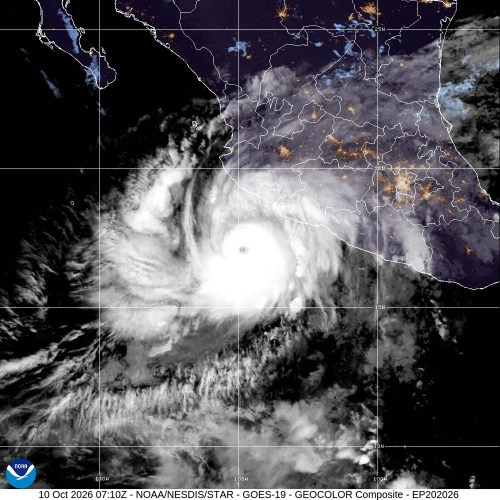
PUERTO VALLARTA, Mexico (AP) — Simon has strengthened into a powerful Category 4 hurricane as it barrels toward Mexico’s coast.

The National Hurricane Center in Miami said Saturday that Simon’s maximum sustained winds increased to 150 mph (240 kph). A storm of that strength or greater is considered a major hurricane.

The center said it expected Simon “to be near or just inland” of Mexico's west-central coast on Sunday. The hurricane could bring as much as 10 to 20 inches (25-50 cm) of rain over parts of southwestern Mexico, with some areas in the states of Michoacan, Colima and Jalisco receiving up to 30 inches (76 centimeters).

“This rainfall will produce life-threatening flooding and mudslides, especially in areas of steep terrain,” the center warned in a bulletin that also urged residents to take immediate action to prepare as tropical-storm conditions were expected to arrive Saturday afternoon.

Read
Saturday, Oct. 10, 2026

Collaros turns back the clock in crucial win over Stamps

Taylor Allen 7 minute read Preview

Collaros turns back the clock in crucial win over Stamps

Taylor Allen 7 minute read Yesterday at 7:14 PM CDT

It was around this time seven years ago that the Winnipeg Blue Bombers officially became Zach Collaros’s team.

Making his first start in blue and gold after being acquired via trade, Collaros ran backwards to escape a collapsing pocket before rolling to his right and firing a perfect pass to Darvin Adams in the back corner of the south end zone during a home game against the Calgary Stampeders.

The play marked the beginning of the Collaros era in Winnipeg.

And a similar play Saturday night, once again against the Stampeders, served as a reminder that the 38-year-old pivot isn’t done just yet.

Read
Yesterday at 7:14 PM CDT

Piece of Winnipeg’s magic history disappears

Kelly-Anne Riess 5 minute read Preview

Piece of Winnipeg’s magic history disappears

Kelly-Anne Riess 5 minute read Saturday, Oct. 10, 2026

A piece of Winnipeg’s magic history has vanished, and internationally renowned escape artist Dean Gunnarson is offering a $500 reward to anyone who can make it reappear.

The plaque marked the birthplace of what has become the world’s largest organization of professional and amateur magicians, the International Brotherhood of Magicians, which was founded in Winnipeg more than a century ago.

Gunnarson said fellow magician and local magic historian Bruce Thompson discovered the disappearance Tuesday while on his way to work.

Thompson returned to inspect the site and found what appeared to be evidence it had been forcibly removed.

Read
Saturday, Oct. 10, 2026