Tefs’ characters learn Survival methods
Advertisement
Read this article for free:
or
Already have an account? Log in here »
To continue reading, please subscribe:

Digital Subscription
One year of digital access for only $205*
- Enjoy unlimited reading on winnipegfreepress.com
- Read the E-Edition, our digital replica newspaper
- Access News Break, our award-winning app
- Play interactive puzzles
*First annual payment billed as $205.00 + GST for one year. This annual subscription will automatically renew at $233.00 + GST every 52 weeks (10% off the regular annual price of $259.35). Offer available to new and qualified returning subscribers only. Cancel any time.
To continue reading, please subscribe:
Add Free Press access to your Brandon Sun subscription for only an additional
$1 for the first 4 weeks*
- Enjoy unlimited reading on winnipegfreepress.com
- Read the E-Edition, our digital replica newspaper
- Access News Break, our award-winning app
- Play interactive puzzles
*Your next Brandon Sun subscription payment will increase by $1.00 and you will be charged $17.95 plus GST for four weeks. After four weeks, your payment will increase to $24.95 plus GST every four weeks.
Read unlimited articles for free today:
or
Already have an account? Log in here »
Hey there, time traveller!
This article was published 18/10/2009 (6116 days ago), so information in it may no longer be current.
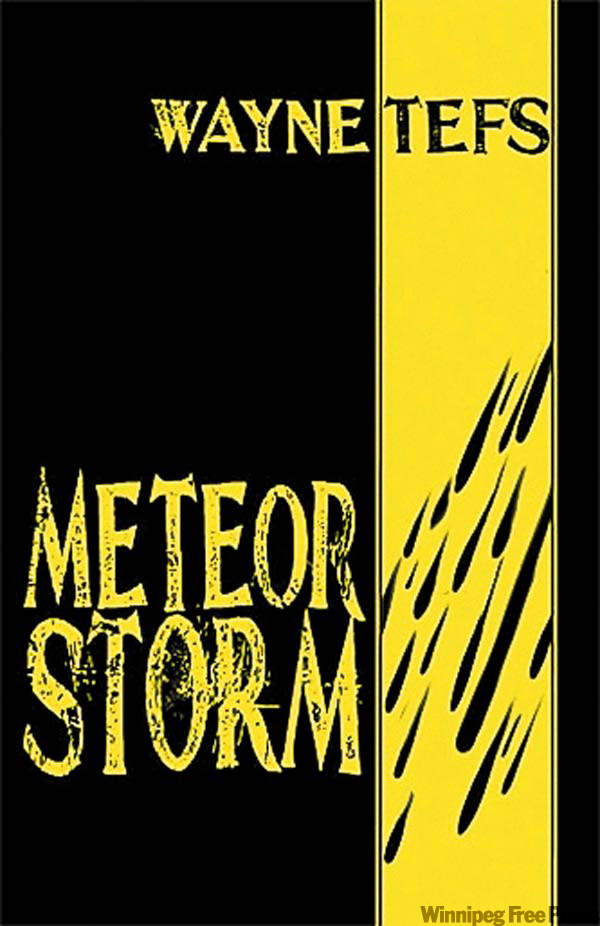
Meteor Storm
By Wayne Tefs
Turnstone Press, 223 pages, $18
ACCORDING to the theory Margaret Atwood expounded 37 years ago in her famous book-length essay Survival, Canadian literature abounds with grim stories in hardscrabble environments like mining towns because our writers are channelling the rage we feel at being exploited by distant political or economic empires.
This collection of 14 stories by Wayne Tefs — a Manitoba literary stalwart whose 2000 novel Moon Lake won the Margaret Laurence Award as the top work of fiction in the province — demonstrates that Survival has survived into the 21st century.
In Survival-themed works, characters who have been abused by distant and unseen forces turn their anger and resentment on the people around them — just as characters in Tefs’ stories do when they perpetuate cycles of violence.
That theme is set at the beginning of the first story, when we learn that the narrator’s father’s hardware store went broke along with the fictional town of Red Rock, Ont.
The rough-and-tumble mining town, we’re told "went bust in the way of mining towns," that is, as a result of distant corporate decisions.
Tefs writes with an honesty and a sense of sympathy for the human condition that is reminiscent of the "dirty realist" short fiction of Richard Ford. His book is a series of variations on a theme of violence, despair and masculinity.
Though each story has a different first-person narrator, there are many common elements. All protagonists are young and male. Most play hockey and are either university students or university-bound.
Many have damaged war-vet fathers and bankrupt family businesses. Most are introduced to traditional masculinity (hunting and/or fighting) by a father or older-brother figure.
The stories place in the foreground domestic explosions by fathers or uncles, or spasms of violence and menace by friends or barroom acquaintances. But Tefs always makes us aware of the larger historical or economic forces that put these characters on the path to violence.
In the prize-winning first story, Red Rock and After, the narrator’s father nearly becomes murderous after his second business, a laundry, is destroyed in a fire.
Witnessing his father’s outburst, which has come after a long decline in the family fortunes, the narrator concludes that: "if my father could take an axe to a man, anyone was capable of anything."
Sometimes Tefs considers the possibility that we have some agency, that we are defined by how we respond to the pain we feel. After all, his narrators, though they may understand the violence they witness, generally resist being violent themselves.

But often his narrators opt for fatalism, concluding like the protagonist of the final story, Black Coat: "We live with the illusion that we’re in control of our lives, that we set our eyes on a goal and then go about achieving it. The truth is that we’re buffeted about — by diseases, bad decisions, needs of children, personal betrayals, a whole string of unpredictables."
In several stories, as in the title one, Meteor Storm, a sudden tragedy is narrowly averted, leading the narrator to reflect on how easily his life could have been destroyed: "A person’s life could turn on one small act … Our hopes and dreams were fragile."
A meteor storm, as Tefs notes in a preface, is the result of comet debris being pulled into Earth’s gravitational field and burning up under atmospheric pressure. The burst of light may seem like a sudden surprise, but it has actually been set in motion by the unyielding laws of physics and has been destined to happen for centuries or millennia.
Tefs’ violent characters ultimately have no more control over their direction as they burn up under pressure from greater, unseen entities.
Bob Armstrong is a Winnipeg playwright.