

Books, not bombs
American humanitarian building schools in deepest, darkest Pakistan and Afghanistan
Advertisement
Read this article for free:
or
Already have an account? Log in here »
To continue reading, please subscribe:
Digital Subscription
One year of digital access for only $1.44 a week*
- Enjoy unlimited reading on winnipegfreepress.com
- Read the E-Edition, our digital replica newspaper
- Access News Break, our award-winning app
- Play interactive puzzles
*Billed as $5.77 plus GST every four weeks. After 52 weeks, price increases to the regular rate of $19.95 plus GST every four weeks. Offer available to new and qualified returning subscribers only. Cancel any time.
To continue reading, please subscribe:
Add Free Press access to your Brandon Sun subscription for only an additional
$1 for the first 4 weeks*
- Enjoy unlimited reading on winnipegfreepress.com
- Read the E-Edition, our digital replica newspaper
- Access News Break, our award-winning app
- Play interactive puzzles
*Your next Brandon Sun subscription payment will increase by $1.00 and you will be charged $17.95 plus GST for four weeks. After four weeks, your payment will increase to $24.95 plus GST every four weeks.
Read unlimited articles for free today:
or
Already have an account? Log in here »
Hey there, time traveller!
This article was published 02/01/2010 (5996 days ago), so information in it may no longer be current.
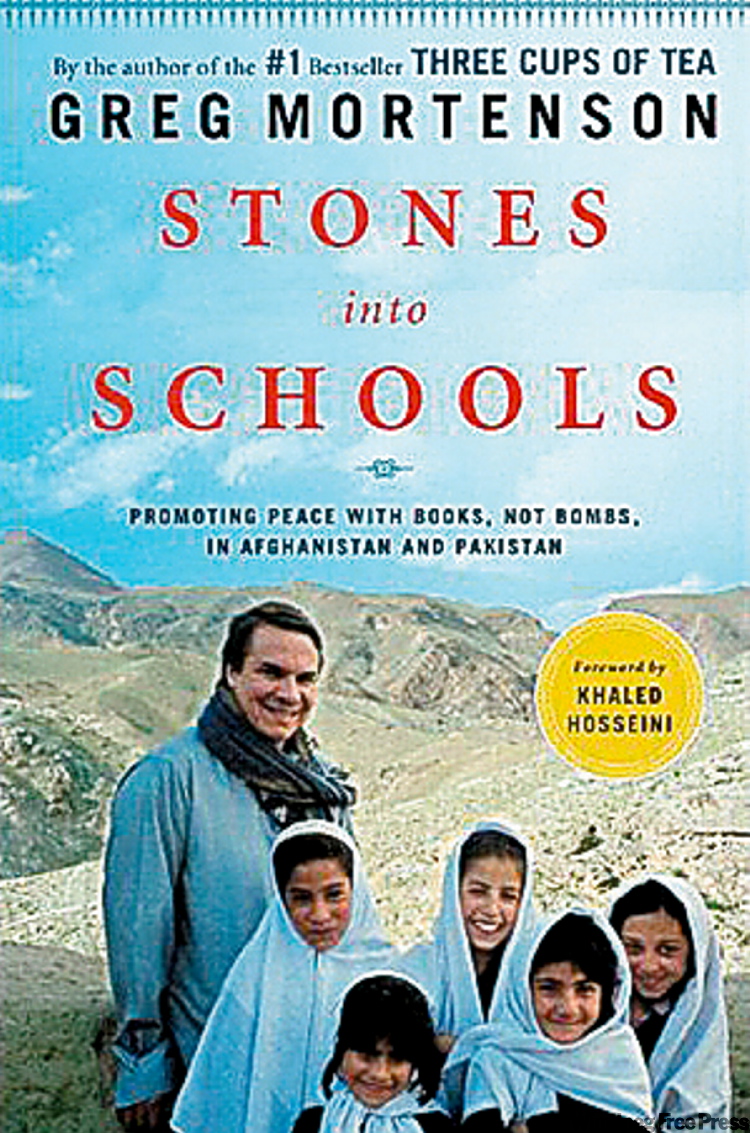
Stones into Schools
Promoting Peace with Books, Not Bombs, in Afghanistan and Pakistan
By Greg Mortenson
Viking, 420 pages, $33.50
American humanitarian Greg Mortenson’s 2006 bestseller, Three Cups of Tea, is required reading for senior U.S. military commanders, Pentagon officials and Canadian Defence Ministry members.
It is also a popular reading assignment in colleges and universities worldwide, and there is even a young reader’s version. It won the 2006 Asia Book of the Year and it remains a New York Times bestseller.
Now Stones into Schools will serve as its complement and likely enjoy similar success.
Its appeal and worthiness lie in the message it gives to those who worry about, and even sacrifice their lives for, dealing with terrorism as practised by extremist Islamic groups like al-Qaida and the Taliban.
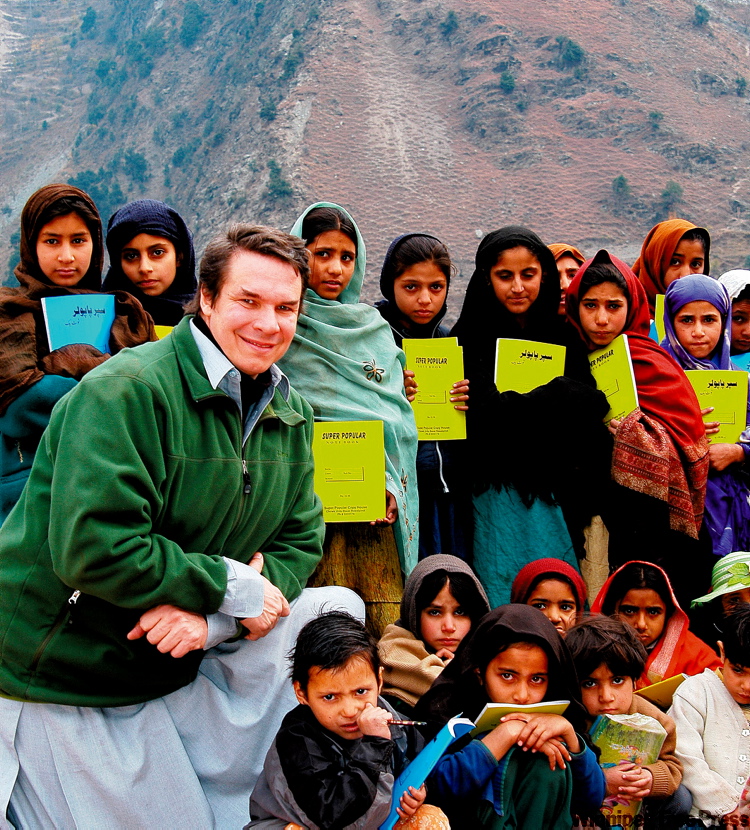
Reflecting Mortenson’s extraordinary organizational skills, the book has pages of area maps, a who’s-who list of the people mentioned and colour photographs depicting many of the people and schools.
It begins with a foreword by Kite Runner novelist Khaled Hosseini and ends with a helpful glossary of Arabic words.
The book continues where Three Cups of Tea left off in 2003 but is written in engaging first-person narrative.
There is a Norman Rockwellian humility to Mortenson as he describes the difficulties in building schools in mountainous Asia paid for by the Central Asia Institute (CAI), an organization he co-founded in 1996 whose mission is to educate girls in the remotest parts of Pakistan and Afghanistan.
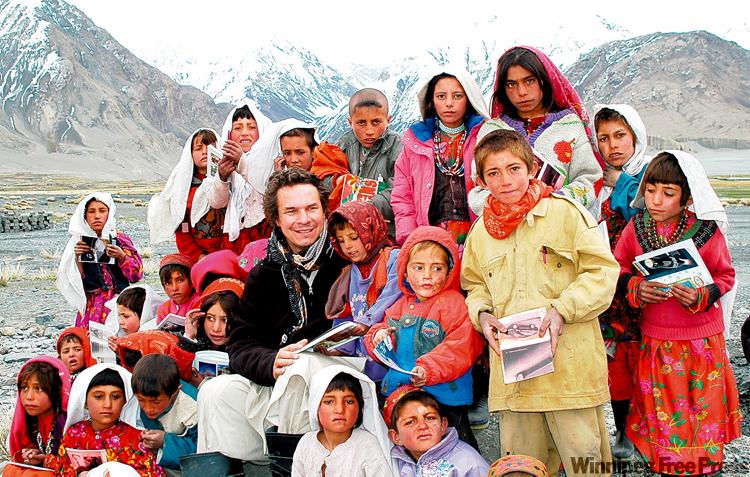
Minnesota-born, an African-raised former mountain climber and a current Montana resident, Mortenson, 52, has become a respected world leader through his education endeavours that are providing more hope for achieving peace and stability than brute military force.
Since beginning his humanitarian work in 1993, he has achieved recognition befitting a hero: 10 honorary doctorates and 30 humanitarian awards, including the Star of Pakistan, that nation’s highest civilian honour.
As Mortenson points out, the CAI has established 131 schools currently serving more than 58,000 students, most of them girls, and it "never used a dollar of federal government USAID funds to build a school or buy a pen," relying instead on generous benefactors and old-fashioned fundraising.
The narrative begins with Mortenson’s promise to build a school for a Kirkhiz community called Bozai Gumbad in Afghanistan’s isolated Wakhan Corridor, a 200-kilometre-long narrow stretch of land surrounded by towering mountain ranges and bordering on Pakistan and Tajikstan.
Afghanistan’s dizzying ethnic, cultural and religious diversity has proven to be its strength in defeating British and Russian imperialist attempts, but decades of war have also given rise to extremist political and religious views and an intense dislike of everything western by groups like al-Qaida and the Taliban.
Recognizing that illiteracy offers little defence against extremist views, and that the Taliban continues to attract recruits from such isolated areas, Mortenson wants to build schools deeper and deeper into such regions.
His successes are a result of months spent in these regions holding village council meetings or "jirgas" with village elders, slowly creating the trust and mutual respect symbolized by drinking tea together.
Mortenson describes travelling through remote regions with his trusted manager, Sarfraz Khan, organizing the building of schools and dealing with corrupt and inept government officials.
Work is interrupted for many months as they help local communities dealing with the devastating earthquake that hit the Azad Kashmir region of Pakistan in October 2005.
In the end, his promise to the Kirkhiz is kept, made bittersweet because circumstances prevent his being there.
Yet having built their school largely on their own, the Kirkhiz had "raised a beacon of hope that called out to… every village and town in Afghanistan where children yearn for education."
Courageous acts like this will not only raise living standards, but will dispel "the grotesque lie that flinging battery acid into the face of a girl who longs to study arithmetic is somehow in keeping with the teachings of the Koran."
The book’s few typos may reflect a rush to publish the underlying message of peace on Earth and goodwill toward men in time for the holiday season.
Joseph Hnatiuk is a retired teacher in Winnipeg.