History of surgery bloody, but lacks some guts
Advertisement
Read this article for free:
or
Already have an account? Log in here »
To continue reading, please subscribe:

Digital Subscription
One year of digital access for only $205*
- Enjoy unlimited reading on winnipegfreepress.com
- Read the E-Edition, our digital replica newspaper
- Access News Break, our award-winning app
- Play interactive puzzles
*First annual payment billed as $205.00 + GST for one year. This annual subscription will automatically renew at $233.00 + GST every 52 weeks (10% off the regular annual price of $259.35). Offer available to new and qualified returning subscribers only. Cancel any time.
To continue reading, please subscribe:
Add Free Press access to your Brandon Sun subscription for only an additional
$1 for the first 4 weeks*
- Enjoy unlimited reading on winnipegfreepress.com
- Read the E-Edition, our digital replica newspaper
- Access News Break, our award-winning app
- Play interactive puzzles
*Your next Brandon Sun subscription payment will increase by $1.00 and you will be charged $17.95 plus GST for four weeks. After four weeks, your payment will increase to $24.95 plus GST every four weeks.
Read unlimited articles for free today:
or
Already have an account? Log in here »
Hey there, time traveller!
This article was published 09/01/2010 (6110 days ago), so information in it may no longer be current.
Blood and Guts
A History of Surgery
By Richard Hollingham
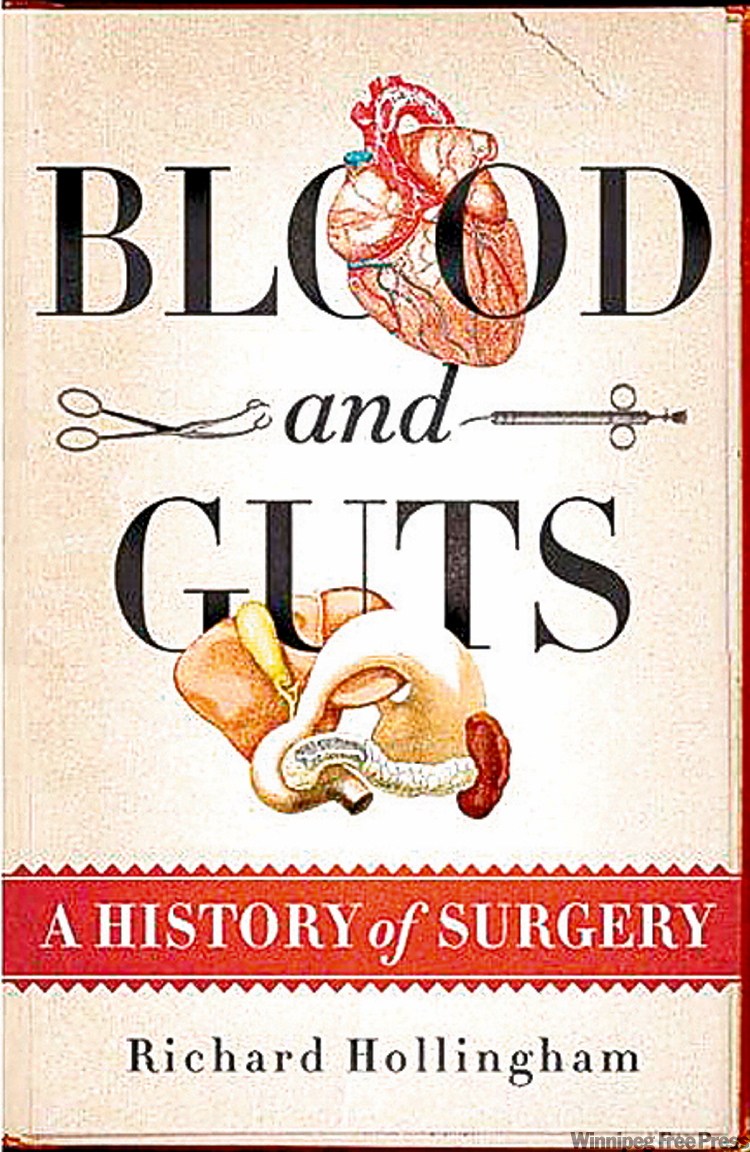
St. Martin’s Press, 320 pages, $36
JOURNALIST and BBC radio presenter Richard Hollingham approaches the history of surgery like a surgeon: he is unafraid to dive right in and get his hands dirty.
But with his tool bag full of gripping anecdotes (the book opens with a visceral description of a 30-second leg amputation) and colourful characters (as pioneering surgeons often were), Hollingham offers riveting descriptions of historical medical events that are at times more entertaining than informative.
Take, for example, his story of Ignaz Semmelweis, a young obstetrics doctor working in Vienna in 1846. Semmelweis was obsessed with figuring out why many of his patients were dying of the infectious disease known as "childbed fever."
After much bizarre experimentation, an unfortunate yet serendipitous event (the death of a colleague) led him to the conclusion that the fatal illness was the result of doctors who cared for their patients immediately after performing autopsies.
"Cadaverous particles" from the dead were infecting living patients, he realized. Semmelweis had a terrible time convincing his colleagues of this discovery, despite the astounding success of the strict post-autopsy hand-washing policies he instituted.
His headstrong nature didn’t help matters. As he found it harder to convince others, he became more obstinate, irritable and vitriolic. Eventually he was forced into a mental institution where he died, ironically, of childbed fever.
You may be wondering what this anecdote has to do with the history of surgery. This problem occurs several times throughout the book: regalement takes precedence over the dissemination of information, and a reader who is interested in the history of surgery is left less than enlightened.
Other anecdotes are more relevant to the topic at hand, and Hollingham writes in an easy, narrative style where characters and contexts spring to life.
He transports us to ancient Rome, to old operating theatres, gruesome laboratories and various war zones, surrounded by the daring and driven surgeons who made history.
The nail-biting moment when Dr. Joseph Lister pulls back the bandage on his young patient’s wounded leg to reveal that there is no infection raging beneath (a feat made possible by his discovery of the use of carbolic acid) is truly exhilarating.
In four of the book’s five sections, Hollingham guides us through events and discoveries in the history of heart, transplant, brain and plastic surgery. Also included is a section on the four major scientific advances that first made surgery a viable option:
"ö An accurate description of human anatomy, accomplished by the stealthy body-snatching practices of medical student Andreas Vesalius.
"ö A procedure for preventing blood loss, invented by wartime surgeon Alexander Paré.
"ö A method for reducing pain to allow for longer operations
"ö And, of course, some way to prevent infection in order to decrease mortality — otherwise, surgery was pointless.
Even though the book’s stated subject is history rather than modernity, each section ends rather abruptly, somehow managing to leave us wondering about the applicability of these discoveries and inventions to modern surgery.

The book certainly doesn’t lack for entertainment value, however, and is probably a good place to begin to learn about the history of surgery.
References are, frustratingly, not included in the text, but Hollingham at least provides a small list of followup readings for the interested learner.
Most readers will rip through the book, enjoying the ride the whole time. When it’s over though, they may find themselves less educated than they’d hoped about the history of surgery.
Jen Robinson is a Winnipeg PhD student in psychology and a freelance writer.