Absorbing Koestler biography good place to start
Advertisement
Read this article for free:
or
Already have an account? Log in here »
To continue reading, please subscribe:

Digital Subscription
One year of digital access for only $205*
- Enjoy unlimited reading on winnipegfreepress.com
- Read the E-Edition, our digital replica newspaper
- Access News Break, our award-winning app
- Play interactive puzzles
*First annual payment billed as $205.00 + GST for one year. This annual subscription will automatically renew at $233.00 + GST every 52 weeks (10% off the regular annual price of $259.35). Offer available to new and qualified returning subscribers only. Cancel any time.
To continue reading, please subscribe:
Add Free Press access to your Brandon Sun subscription for only an additional
$1 for the first 4 weeks*
- Enjoy unlimited reading on winnipegfreepress.com
- Read the E-Edition, our digital replica newspaper
- Access News Break, our award-winning app
- Play interactive puzzles
*Your next Brandon Sun subscription payment will increase by $1.00 and you will be charged $17.95 plus GST for four weeks. After four weeks, your payment will increase to $24.95 plus GST every four weeks.
Read unlimited articles for free today:
or
Already have an account? Log in here »
Hey there, time traveller!
This article was published 13/03/2010 (6056 days ago), so information in it may no longer be current.
Koestler
The Literary and Political Odyssey of a Twentieth-Century Skeptic
By Michael Scammell
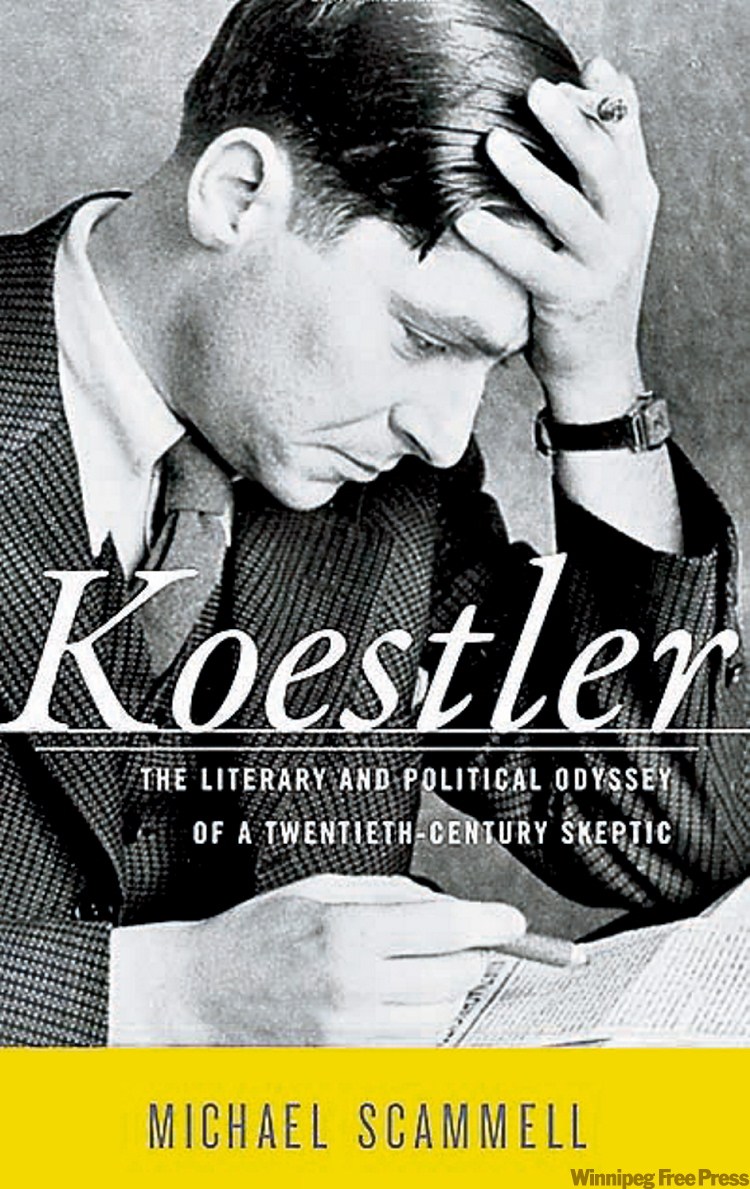
Random House, 689 pages, $43
THIS meticulously researched and comprehensive biography describes the life and times of a writer, activist and intellectual gadfly, once described as "one of the most versatile and protean writers of the twentieth century."
Its author, Michael Scammell, is a Columbia University academic, translator of Nabokov, Tolstoy and other Russian novelists, and author of a prize-winning biography of Alexander Solzhenitsyn.
Born in Budapest in 1905, Arthur Koestler was an ardent Zionist in the 1920s and an equally ardent Communist in the 1930s, ending up in a fascist prison during the Spanish Civil War. Winston Churchill and Noel Coward were among those who campaigned for his release.
At the beginning of the Second World War, he was imprisoned again, this time in a French internment camp, triply suspect as an alien, a Communist and a Jew.
On his release he joined the Foreign Legion and, after a series of hair-raising adventures, made his way to Britain, where he was jailed once more, this time as a security risk.
After brief service in the British army, he spent the war as an anti-Nazi propagandist and by 1945 had established himself as a leading political commentator, essayist and author.
After the war, he became an unrepentant Cold War warrior, disillusioned with Communism and insisting that the Soviet regime was as serious a threat as the Nazis had ever been
In the 1950s he abandoned politics, first for science and then the pursuit of the paranormal where he sought the certainties that had eluded him in politics. He and his wife committed suicide in 1983, dedicating his estate to creating a professorship in parapsychology, an offer taken up by the University of Edinburgh.
Along the way, Koestler wrote countless essays and articles and some 30 books, of which the best known today is his 1940 novel, Darkness at Noon, his take on Stalin’s 1930s show trials that, together with the Soviet-Nazi pact of 1939, destroyed his faith in Soviet-style Communism.
On a personal level, Koestler was often charming and generous but could be boorish and worse, though most of the people he quarrelled with forgave him.
Scammell gives us his "brilliant mind, exceptional inventiveness, intellectual rigour, and campaigning verve" and also the "incorrigibly volatile, egocentric, irascible and promiscuous tyrant," not neglecting his frenetic sex life and his domineering and sometime violent treatment of the many women in his life.
A celebrity in his day, Koestler is not much read today. Why then bother with this new biography?
Here are three reasons.
First it is a hugely informative, sometimes disturbing, sometimes entertaining, but always interesting portrayal of a complex personality.
Second, Koestler’s life was full of incident. He tried out (unsuccessfully) for an Israeli kibbutz; toured the Arctic in a German zeppelin and Soviet Asia with the African-American writer Langston Hughes; risked his life as an anti-Nazi activist; shared suicide pills with Walter Benjamin (they killed Benjamin but not Koestler); was one of the first people to draw attention to the Holocaust; partied with Sartre; gave Camus a black eye; pursued the paranormal; and much else besides.
Third, Koestler’s career puts a human face on a key period of 20th-century history and especially the struggle between Nazism, Communism and liberal democracy that shaped his life and work from the 1920s into the 1950s.

For Scammell, Koestler’s best books are "as thrilling and compelling today as when they were written."
It’s a bit of a stretch. Of his novels, only Darkness at Noon has stood the test of time. His various memoirs are minor masterpieces but his other work has lost much of its appeal.
If we read Koestler today it is more to discover what he said about his own times than what he tells us about ours. And this absorbing biography is a good place to start.
Ken Osborne is a professor emeritus of education at the University of Manitoba.