Unlikable, flawed character emerges as sympathetic
Advertisement
Read this article for free:
or
Already have an account? Log in here »
To continue reading, please subscribe:

Digital Subscription
One year of digital access for only $205*
- Enjoy unlimited reading on winnipegfreepress.com
- Read the E-Edition, our digital replica newspaper
- Access News Break, our award-winning app
- Play interactive puzzles
*First annual payment billed as $205.00 + GST for one year. This annual subscription will automatically renew at $233.00 + GST every 52 weeks (10% off the regular annual price of $259.35). Offer available to new and qualified returning subscribers only. Cancel any time.
To continue reading, please subscribe:
Add Free Press access to your Brandon Sun subscription for only an additional
$1 for the first 4 weeks*
- Enjoy unlimited reading on winnipegfreepress.com
- Read the E-Edition, our digital replica newspaper
- Access News Break, our award-winning app
- Play interactive puzzles
*Your next Brandon Sun subscription payment will increase by $1.00 and you will be charged $17.95 plus GST for four weeks. After four weeks, your payment will increase to $24.95 plus GST every four weeks.
Read unlimited articles for free today:
or
Already have an account? Log in here »
Hey there, time traveller!
This article was published 29/05/2010 (5947 days ago), so information in it may no longer be current.
Wilson
By Daniel Clowes
Drawn and Quarterly, 80 pages, $24
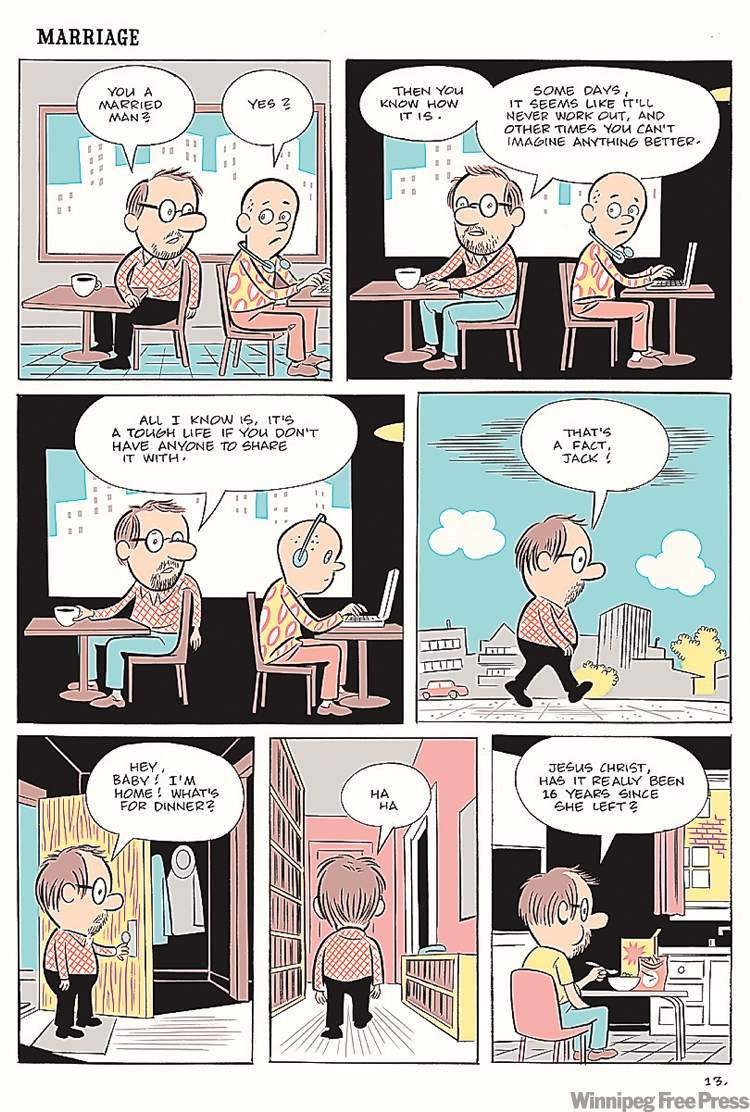
It’s a recurring rebuke levelled at writers, playwrights and filmmakers that their characters are just so unlikable that it’s impossible to care what happens to them.
The title figure of Daniel Clowes’ first all-new graphic novel seems the kind of character such critics are thinking of. Indeed, for the seminal American "alternative" comics artist, whose Ghost World and Eightball also challenge the reader with off-putting protagonists, the misanthropic Wilson may represent a pinnacle.
"I love people! I’m a people person!" Wilson says on Page 1, Panel 1. By the final frame of the full-page sequence, he’s asking a fellow dog-walker, "For the love of Christ, don’t you ever shut up?"
Wilson’s shtick is to disdain just about anybody and everybody, whether on account of their jobs, vehicular preferences, or admiration of the Dark Knight. Little wonder that, even at middle age, his only companion is his dog Pepper.
The advantage (and, one could say, great value) of fiction, however, is that it provides a means to endure abrasive personalities — and develop empathy for the flawed human beings that generate them.
Wilson isn’t likable. God no. But he nonetheless emerges as sympathetic because, God help us all, he’s just like the rest of us in the really important ways.
When he sits down, uninvited, with total strangers in coffee shops, or collapses on a childhood baseball diamond whimpering "Oh Daddy Daddy Daddy" — well, he’s merely looking for love, acceptance and some form of human connection.
He’s a tragic figure. Deep inside, he’s got some inkling of who and what he is. Yet he’s so self-focused, he’ll never achieve any meaningful communion with others.
How Wilson manages to live comfortably with no visible means of support Clowes never clarifies; he suggests Wilson’s father, a tenured professor, provides a subsidy.
When the old man is struck by cancer, Wilson is spurred to reconnect first with him, then his ex-wife, who reveals a long-held secret: Wilson is a father.

This is a man singularly unfit for parenthood. One of the book’s biggest laughs inspires a simultaneous cringe, when Wilson informs a successful professional "some of us have to act like grown-ups occasionally."

While Clowes has constructed a clear overall narrative, he structures Wilson like a series of one-page gag strips, with each page-long panel sequence ending in a punchline of sorts. Simultaneously, however, the structure enables the greater continuity, with each final panel compelling the reader to turn the page.
No, characters don’t really have to be likable. You don’t even have to completely understand them; we’re never given any explanation, after all, as to why Wilson is who he is.
All characters really have to be is human. Look at Wilson, and one can see a prize jerk, loser and anti-social misfit. But if you can’t also see something of you and yours there, you’re not looking hard enough — or you’re denying what you see.
Winnipegger Kenton Smith is a freelance arts and culture critic and comics enthusiast. He reviews movies for Uptown magazine.