Quebec graphic novel has winning style
Advertisement
Read this article for free:
or
Already have an account? Log in here »
To continue reading, please subscribe:

Digital Subscription
One year of digital access for only $205*
- Enjoy unlimited reading on winnipegfreepress.com
- Read the E-Edition, our digital replica newspaper
- Access News Break, our award-winning app
- Play interactive puzzles
*First annual payment billed as $205.00 + GST for one year. This annual subscription will automatically renew at $233.00 + GST every 52 weeks (10% off the regular annual price of $259.35). Offer available to new and qualified returning subscribers only. Cancel any time.
To continue reading, please subscribe:
Add Free Press access to your Brandon Sun subscription for only an additional
$1 for the first 4 weeks*
- Enjoy unlimited reading on winnipegfreepress.com
- Read the E-Edition, our digital replica newspaper
- Access News Break, our award-winning app
- Play interactive puzzles
*Your next Brandon Sun subscription payment will increase by $1.00 and you will be charged $17.95 plus GST for four weeks. After four weeks, your payment will increase to $24.95 plus GST every four weeks.
Read unlimited articles for free today:
or
Already have an account? Log in here »
Hey there, time traveller!
This article was published 17/07/2010 (5878 days ago), so information in it may no longer be current.
Ruts & Gullies
Nine Days in St. Petersburg
By Philippe Girard
Conundrum Press, 160 pages, $17
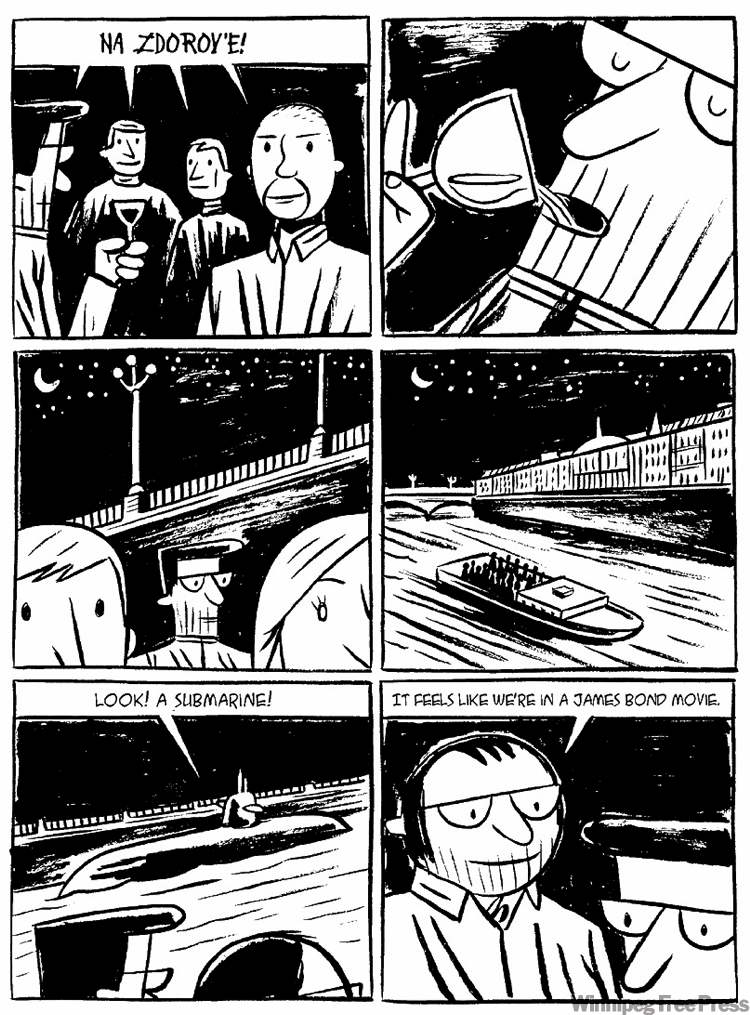
For those who wish to understand what distinguishes the comics medium, this charming graphic novel from Quebec offers no shortage of illustrations.
Philippe Girard’s Ruts & Gullies is the sixth in Conundrum Press’s BDang imprint, formed to translate and expose the work of underground Quebec comics artists. Much of this work has found readers in Europe, but has only slowly become accessible to English-speaking North America.
Girard’s book, in fact, concerns his and fellow Quebec comics artist Jimmy Beaulieu’s trip to Russia, in part to promote their work.
Where overall narrative is concerned, though, Ruts & Gullies is very loosely fashioned: it’s more about small moments, anecdotes and observations than overarching plotlines.
And in its own understated fashion, it offers multiple examples of sophisticated comics storytelling. Consider Girard’s use of subtle graphic effects, as when various figures become wavy and distorted in characters’ dreams.
There’s another bit where Girard tries to place the familiarity of a building’s design, and it shimmers and morphs into the object of his memory’s reference.
Both examples demonstrate comics’ nature as a drawn medium, which allows forms of visual expression not possible even in live action filmmaking.
Then there’s a quiet moment near the book’s end: a two-page spread where the pair pack up and leave their St. Petersburg accommodations. The sequence’s second page uses several panels just to have Girard slowly close the door. There’s a drawn-out poignancy to the scene that quietly conveys the characters’ feelings.
If there is anything in Girard’s technique to criticize, it is perhaps its underdevelopment. There are panels, for instance, that disregard the laws of perspective for no apparent reason: heads in the foreground appear smaller than those in the background, on account of what looks like just sloppy drawing.
Yet other sequences, such as the characters’ flights to and within Russia, showcase sharper draftsmanship.
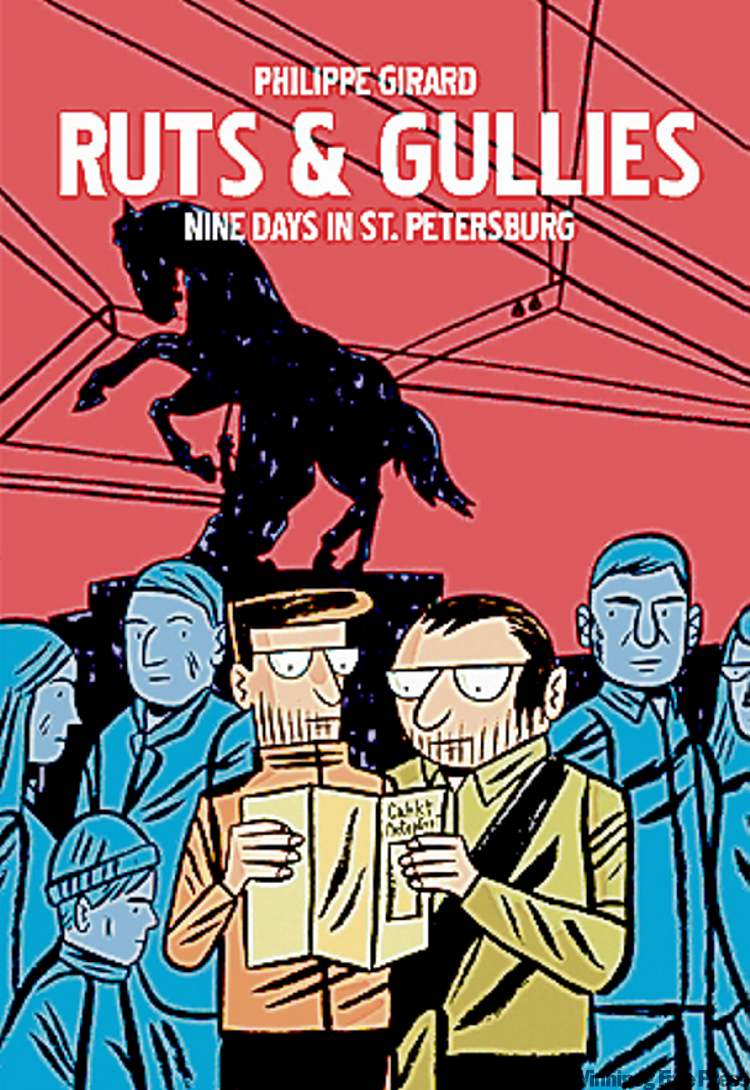
Overall, Girard’s simple style is disarmingly direct, even winning. There’s a cartoonish look at times that recalls the work of Quebecers Michel Rabagliati (the Paul series) and Guy Delisle (Burma Chronicles).
Like fellow underground Quebec artist Line Gamache (Hello, Me Pretty, POOF!), Girard is unabashed about throwing in moments of magical realism. Whether it’s Lenin and Stalin looming during his flight, his dead friend Guillaume materializing for conversations, or framed art commenting on disagreeable security guards, he treats such moments as perfectly natural parts of the narrative.
Ruts & Gullies also resembles Delisle’s Burma Chronicles in its observations of a foreign milieu. Take the building Girard and Beaulieu stay in: it’s strikingly handsome from the outside, and also on the inside — at least, for the first couple of floors. It’s a simple example of Communist Russia’s propagandistic legacy.
Like Delisle, Girard’s vantage point allows only limited opportunity to expose the underlying rot; the book can’t match the gold standard in foreign correspondence set by Joe Sacco (Palestine, Footnotes in Gaza). But that’s not really the subject anyway.
What is? Seemingly, what Girard was feeling and thinking about at the time, in no particular order. Some may consider Ruts & Gullies sketchy and undercooked, but it doesn’t seem to be trying for anything more.
It’s content to be a little free, a little meandering. That’s life, after all, is what seems to be its point.
Kenton Smith a Winnipeg freelance writer and comics enthusiast.