

Looking for common sense in schools
Advertisement
Read this article for free:
or
Already have an account? Log in here »
To continue reading, please subscribe:
Digital Subscription
One year of digital access for only $1.44 a week*
- Enjoy unlimited reading on winnipegfreepress.com
- Read the E-Edition, our digital replica newspaper
- Access News Break, our award-winning app
- Play interactive puzzles
*Billed as $5.77 plus GST every four weeks. After 52 weeks, price increases to the regular rate of $19.95 plus GST every four weeks. Offer available to new and qualified returning subscribers only. Cancel any time.
To continue reading, please subscribe:
Add Free Press access to your Brandon Sun subscription for only an additional
$1 for the first 4 weeks*
- Enjoy unlimited reading on winnipegfreepress.com
- Read the E-Edition, our digital replica newspaper
- Access News Break, our award-winning app
- Play interactive puzzles
*Your next Brandon Sun subscription payment will increase by $1.00 and you will be charged $17.95 plus GST for four weeks. After four weeks, your payment will increase to $24.95 plus GST every four weeks.
Read unlimited articles for free today:
or
Already have an account? Log in here »
Hey there, time traveller!
This article was published 19/03/2011 (5558 days ago), so information in it may no longer be current.
What’s Wrong with Our Schools
and How We Can Fix Them
By Michael C. Zwaagstra, Rodney A. Clifton, and John C. Long
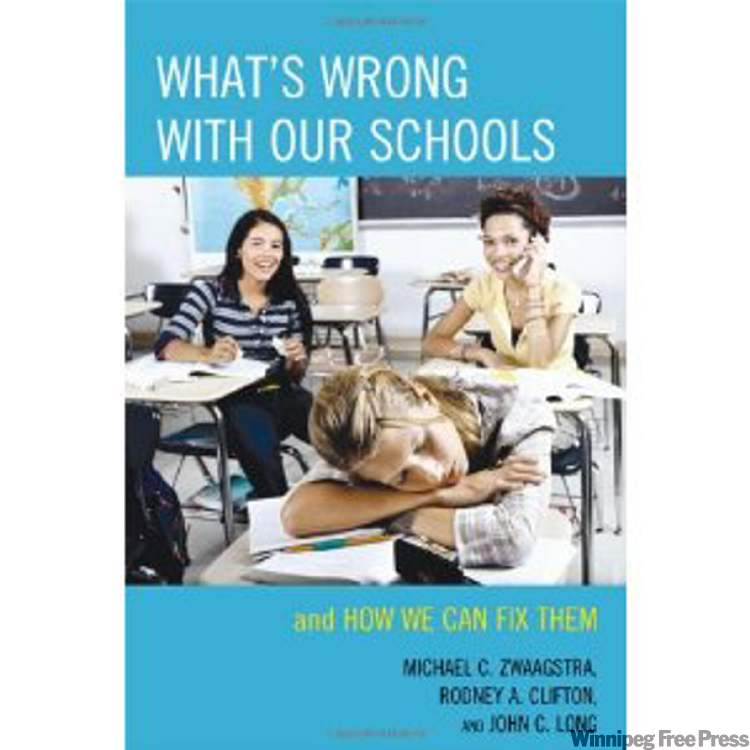
Rowan & Littlefield, 190 pages, $22
Whatever happened to common sense in education? These three Manitoba educators come out swinging with the question and they finish with a blast at teachers’ organizations.
In between they spell out the basics of public schooling as they think it once was and should be again.
Michael Zwaagstra is a teacher and an associate with the Frontier Centre for Public Policy. Rodney Clifton is a much published professor in the faculty of education at the University of Manitoba. John Long is a senior scholar at that same university.
The trouble with schools, according to their analysis, is that they have strayed from the purpose of using “intelligence and talents in a balanced pursuit of the good life.”
Instead of promoting standards of excellence or the preparation of knowledgeable and skilful graduates, they have adopted nebulous notions of “community building” or fostering the “unique needs of each child.”
Schools, they argue, have fallen into the hands of misguided souls who seem to have forgotten that graduates need to be familiar with the important ideas and achievements in the sciences, literature and the arts — as well as a basic understanding of at least “their own nation’s history, society, and government.”
These three veterans in the field of education bring considerable expertise to the challenge of restoring common sense to public schooling. They argue for a kind of “back to basics” approach.
They oppose what they scorn as the “romantic progressive educators.” Zwaagstra and company have nothing but disdain for the educator element attracted by non-rigorous teaching styles.
They see the curriculum as having been diluted to a “hodgepodge of incoherent exercises” where students learn “practically nothing of substance” or solid communication skills.
Though all are, or have been, associated with university schools of education, they show no reluctance to criticize these institutions. Of course, they direct their fire at the modernists, who seek to reform schooling in child-centred, supposedly humane ways.

They express their views with clarity and vigour. Their defence of direct teaching, sometimes referred to as the “stand up and shout” method, is convincing, as they illustrate the functions of the teacher-centred classroom.
Though direct instruction may be old-fashioned, it can be the most efficient way to convey useful information in the limited amount of time often available in a classroom.
They stress the importance of variety in teaching procedures. They demonstrate a range of activities, from teaching content to testing. They do concede that rigorous education can take many forms, as long as it is focused and monitored. Variety, they acknowledge, is an important element of effective teaching.
Ultimately they declare the need for reversing the current trends to ambiguous curricula and the negative effect of “edu-babble” (jargon). They set out to show what is wrong with schools, and they have put forward their case for improvement.
Ron Kirbyson is a Winnipeg writer and teacher.