Everything you ever wanted to know about cocaine, but…
Advertisement
Read this article for free:
or
Already have an account? Log in here »
To continue reading, please subscribe:

Digital Subscription
One year of digital access for only $205*
- Enjoy unlimited reading on winnipegfreepress.com
- Read the E-Edition, our digital replica newspaper
- Access News Break, our award-winning app
- Play interactive puzzles
*First annual payment billed as $205.00 + GST for one year. This annual subscription will automatically renew at $233.00 + GST every 52 weeks (10% off the regular annual price of $259.35). Offer available to new and qualified returning subscribers only. Cancel any time.
To continue reading, please subscribe:
Add Free Press access to your Brandon Sun subscription for only an additional
$1 for the first 4 weeks*
- Enjoy unlimited reading on winnipegfreepress.com
- Read the E-Edition, our digital replica newspaper
- Access News Break, our award-winning app
- Play interactive puzzles
*Your next Brandon Sun subscription payment will increase by $1.00 and you will be charged $17.95 plus GST for four weeks. After four weeks, your payment will increase to $24.95 plus GST every four weeks.
Read unlimited articles for free today:
or
Already have an account? Log in here »
Hey there, time traveller!
This article was published 20/08/2011 (5510 days ago), so information in it may no longer be current.
An Anatomy of Addiction
Sigmund Freud, William Halsted, and the Miracle Drug Cocaine
By Howard Markel
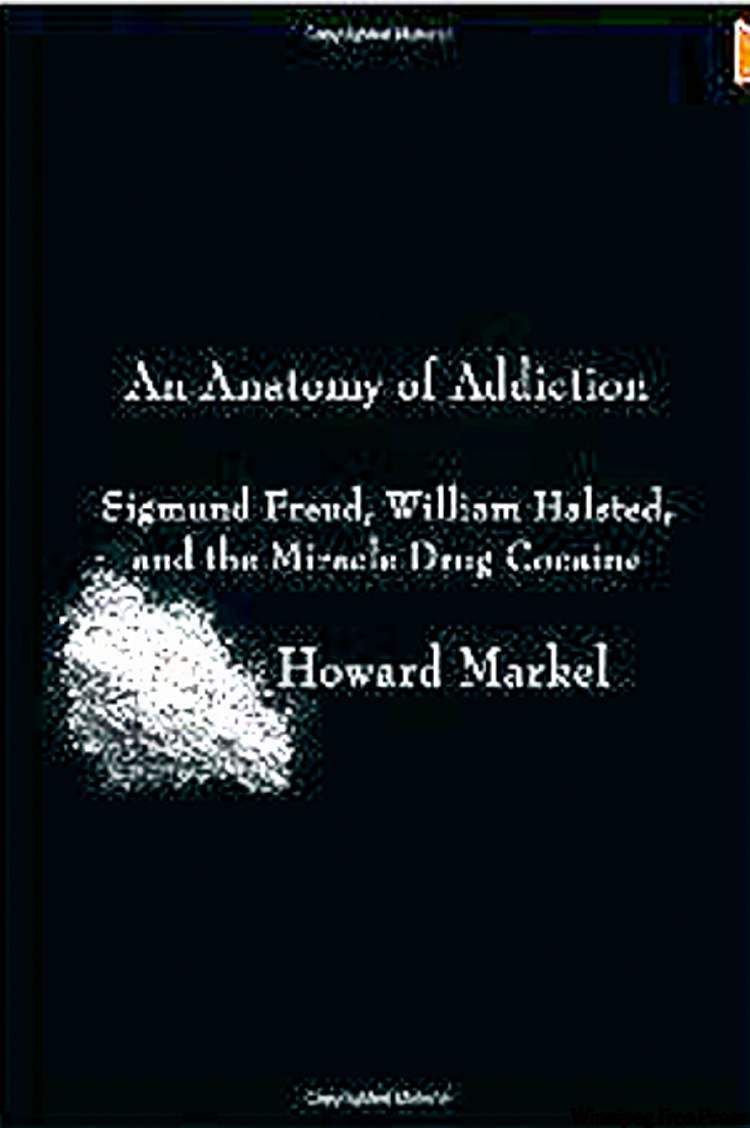
Pantheon Books, 314 pages, $33
THE best medical histories are the ones that cause the imagination to run riot. A fast-rising master of satisfying this human quest for mind-altering willies is the Michigan medical historian Howard Markel.
In An Anatomy of Addiction, Markel turns his attention to a line of inquiry sparked by conversations with patients deeply addicted to cocaine.
His core mission is to expose the origins of cocaine and its addictive nature. To provide an enhanced insight, Markel conveys his account through the histories of Sigmund Freud and William Halsted, two physicians on the leading edge of exploring and discovering significant medical advances to save lives and improve outcomes.
Freud, in Vienna, and Halsted, in New York and later Baltimore, never met. However, in strikingly similar lives, they both worked to prove cocaine’s potential as an anesthetic and treatment for morphine addiction.
More intriguing for Markel, which he methodically details, is Freud and Halsted’s parallel personal experimentation with the drug and the unexpected consequences they suffered.
As was the practice in emerging field of medical science in the 1800s, physicians regularly tested new techniques and promising elixirs on themselves. Freud developed his addiction after self-administering cocaine alkaloid crystals.
Starting in 1884, Freud “on too many days and nights… availed himself of some of the magical drug.” According to Markel, Freud reached the addict’s nadir of “an endless reserve of negative physical, emotional and social consequences,” and in 1896 reported to a colleague and mentor that “the cocaine brush has been completely put aside.”
Markel tentatively attributes Freud’s post-cocaine productivity, including “the dazzling thesis that helped shape The Interpretation of Dreams” to his relentless work schedule, designed to meet “the two touchstones of a successful recovery — daily routines and rigorous accountability.”
Markel’s profile of Halsted, another medical giant and brilliant surgeon, recounts a cocaine addiction far more intractable. Halsted initially administered his cocaine by injection while investigating its anesthetic properties.
Markel notes that Halsted’s “path from scientific investigator to full-blown addict required only a few months.” While making medical history by introducing antiseptic operating theatres and ward rounds, Halsted became equally renowned for his addiction-fuelled offensiveness and erratic behaviour.
Markel describes Halsted’s repeated attempts at recovery, including two admissions to the Butler Institute for the Insane. A devastating experiment to vanquish the cocaine addiction by switching to morphine only enslaved him to both drugs.

The lure of Markel’s work is that he drills down and wide to put the entire context of his topic in view. There is an entire chapter on the discovery of cocaine and its pre-regulatory heyday as an additive to wine and soft drinks.
Markel weaves histories of famous medical institutions like Bellevue Hospital in New York, John Hopkins Hospital and Medical School in Baltimore and Allgemeines Krankenhaus in Vienna into Freud and Halsted’s stories.
And for the visually inclined, there are a whopping 247 black and white photos. About the only thing Markel hasn’t included is the recipe for making cocaine from coca leaves.
Winnipegger Joanne Thibault worked for the Addictions Foundation of Manitoba prior to her recent retirement.