Sly send-ups confirm Coady as comic genius
Advertisement
Read this article for free:
or
Already have an account? Log in here »
To continue reading, please subscribe:

Digital Subscription
One year of digital access for only $205*
- Enjoy unlimited reading on winnipegfreepress.com
- Read the E-Edition, our digital replica newspaper
- Access News Break, our award-winning app
- Play interactive puzzles
*First annual payment billed as $205.00 + GST for one year. This annual subscription will automatically renew at $233.00 + GST every 52 weeks (10% off the regular annual price of $259.35). Offer available to new and qualified returning subscribers only. Cancel any time.
To continue reading, please subscribe:
Add Free Press access to your Brandon Sun subscription for only an additional
$1 for the first 4 weeks*
- Enjoy unlimited reading on winnipegfreepress.com
- Read the E-Edition, our digital replica newspaper
- Access News Break, our award-winning app
- Play interactive puzzles
*Your next Brandon Sun subscription payment will increase by $1.00 and you will be charged $17.95 plus GST for four weeks. After four weeks, your payment will increase to $24.95 plus GST every four weeks.
Read unlimited articles for free today:
or
Already have an account? Log in here »
Hey there, time traveller!
This article was published 03/09/2011 (5482 days ago), so information in it may no longer be current.
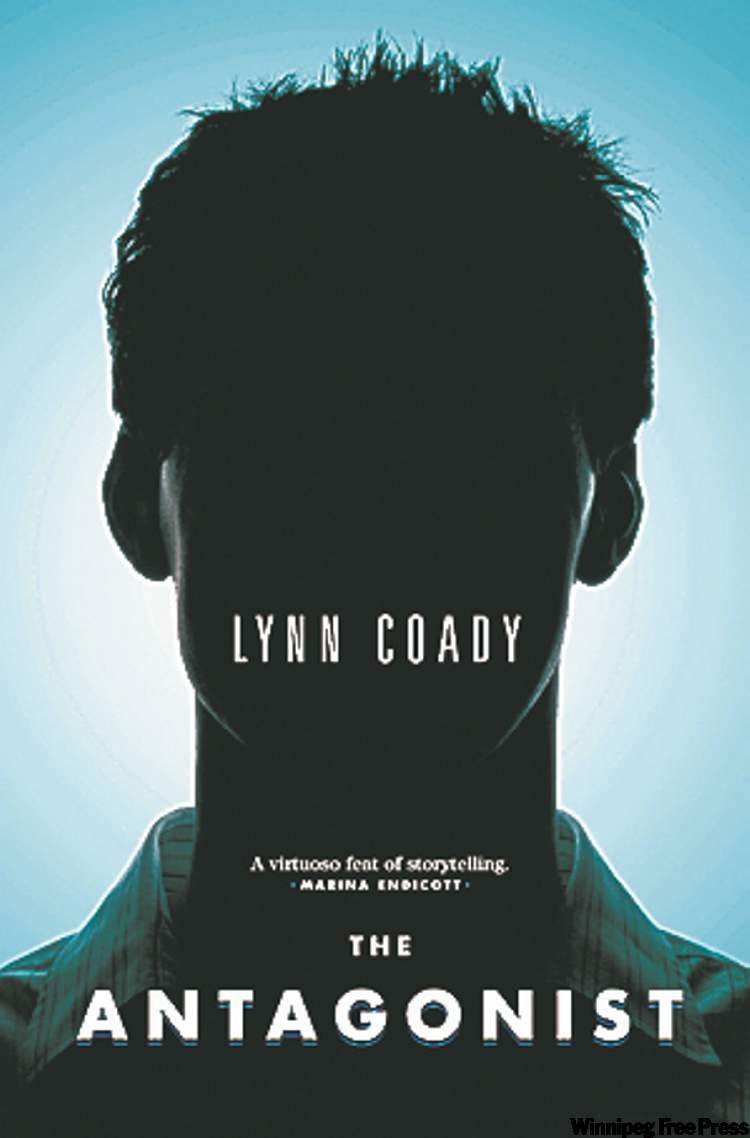
The Antagonist
By Lynn Coady
Anansi, 352 pages, $33

A few pages into this wicked page-turner of a coming-of-age novel, narrator Gord Rankin (Rank) sarcastically growls, “Consider this the first chapter,” as he fires off a late-night email to former university-friend Adam Grix, a “tight-lipped son of a bitch” whose reticence reminds him of another cagey nerd, “actually, the Prime Minister.”
With characteristic energy and skill, CanLit wunderkind Lynn Coady thus sets the tone for her fifth work of fiction in just over a decade.
Composed as a succession of one-sided missives, Rank’s story brilliantly moves between the harrowing and the hilarious. And, just as we do, he gradually realizes that he is composing the autobiography from which Adam picked the threads (in private conversations) and turned into a third-rate novel.
There’s no escaping Coady’s spell: her narrator-emailer is so funny, so poignant and wounded in all his detailed self-revelations that we’re onside from the opening line against this Adam fellow. How dare he publish a book that exploits someone’s agonizing secrets for the sake of a story?
Securing Rank’s sense of injury — that familiar feeling of having been misunderstood and misrepresented — Coady expertly moves us into his point of view and into the world of his menacing sense of humour.
The page becomes the computer screen, with Rank tapping away into our vicarious enjoyment of payback, of what it might feel like to drop all pretense of courtesy and just unstop a monologue of bottled-up outrage.
Revelling in the immediacy of electronic contact and ferreting out Adam from Facebook — the sly use and send-up of which truly confirms Coady as a comic genius — Rank gets Adam where he wants him, telling him to “sit back and enjoy the story” and scoffing at Adam’s weak retaliation: “How do you expect to serve me ‘notice,’ whatever that means. You don’t know where I am.”
From the first page to the last, the capacity for self-invention and cruelty made possible by email is brilliantly mined by one of Canada’s best writers of fiction.
Originally from Nova Scotia, Coady hit the literary ground running in 1998 with Strange Heaven, a debut novel marked by such melancholic hilarity that it’s hard to believe she was only in her 20s when she published it.
Moving to the other side of the country, she followed it up from Vancouver with a story collection, Play the Monster Blind. Currently in Edmonton, Coady has since published three more novels — Saints of Big Harbor, Mean Boy and now The Antagonist — in what has become a consistently gifted and highly recommended body of work.
In The Antagonist, she returns to a setting that she knows well: small-town Canada, circa 1970-1990. Because she never names the town, Rank’s struggles become framed in a wider lens.
His history could be pulled from anywhere in white, suburban Canada: he grows up in a nondescript place, learns to play hockey, goes to school and works in his father’s business. But Coady’s sympathetic exploration of how hard it is to be young makes this history intriguing. That, and her staging of the tragedies that Rank must survive — the accidents of fate that crash into his already-difficult adolescence.
In order to find his way in the world, Rank has to face and comprehend his crazy little father, Gord Rankin Sr., a character who seems modelled on some of William Faulkner’s most insanely comical figures — the wiry, diminutive kind who are still reeling from the South’s loss of the American Civil War two generations earlier and who smugly wipe their dung-soiled boots on the white carpets of their social and physical superiors in acts of petty vengeance.
When we first meet Gord Sr., it is in Rank’s recollection of the story of his adoption, told and told retold by Gord to his own great amusement: how the soon-to-be father famously shoots his mouth off at the convent-orphanage, marveling at Rank’s size as an infant. “The little bastard,” he says to the shocked nuns, “looks old enough to drive.”
Entirely unlike his father in build and temperament, Rank struggles to detach from Gord and from the ways in which Gord attempts to define his son as some kind of hulking reflection of himself.
This eerie motif involving reflections and mirrors runs throughout the novel, which is made steadily richer by scenes in which people hide behind transparent barricades, glasses, or windows, leaving others to thrash around in the waves of sorrow on the other side. The computer screen forms part of this motif, too, and Rank uses it both as a mirror and a blank page in an energetic experiment with narrative form.
Rank’s progression of emails not only builds the story but also breaks it open for interpretation. The tale is filled with surprises and depths of intelligence. It also presses against Adam’s silence, leaving us to wonder if Adam is reading these emails at all — if he is even there, on the receiving end of things.
As Coady layers complexity of theme and image into Rank’s developing autobiography, she delves into the notions of perspective and projection, forcing us to contemplate how we are all fictional characters in each other’s lives and tales. The biggest fiction may just be God, more reticent and unforthcoming than Adam Grix, more aloof and pitiless than Stephen Harper.

In this coming-of-age tale, male friendships and relationships are explored in all their goofiness and complexity. What Rank needs from Gord, or God, or Adam becomes part of his own self-interrogation.
There’s a point in the novel when Rank recalls Adam writing an essay on Satan in Milton’s Paradise Lost — on whether it’s possible to see the devil in the role of a hero.
This is Coady’s hint that things aren’t what they seem, that protagonists and antagonists sometimes switch places and that redemption follows only from being open to the possibility of such transformations in others.
Dana Medoro is a professor in the department of English, film and theatre at the University of Manitoba.
Related Articles
On the Night Table: Art DeFehr
Advertisement Advertise With Us
Advertisement Advertise With Us
History
Updated on Sunday, September 4, 2011 2:44 PM CDT: Corrected typos in lede