WEATHER ALERT

Iago novel imagines aftermath of Bard’s play

Advertisement

Advertise with us

IAGO, the villain of William Shakespeare's Othello, has both fascinated and puzzled critics in the centuries since the play's first performance.

Read this article for free:


or

Already have an account? Log in here »

To continue reading, please subscribe:

Subscribe and receive a limited-edition Free Press branded hat or tote.

Digital Subscription

One year of digital access for only $205*

  • Enjoy unlimited reading on winnipegfreepress.com
  • Read the E-Edition, our digital replica newspaper
  • Access News Break, our award-winning app
  • Play interactive puzzles

*First annual payment billed as $205.00 + GST for one year. This annual subscription will automatically renew at $233.00 + GST every 52 weeks (10% off the regular annual price of $259.35). Offer available to new and qualified returning subscribers only. Cancel any time.

To continue reading, please subscribe:

Add Free Press access to your Brandon Sun subscription for only an additional

$1 for the first 4 weeks*

  • Enjoy unlimited reading on winnipegfreepress.com
  • Read the E-Edition, our digital replica newspaper
  • Access News Break, our award-winning app
  • Play interactive puzzles
Start now

*Your next Brandon Sun subscription payment will increase by $1.00 and you will be charged $17.95 plus GST for four weeks. After four weeks, your payment will increase to $24.95 plus GST every four weeks.

Opinion

Hey there, time traveller!
This article was published 07/01/2012 (5343 days ago), so information in it may no longer be current.

IAGO, the villain of William Shakespeare’s Othello, has both fascinated and puzzled critics in the centuries since the play’s first performance.

Commentators and adapters have struggled to make sense of the seeming senselessness of Iago’s villainy, with one critic famously concluding that Iago is “a motiveless malignity.”

In this uneven historical novel, Englishman David Snodin, producer and writer of a number of TV movies, imagines the aftermath of Shakespeare’s play. The story shifts through a range of narrative perspectives, which serve both to remind the reader of the essential elements of the play and to introduce us to Snodin’s vision of 16th-century Venice, ripe with vendetta, sewage-choked canals and garrulous prostitutes.
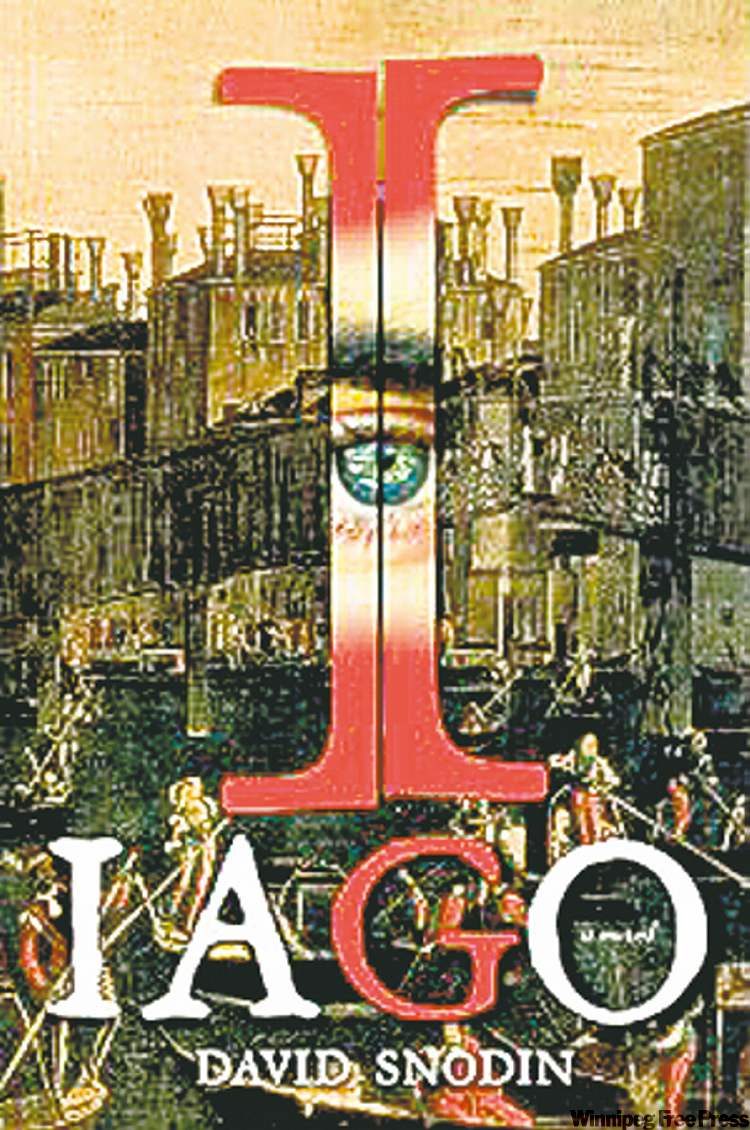
The novel follows three characters: Iago, who has escaped the custody of the Venetian authorities; the inquisitor Annibale Malipiero, who is charged not only with capturing Iago, but also with making sense of the violence Iago has loosed on Venice; and the bookish, virginal Gentile Stornello, who accompanies Iago in his flight from Venice.

Gentile, whose narration supplies most of our exposure to Iago, is an overeducated weakling, despised by his father, overshadowed by his breezily muscular soldier brother, and tormented by his nemesis Jacopo, the handsome, violent scion of the Malipiero family.

It is by way of one of his conflicts with Jacopo that Gentile comes to the attention of his uncle Annibale, who sees Gentile as a tool to ferret out Iago’s motives for causing the deaths of Othello and his wife, Desdemona.

Annibale places Gentile in a cell with the taciturn Iago, who hasn’t spoken since the final scene of Othello, and then engineers their escape from the Venetian Prigioni Ducale so that he can follow them and discover Iago’s motives.

The events leading up to the escape comprise the first half of Snodin’s book, which moves more slowly than it needs to, bogged down by repeated confrontations with Jacopo and his clan, and a Romeo and Juliet-inspired subplot in which Gentile pines for Jacopo’s servant-cum-mistress Franceschina.

This section underscores the novel’s biggest problem: Snodin is a much better plotter than he is a writer. As long as the story stagnates in Venice, the reader must endure Gentile’s adolescent, poetry-inspired romantic fantasies, made less tolerable by Snodin’s uneven prose.

Once the characters leave Venice, Iago, who is far more interesting than his young companion, becomes central, and the story becomes more engaging as it moves inexorably towards the answer to the question that Annibale, like four centuries of readers, can’t help asking: why?

Snodin worked as script editor for the BBC/Time-Life adaptations of Shakespeare’s plays in the 1980s and his familiarity with his source text is fully on display in the novel. Characters repeatedly echo lines not only from Othello but from a number of Shakespeare’s plays.

One of these lines, “I am not what I am,” serves as an epigraph to the novel. It is a quintessential expression of Iago’s nihilistic world view, a refusal to be analysed and understood. Snodin’s Iago, though, emphatically is what he is, as the story’s slow trek through the Italian countryside moves ever closer, in terms of both geography and narrative, to the source of Iago’s malevolence.

It is a journey that ends, as it seems all post-Freudian accounts of evil must, with sexual trauma suffered in childhood.

This is perhaps the most disappointing aspect of the novel, betraying as it does the most unsettling aspect of Shakespeare’s play. Whereas Shakespeare’s Othello reveals to us monstrosity disguised as mundanity, Snodin’s Iago only manages to make the monstrous mundane.


Brandon Christopher teaches Shakespeare at the University of Winnipeg.
Report Error Submit a Tip

More Stories

Frustration mounts as drug raids sweep problems out of downtown, into West End

Scott Billeck 7 minute read Preview

Frustration mounts as drug raids sweep problems out of downtown, into West End

Scott Billeck 7 minute read Friday, Aug. 21, 2026

West End business owners say their neighbourhood has been under siege for months, and some believe downtown police drug sweeps have made things worse by pushing more street disorder in their direction — and pushing customers away.

Read
Friday, Aug. 21, 2026

Conservatives call on government to release U.S. trade offer details

Nick Murray, The Canadian Press 4 minute read Preview

Conservatives call on government to release U.S. trade offer details

Nick Murray, The Canadian Press 4 minute read Updated: Yesterday at 3:17 PM CDT

OTTAWA - Federal conservatives are calling on the government to release the full details of the trade offer from the United States that Canada rejected this week.

In a letter to Trade Minister Dominic LeBlanc, Canada-U.S. relations critic Shuvaloy Majumdar said while his party supports the government's decision to reject the deal, Parliament is in the dark on what was on the table.

"If there was a draft text of any agreement that both governments have seen, please release it. The U.S. administration has seen it. Your government has seen it. Canadians deserve to see it," Majumdar wrote.

"Even after addressing Canadians and the media, the public and Members of Parliament still remain in the dark on your government's demands in negotiations with the Trump administration.

Read
Updated: Yesterday at 3:17 PM CDT

‘We got attacked’: Carney says retaliatory tariffs on U.S. to take effect next month

Catherine Morrison and David Baxter, The Canadian Press 7 minute read Preview

‘We got attacked’: Carney says retaliatory tariffs on U.S. to take effect next month

Catherine Morrison and David Baxter, The Canadian Press 7 minute read Saturday, Aug. 22, 2026

OTTAWA - Prime Minister Mark Carney says retaliatory tariffs will hit the U.S. starting next month after Canada walked away from what he called a "bad deal."

The U.S. introduced new 50 per cent tariffs on billions of dollars in Canadian exports on Saturday after trade talks failed.

"We got attacked," Carney told reporters on Parliament Hill Saturday when asked about the escalating trade war.

Carney suspended talks with the United States late Friday and summoned his negotiators back to Ottawa.

Read
Saturday, Aug. 22, 2026

Free Press arts team shares books for passing the dog days

4 minute read Preview

Free Press arts team shares books for passing the dog days

4 minute read 6:00 AM CDT

When most people mention a “summer read” or a “beach book,” the types of writing they’re referring to is lighter fare most of us would consider enjoyable but not overly profound: think cosy mysteries, historical bodice rippers, otherworldy romantasies, fast-paced whodunits, chilling (but not too chilling) horror and, notably as of late, romance novels of all persuasions — perhaps, say, between two hockey players?

But not everyone dives into such popular picks over the summer months. Here’s what the Free Press arts and life team has been poring over in the past months…

Temporary Palaces, by Jeff Miller

If you spent your youth in the late 1990s/early 2000s going to protests, making zines, DIY art or punk rock — or, failing that, reading about it all in Adbusters magazine — and consider yourself a hopeless romantic, this new novel from Nova Scotia’s Jeff Miller is for you. Themes of idealism, artistic integrity, heartbreak and shared trauma are all on the menu for this will-they-won’t they pairing of punk rocker Ben and visual artist Alex, set amid the squats of Ottawa and the art lofts of Montreal.

Read
6:00 AM CDT

The good, bad and record setting performance in Bombers loss to Elks

Joshua Frey-Sam 7 minute read Preview

The good, bad and record setting performance in Bombers loss to Elks

Joshua Frey-Sam 7 minute read Saturday, Aug. 22, 2026

The Winnipeg Blue Bombers’ 22-19 defeat at the hands of the Edmonton Elks at Commonwealth Stadium in Alberta on Friday was fitting for all the wrong reasons.

The Bombers looked reinvigorated as they jumped out to a 16-point lead in the first half. Then some bad habits reared their ugly head, as the Elks roared back with 19 straight points before kicker Vincent Blanchard walked it off with a 40-yard field goal.

A night that began with so much promise left many fans to wonder what the ceiling actually is for this team in 2026.

On offence, Zach Collaros completed 19 of 30 passes for 219 yards, one touchdown and an interception; Brady Oliveira amassed 118 yards on 16 carries and added a pair of catches for 11 yards; and Nic Demski secured five grabs for 80 yards.

Read
Saturday, Aug. 22, 2026

Downtown Rudy’s restaurant announces closure

1 minute read Yesterday at 1:55 PM CDT

A downtown eatery has announced its closure.

Rudy's Eat and Drink, located on the main floor of the Manitoba Hydro building at 375 Graham Ave., posted on social media that the restaurant would be closing after "one last hurrah" on Friday, Aug. 21.

"With heavy hearts it is time to announce that Rudy’s will officially be closing its doors after an incredible 15 years," the post reads.

The post gave no reason for the closure. Rudy's and other restaurants in the building expressed concerns after an assault and resulting lockdown at Hydro Place in late January.