Finding the true meaning of cowardice, courage
Advertisement
Read this article for free:
or
Already have an account? Log in here »
To continue reading, please subscribe:

Digital Subscription
One year of digital access for only $205*
- Enjoy unlimited reading on winnipegfreepress.com
- Read the E-Edition, our digital replica newspaper
- Access News Break, our award-winning app
- Play interactive puzzles
*First annual payment billed as $205.00 + GST for one year. This annual subscription will automatically renew at $233.00 + GST every 52 weeks (10% off the regular annual price of $259.35). Offer available to new and qualified returning subscribers only. Cancel any time.
To continue reading, please subscribe:
Add Free Press access to your Brandon Sun subscription for only an additional
$1 for the first 4 weeks*
- Enjoy unlimited reading on winnipegfreepress.com
- Read the E-Edition, our digital replica newspaper
- Access News Break, our award-winning app
- Play interactive puzzles
*Your next Brandon Sun subscription payment will increase by $1.00 and you will be charged $17.95 plus GST for four weeks. After four weeks, your payment will increase to $24.95 plus GST every four weeks.
Read unlimited articles for free today:
or
Already have an account? Log in here »
Hey there, time traveller!
This article was published 28/04/2012 (5271 days ago), so information in it may no longer be current.
IN Irish author John Boyne’s seventh novel, it doesn’t take the stranger in the English pub long to identify protagonist Tristan Sadler’s emotional problems — he is full of guilt, and he hates himself.
The 20-year-old veteran of the Great War had travelled from London to Norwich to see the sister of a fellow soldier who had been executed for cowardice.
The nominal reason for the visit is to return letters to Marian Bancroft that she had written to her brother Will while he was in the army. More important, he hopes to work up the courage to share the reason for his guilt with Marian, and ease his burden.
His guilt is a complex brew of sexual and moral attitudes that fuels his self-loathing and drives the narrative along its path in search of the true meaning of cowardice and courage.
The story unfolds as Tristan and Marian stroll through Norwich, where people are still recovering physically and mentally from the savagery of the Great War, and no one likes to talk about their experiences “over there.”
A melancholy mood hangs over The Absolutist, as the author peels back the layers of a complex personal relationship and lays bare the hopelessness of a war where the only clearly defined objective a soldier had was to survive for another day.
Boyne’s novel taps into a vein of moral ambiguity about the war, and the rising, although never huge, pacifist sentiment in Britain, where by the end of the conflict, up to 20,000 British men of military age had refused the draft.
While the story flows seamlessly between Norwich, the army training camp at Aldershot and the trenches of northern France, The Absolutist is difficult to read, not because of its style, but because readers must wrestle with their own moral judgments.
Boyne is best known for his 2006 young adult novel, The Boy in the Striped Pyjamas, which was adapted into an acclaimed movie. In The Absolutist, Boyne is at his best chronicling the visceral, emotional struggles and debates between Tristan and his doomed friend, Will.
Readers cannot help but be dragged into the arguments, and it is easy to forget they are two teenagers, numbed by war, trying to make critical moral decisions.
They had become friends, and later lovers, at the training camp in Aldershot in 1916. This intermittent, but intense relationship, carried over to the trenches in northern France, and in many cases, clouded Tristan’s judgment.
Tristan had been expelled from school following a homosexual incident in class, and was thrown out of his home by his father, who said it would be better for everyone if the Germans killed him.
The seeds of doubt about war have been planted, and Will carries these through the horrors of the trenches. He eventually surrenders his weapons, and declares himself to be an “absolutist” — someone who will do nothing to further the war effort. Tristan tries to talk him about this decision, urging him to put his moral concerns aside “Just until it’s all over.”

But Will is adamant. In order for his objection to have any point, he says, it must be made while the fighting is still going on. He says Tristan is the real coward for going along with the system. Boyne does not pass judgment on the debate, but leaves the reader to decide.
Setting the physical stage — the trenches of northern France — for this debate is not, unfortunately, as well handled as the moral arguments. Boyne leaves the impression that he has simply picked from a Harrods catalogue of war props and plopped them in as backdrop for the debate.
This is not a fatal flaw, but it would be easier for readers to feel the debate if they had a better feeling for the setting. The arguments are not academic abstractions, but soldiers’ gut-level morality born in the trenches.
Gordon Arnold is a recently retired Free Press copy editor.
Book review
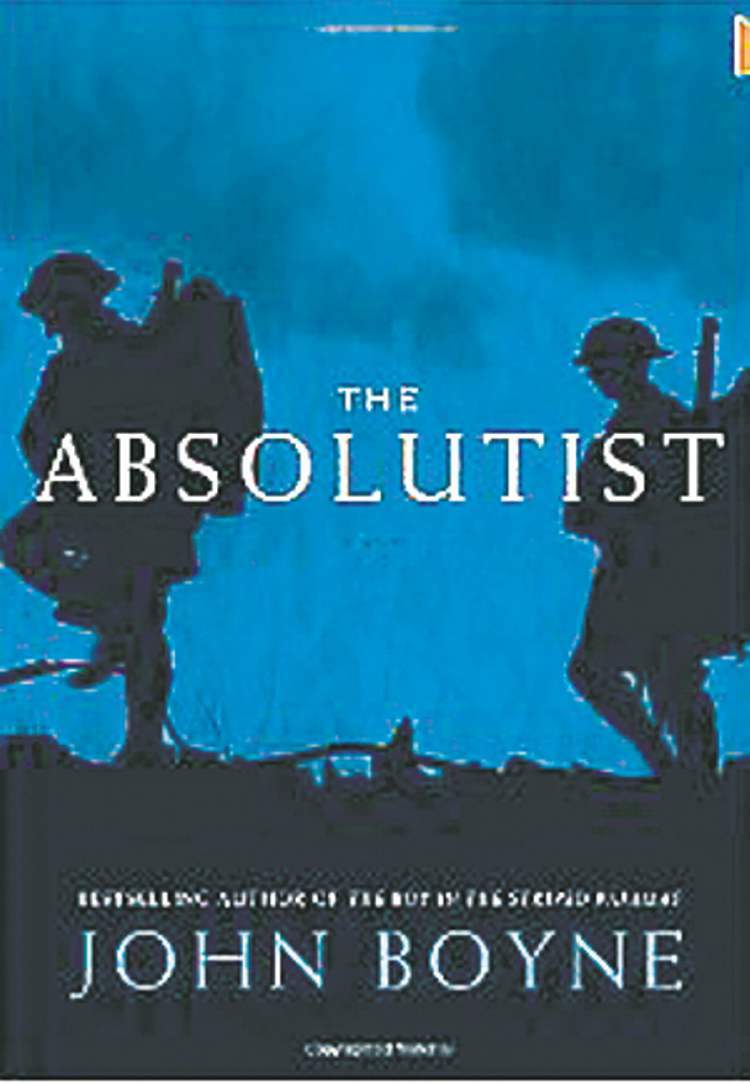
The Absolutist
- By John Boyne
- Doubleday Canada, 309 pages, $25
Related Articles
British country house anchors social satire
Advertisement Advertise With Us
Advertisement Advertise With Us