Ike knew how to bluff in Cold War poker
Advertisement
Read this article for free:
or
Already have an account? Log in here »
To continue reading, please subscribe:
Digital Subscription
One year of digital access for only $1.44 a week*
- Enjoy unlimited reading on winnipegfreepress.com
- Read the E-Edition, our digital replica newspaper
- Access News Break, our award-winning app
- Play interactive puzzles
*Billed as $5.77 plus GST every four weeks. After 52 weeks, price increases to the regular rate of $19.95 plus GST every four weeks. Offer available to new and qualified returning subscribers only. Cancel any time.
To continue reading, please subscribe:
Add Free Press access to your Brandon Sun subscription for only an additional
$1 for the first 4 weeks*
- Enjoy unlimited reading on winnipegfreepress.com
- Read the E-Edition, our digital replica newspaper
- Access News Break, our award-winning app
- Play interactive puzzles
*Your next Brandon Sun subscription payment will increase by $1.00 and you will be charged $17.95 plus GST for four weeks. After four weeks, your payment will increase to $24.95 plus GST every four weeks.
Read unlimited articles for free today:
or
Already have an account? Log in here »
Hey there, time traveller!
This article was published 27/10/2012 (5106 days ago), so information in it may no longer be current.
THIS well-written volume of 20th-century history details how a great American wartime general managed to avoid war during his time in the White House a few years later.
There are dozens of books about Dwight D. Eisenhower (president from 1953 to 1961), ranging from full-blown biographies, like Stephen Ambrose’s Eisenhower: Soldier and President and Eisenhower in War and Peace by University of Toronto professor Jean Edward Smith, to monographs dealing with specific issues like David Nichols’ Eisenhower 1956.
American journalist Evan Thomas’s book is an interesting addition to the list and worth a look because he reveals a side of Eisenhower that may not be familiar to most people.
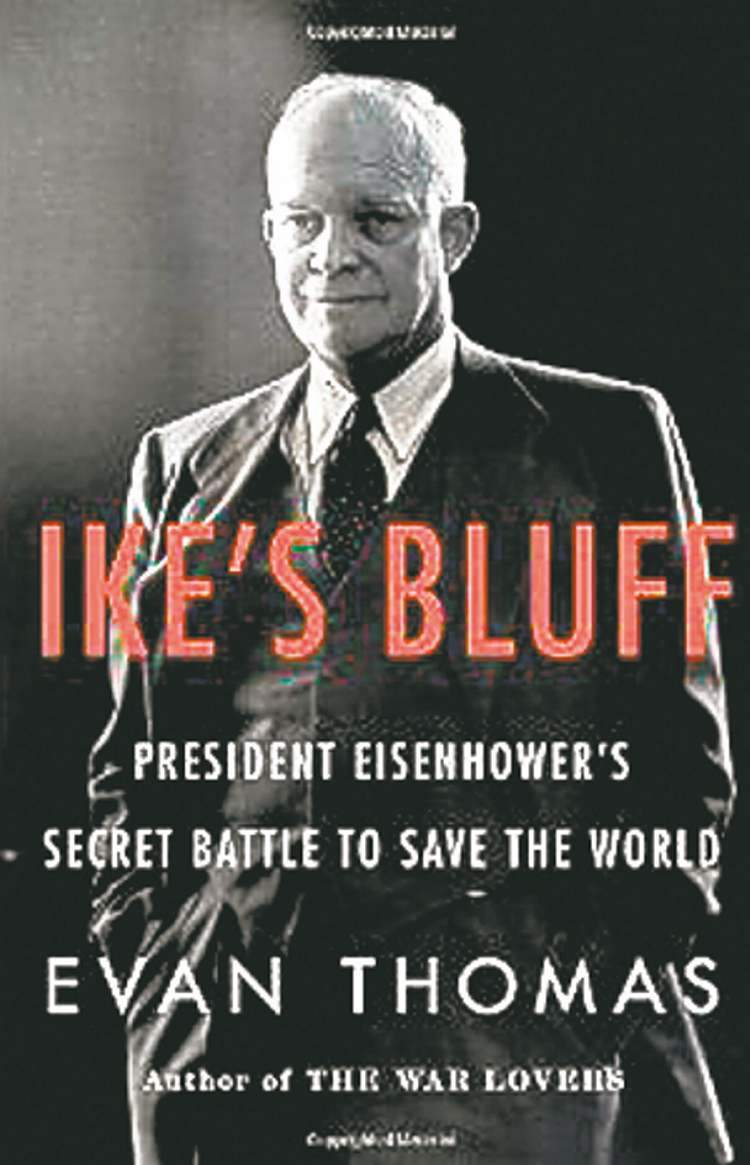
Intended for the general reader, Ike’s Bluff shows us a president who, affable and fatherly on the surface, was often in turmoil over the threat of nuclear war.
Unlike many Pentagon officials, the former supreme commander of the Allied Forces who had sent hundreds of thousands of men to their deaths in the war against Hitler opposed pouring billions into the buildup of the military.
He wanted, in Thomas’s words, “to stop global communism without spending America into bankruptcy or forcing it to become a garrison state run by a military dictatorship.”
Ike relied instead on creating the impression that he would not hesitate to use the American nuclear arsenal. On a number of occasions he simply bluffed the Russians into backing down, gambling that they would fear the results of nuclear war as much as he did.
He carefully avoided “limited war” because he understood that small wars often become big ones. The fate of America in Vietnam would soon prove him right.
Thomas reveals that Eisenhower had a terrible temper. If he lost at cards or golf he could explode, on one occasion injuring his doctor when he threw a golf club at him.
Thomas sees his temper as a product of the tension between his need to show the world a calm face while at the same time suffering through the stress of knowing just how dangerous the situation often was.
There were many occasions when Eisenhower played his cards close to his vest, leading his opponents to condemn him for being out of touch or even cowardly. Thomas consistently argues that Ike’s caginess was good strategy and almost always got him what he wanted.

Indeed, he describes Eisenhower as “the most subtle and brutal strategist of the nuclear age,” giving as one example his blocking a massive loan repayment to Britain until she abandoned her attempt to wrest control of the Suez Canal from the Egyptians.
Perhaps Ike’s greatest disappointment came late in his presidency in a situation where bluffing did not pay off. On the eve of the first disarmament talks with Khrushchev in 1960, an American U2 spy plane crashed in Russia, destroying the relationship of trust he had worked very hard to build with the Communist leader.
The book leaves us with a new appreciation of this man who, at an age when most people are retired and in spite of failing health, stayed on through two terms in the White House because he understood that only he had the stature and influence to avoid nuclear war.
Jim Blanchard is a librarian at the University of Manitoba and a local historian.
Book review
Ike’s Bluff
President Eisenhower’s Secret Battle to Save the World
- By Evan Thomas
- Little, Brown and Co., 465 pages, $33
Related Articles
New in paper
Advertisement Advertise With Us
Advertisement Advertise With Us
History
Updated on Saturday, October 27, 2012 12:45 PM CDT: adds fact box