Sci-fi author knows to keep series fresh
Advertisement
Read this article for free:
or
Already have an account? Log in here »
To continue reading, please subscribe:
Digital Subscription
One year of digital access for only $1.44 a week*
- Enjoy unlimited reading on winnipegfreepress.com
- Read the E-Edition, our digital replica newspaper
- Access News Break, our award-winning app
- Play interactive puzzles
*Billed as $5.77 plus GST every four weeks. After 52 weeks, price increases to the regular rate of $19.95 plus GST every four weeks. Offer available to new and qualified returning subscribers only. Cancel any time.
To continue reading, please subscribe:
Add Free Press access to your Brandon Sun subscription for only an additional
$1 for the first 4 weeks*
- Enjoy unlimited reading on winnipegfreepress.com
- Read the E-Edition, our digital replica newspaper
- Access News Break, our award-winning app
- Play interactive puzzles
*Your next Brandon Sun subscription payment will increase by $1.00 and you will be charged $17.95 plus GST for four weeks. After four weeks, your payment will increase to $24.95 plus GST every four weeks.
Read unlimited articles for free today:
or
Already have an account? Log in here »
Hey there, time traveller!
This article was published 01/12/2012 (5072 days ago), so information in it may no longer be current.
The Fractal Prince
By Hannu Rajaniemi
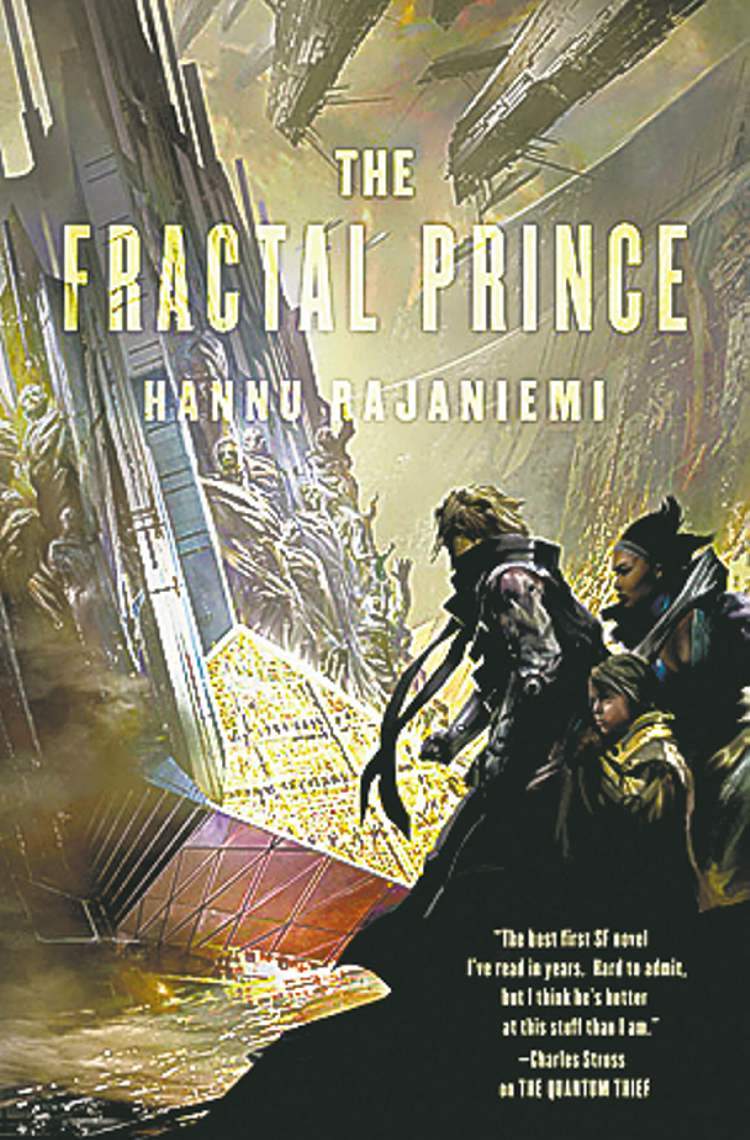
Tor Books, 336 pages, $30
FINNISH-BORN U.K. sci-fi writer Hannu Rajaniemi presents his latest novel amid a fair amount of publishing buzz. As the followup to his much-lauded 2010 debut, The Quantum Thief, this sophomore effort had a lot to live up to. By and large, it delivers.
In that first novel, Rajaniemi combined diamond-hard science-fiction with the classic narrative conceits of Maurice LeBlanc’s popular Arsène Lupin series.
The setting was a Martian city called “the Oubliette,” based on French culture with some truly alien social aspects. The plot was your classic caper, centring on the heist of a quantum object — a challenge even for the venerable Jean le Flambeur, a gentleman thief of legendary status throughout the solar system.
But Mars is just a dot in the rear-view mirror in this new adventure. Instead, we find ourselves in the city of Sirr, on Old Earth, a futuristic analogue of ancient Arabia. In this place, uploaded human minds, known as gogols elsewhere, roam the desert via a previous civilization’s embedded cloud-computing infrastructure.
The most desperate and ruthless of these are feared as potential body thieves, constantly prodding and encroaching on the electronic defences of the city. Still other minds, some human, some post-human, serve the citizens of the city as summoned jinni, though they aren’t brought forth by rubbing a lamp, and won’t grant just any wish.
The all-pervasive environmental technology can also create pseudo-magical seals against marauding “wildcode,” and summon up magical carpets as emergency transport, though only if one knows the proper code words. Like the “open sesame” of Ali Baba, magic words feature heavily here.
The secondary protagonist of this novel is Tawaddud, for all intents and purposes a princess of Sirr. The black sheep of the ruling family, she wishes to prove her worth to her sister and widowed father.
Given some persistence on her part, she wins the task of investigating the mysterious death of a political ally (just before a critical vote). She can’t know what dark secrets she will uncover along the way. And of course, she has no idea the famous Flambeur will soon arrive in Sirr with his own schemes.

Thematically, these sections of the novel riff heavily on the One Thousand and One Nights. Muslim creatures of myth aside, Rajaniemi plays a lot with the idea of storytelling as a magician’s art, though with a sci-fi twist. Fiction is outlawed in Sirr, in part because body thieves use forbidden tales as Trojan horses to crash minds and hijack genetic programming.
There are also references galore to both science-fictional tropes and real-life work in artificial intelligence, information theory and mathematics. Astute readers will note the influence of Douglas Hofstadter: consciousness as a self-referential process (an infinite loop) is mentioned explicitly. But Rajaniemi also includes a short story whose ending leads back to its beginning, implying the same concept.
Stories within stories, nested frames of reference, these were also a major feature of Scheherezade’s ongoing story from the original One Thousand and One Nights. Both literature and math nerds will find plenty of Easter eggs to geek out about throughout Rajaniemi’s text.
This new author already understands the necessity of keeping things fresh in an ongoing series, and The Fractal Prince is well-served by the new characters and novel setting. No word yet on where Flambeur’s long con will take the series next.
Joel Boyce is a Winnipeg writer and teacher.