Famous prof argues traditional cultures have lessons for modern society
Learning from the past
Advertisement
Read this article for free:
or
Already have an account? Log in here »
To continue reading, please subscribe:

Digital Subscription
One year of digital access for only $205*
- Enjoy unlimited reading on winnipegfreepress.com
- Read the E-Edition, our digital replica newspaper
- Access News Break, our award-winning app
- Play interactive puzzles
*First annual payment billed as $205.00 + GST for one year. This annual subscription will automatically renew at $233.00 + GST every 52 weeks (10% off the regular annual price of $259.35). Offer available to new and qualified returning subscribers only. Cancel any time.
To continue reading, please subscribe:
Add Free Press access to your Brandon Sun subscription for only an additional
$1 for the first 4 weeks*
- Enjoy unlimited reading on winnipegfreepress.com
- Read the E-Edition, our digital replica newspaper
- Access News Break, our award-winning app
- Play interactive puzzles
*Your next Brandon Sun subscription payment will increase by $1.00 and you will be charged $17.95 plus GST for four weeks. After four weeks, your payment will increase to $24.95 plus GST every four weeks.
Read unlimited articles for free today:
or
Already have an account? Log in here »
Hey there, time traveller!
This article was published 05/01/2013 (5031 days ago), so information in it may no longer be current.
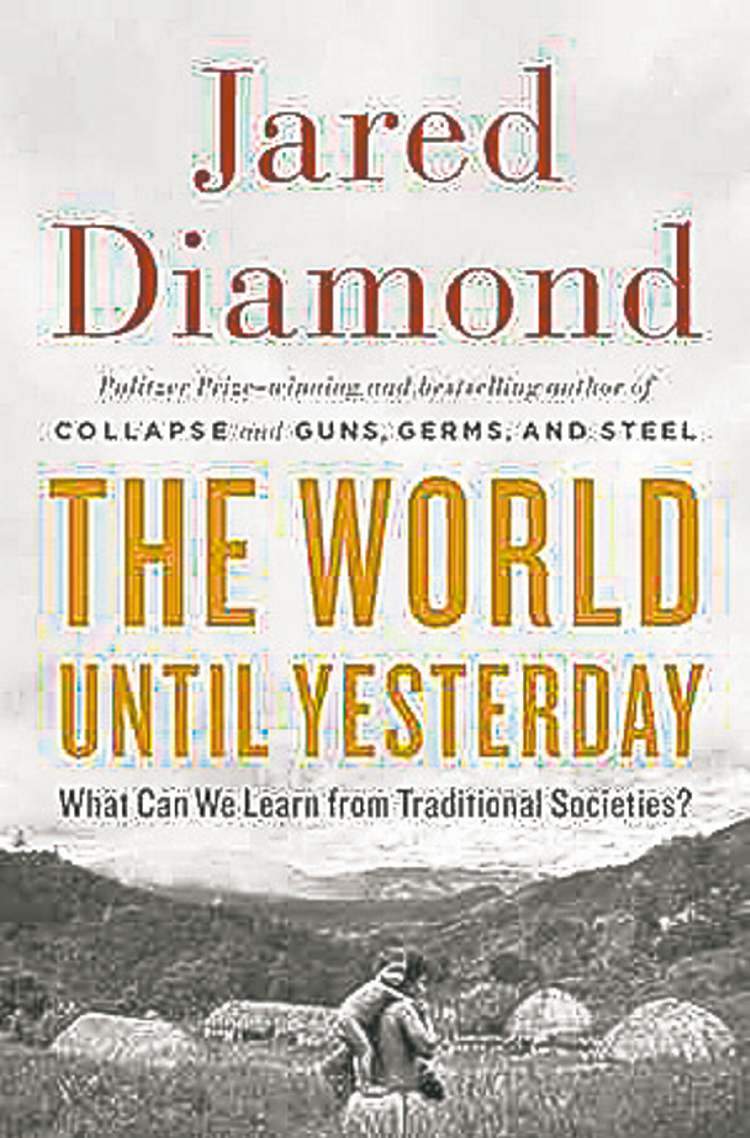
JARED Diamond, professor of geography at the University of California, ornithologist, biophysicist, anthropologist and Pulitzer Prize-winning author of bestsellers such as Guns, Germs and Steel and Collapse, has no fear of biting off more than he can chew — in this case, 11,000 years of human culture.
Always thought-provoking, sometimes annoying and perhaps, despite its wide-ranging subject, longer than it needs to be, his new book is best understood as a classic personal essay, if such essays ever exceeded 500 pages.
Like the classic essay, The World Until Yesterday is written in a colloquial tone, relies strongly on personal experience and is leavened by a droll sense of humour. It invites the reader to join in the conversation and meets Aldous Huxley’s criterion of “saying almost everything about almost anything.”

As concerned as any Enlightenment philosopher to understand how social and political organizations work, Diamond regrets that most research on human nature narrowly focuses on what he calls “WEIRD” (Western, educated, industrialized, rich and democratic) societies.
Diamond argues that modern societies are outside the norm of human history. For at least 60,000 years, our distant ancestors lived in small, family-based hunter-gatherer groups until the beginnings of agriculture about 11,000 years ago.
During that time they developed thousands of solutions to human problems, solutions very different from those practised in modern societies.
Diamond believes that the relatively isolated huntergatherer or pre-industrial farming societies (which he calls “traditional” and not “primitive”) still surviving today provide us with myriad natural experiments on how to operate human society.
He does not romanticize traditional societies, recognizing their brutal aspects, and their susceptibility to disease and starvation, but suggests that there are other aspects that could be adopted by us to our benefit.
Neither does he belittle the advantages of modern societies: individual freedom, abundance of food, personal security, effective medicine, technological amenities and longer life.
His point is that there are beneficial lessons we could learn from traditional societies about war, religion, raising children, treating the elderly, settling disputes, assessing danger and avoiding diseases such as diabetes and hypertension.
Although he references research from the Arctic to the Kalahari, Diamond illustrates his thesis for the most part by recounting vignettes from his own experiences, especially in New Guinea.
He tells a harrowing story, worthy of Joseph Conrad, of a near-fatal boat accident in the sea off New Guinea to demonstrate how the locals accept responsibility for their own actions rather than, as we often do, blaming others as much as possible.
On another occasion while at a camp with 20 New Guinea highlanders, Diamond asked each how many languages he spoke. The number ranged from five to 15.
These were not dialects but genuine, mutually unintelligible languages. As there are about 1,000 languages in New Guinea, the locals pick up the languages of neighbouring tribes during the course of trade or social interaction.
Diamond believes the ability to speak more than one language brings lifelong social and intellectual benefits. As a result, he would like to see governments and individuals provide more opportunities for children to become at least bilingual. He particularly encourages North American parents who can do so to speak languages other than English to their children.
Among a family he knew in a remote village was a 14-year-old wife with her first child. Unlike many teenage parents in our society, she was already a competent parent because in her small village, adults and children were in constant contact. Not only did the adults socialize the children but the older children cared for the younger ones. The young wife was more qualified to be a parent than many adults in North America.
Without a strong state government, justice in traditional societies is achieved through attempting to resolve feelings and re-establish relationships through negotiation.
In modern states, justice is not usually concerned with the feelings of the victims. Often, court proceedings, criminal or civil, exacerbate the bitterness of the parties. To offset this, Diamond recommends that states put greater emphasis on mediation and restorative justice.
At 75, Diamond takes a personal interest in what traditional societies can teach us about the treatment of the old. It is no surprise that he prefers Fiji, where children look after their aged parents to the extent of pre-chewing their food to the Ache people of Paraguay, who beat the elderly to death.
For all his engaging style, Diamond sometimes tests the reader’s tolerance.
He persists in telling us what he will say, saying it and then telling us what he has said. This is fine in a speech but a bit redundant in a book.
He can be less than meticulous in his research. For example, he generalizes from “British friends” that the British had to eat mice during the Second World War and he tells us that there are only two aboriginal languages, Navajo and Yupik Eskimo, broadcast on the radio in North America. He might have Googled Nunavut or even Manitoba’s NCI-FM Radio.
Diamond may not get everything right, but he will make you think about what matters. Just wait until you read his chapter on religion.
Winnipegger John K. Collins still chews his own food.
Book review
The World Until Yesterday
What Can We Learn from Traditional Societies?