Cosmologist fights to bring real time back into physics

Advertisement

Advertise with us

As an essay in history, this book starts off badly. In the first 25 pages there are four historical errors (on Aristotle, Ptolemy, Galileo and Kepler), anachronistic and naïve interpretations of history, and even a mistake in astronomy. (Mercury, not Mars, has the most eccentric orbit of the five visible planets.)

Read this article for free:


or

Already have an account? Log in here »

To continue reading, please subscribe:

Subscribe and receive a limited-edition Free Press branded hat or tote.

Digital Subscription

One year of digital access for only $205*

  • Enjoy unlimited reading on winnipegfreepress.com
  • Read the E-Edition, our digital replica newspaper
  • Access News Break, our award-winning app
  • Play interactive puzzles

*First annual payment billed as $205.00 + GST for one year. This annual subscription will automatically renew at $233.00 + GST every 52 weeks (10% off the regular annual price of $259.35). Offer available to new and qualified returning subscribers only. Cancel any time.

To continue reading, please subscribe:

Add Free Press access to your Brandon Sun subscription for only an additional

$1 for the first 4 weeks*

  • Enjoy unlimited reading on winnipegfreepress.com
  • Read the E-Edition, our digital replica newspaper
  • Access News Break, our award-winning app
  • Play interactive puzzles
Start now

*Your next Brandon Sun subscription payment will increase by $1.00 and you will be charged $17.95 plus GST for four weeks. After four weeks, your payment will increase to $24.95 plus GST every four weeks.

Opinion

Hey there, time traveller!
This article was published 27/04/2013 (4850 days ago), so information in it may no longer be current.

As an essay in history, this book starts off badly. In the first 25 pages there are four historical errors (on Aristotle, Ptolemy, Galileo and Kepler), anachronistic and naïve interpretations of history, and even a mistake in astronomy. (Mercury, not Mars, has the most eccentric orbit of the five visible planets.)

Thankfully, most of the rest of book is on contemporary cosmology, relativity theory, quantum mechanics, and fundamental particle physics — the stuff of Ontario scientist Lee Smolin’s trade.

Smolin is a theoretical physicist at the famed Perimeter Institute of Waterloo University, working in the forefront of cosmology and the endeavor to link gravity with quantum physics, the so-called unified theory of everything.

NIR BAREKET PHOTO / courtesy of the author
Lee Smolin has an idiosyncratic viewpoint in his new book.
NIR BAREKET PHOTO / courtesy of the author Lee Smolin has an idiosyncratic viewpoint in his new book.

Journeying beyond the insular confines of abstruse physics, Smolin has spread his wings by writing non-technical books explaining his ideas on these matters to the scientifically curious reader. This is his fourth book in this genre.

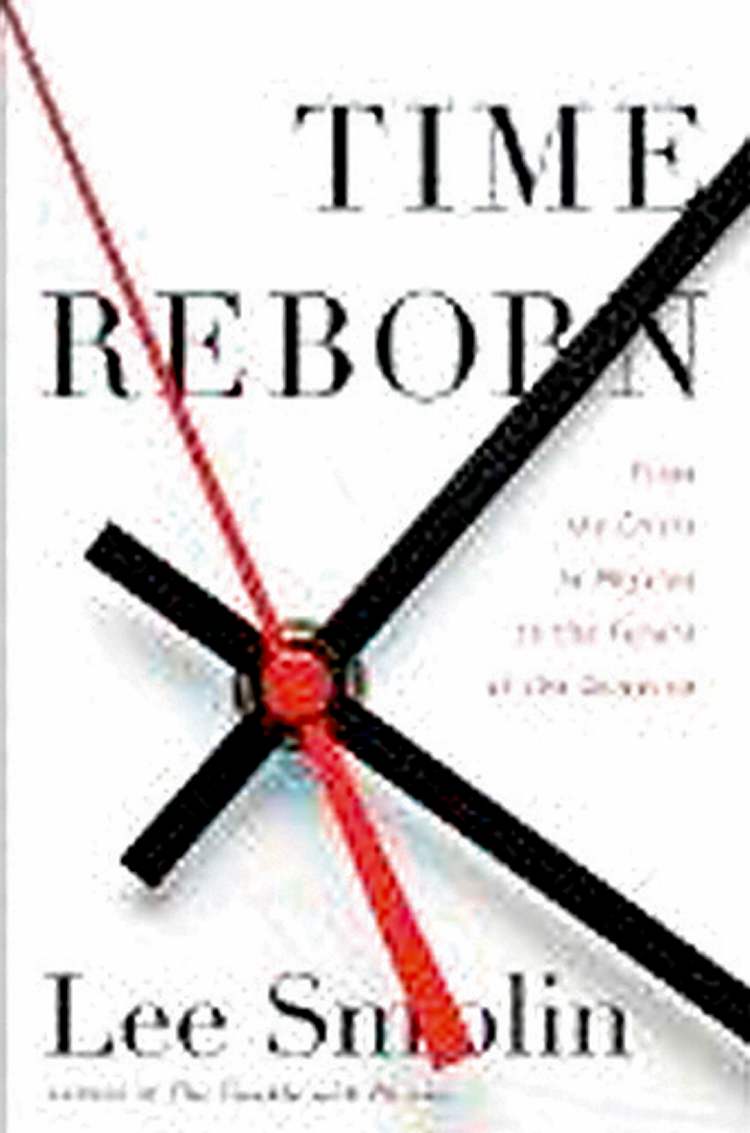
His last book, The Trouble with Physics (2006), was a fervent critique of string theory, one of the major contemporary models of the fundamental structure of matter. In light of the early pages of Time Reborn, a better subtitle of this latest book might have been The Trouble with Physicists Writing History.

Nonetheless, as an essay on contemporary debates in important areas of physics, Time Reborn is up-to-date and chock-full of diverse hypothetical models put forth by a coterie of physicists having a go at discovering the ultimate theory, which, if successful, is an assured route to a Nobel Prize. To be sure, all this is filtered through Smolin’s idiosyncratic viewpoint.

In addition to a critique of string theory, another topic that puts him at odds with many fellow cosmologists is his critique of the multiverse model, which has gained credence among cosmologists in recent years. The key concept in this model is that our universe is merely one of possibly an infinite number of universes co-existing at the same time.

Smolin, however, believes we live in only one universe, or, at least, one universe at a time — one reason being that the multiverse model, as he interprets it, means that time is an illusion. This idea, he argues, is the culmination of a process of eliminating time in physics that goes back to Newton, yet which he believes is wrong. Time, instead, is real: hence Time Reborn.

Despite Smolin’s previous efforts to solve the unification puzzle, in Time Reborn he calls off that chase, believing that a more fundamental approach is required to bring real time back into physics. A possible model that accomplishes this is what he calls “cosmological natural selection,” in which a universe is created from of a black hole.

In such a model the laws of nature evolve over time — real time. The evolution of the universe along the so-called arrow of time, as set out in the entropy law of thermodynamics, is further evidence for Smolin of the reality of time.
From a historical and philosophical viewpoint, what is fascinating about this idea is that physics is drawing on methodology from biology rather than the other way around, as in traditional reductionism.

Finally, in his endeavor to eliminate flawed cosmological hypotheses, Smolin repeatedly returns to the principle of sufficient reason, an idea from the 17th-century mathematician-philosopher Gottfried Leibniz.

This idea that nothing in nature can exist without a rational explanation also influenced Einstein who flirted with it as a methodological approach. All of which shows how enduring and recurring are some basic conceptual ways that humans think about the world.

David Topper is senior scholar in history at the University of Winnipeg. His latest book, How Einstein Created Relativity, was recently published by New York-based Springer Publishing.


Report Error Submit a Tip

More Stories

U of M researchers studying ‘digital legacy planning’ before death

Maggie Macintosh 6 minute read Preview

U of M researchers studying ‘digital legacy planning’ before death

Maggie Macintosh 6 minute read Wednesday, Aug. 5, 2026

A team of researchers at the University of Manitoba wants adults to take the cloud they leave behind into special consideration when they envision heaven and their afterlife.

Read
Wednesday, Aug. 5, 2026

No critical incidents, adverse public safety events resulted from July 911 outage, Bell says in report to CRTC

Erik Pindera 4 minute read Preview

No critical incidents, adverse public safety events resulted from July 911 outage, Bell says in report to CRTC

Erik Pindera 4 minute read 2:29 PM CDT

The telecommunications outage that prevented Manitobans outside Winnipeg from contacting 911 for several hours last month did not result in “critical incidents or adverse public safety outcomes,” Bell Canada says.

Bell, which runs Manitoba’s 911 network, issued its post-incident report on the July 22 outage to the Canadian Radio-television and Telecommunications Commission on Thursday.

In total, calls to 911 made by 84 people from 11:40 a.m. to 3:25 p.m. could not be routed to the public safety call centre in Brandon. That facility answers 911 calls for most of the province outside Winnipeg.

Officials at the 911 call centre in Brandon advised Bell that, as of Thursday, there had been no reported critical incidents or public-safety issues as a result of the missed calls, the telecom company said in its report.

Read
2:29 PM CDT

Mayoral race lineup grows to 10 candidates

Joyanne Pursaga 2 minute read Preview

Mayoral race lineup grows to 10 candidates

Joyanne Pursaga 2 minute read Yesterday at 1:50 PM CDT

An electrical contractor has become the 10th candidate to register for the race to become Winnipeg’s next mayor.

Zac Uminski has thrown his name into the competition, after Scott Gillingham signed up to seek re-election as mayor and eight other candidates previously registered.

The father of four said concern about homelessness and addictions sparked his interest in politics.

“My campaign will focus on practical solutions to improve public safety, support families and strengthen the city services,” Uminski said. “We need safer communities.”

Read
Yesterday at 1:50 PM CDT

A measure of hope a decade after senseless death, injustice

Niigaan Sinclair 5 minute read Preview

A measure of hope a decade after senseless death, injustice

Niigaan Sinclair 5 minute read 3:29 PM CDT

I’m a few hundred kilometres from the farm near Biggar, Sask. — the place where 22-year old Colten Boushie from Cree Red Pheasant First Nation was shot and killed by farmer Gerald Stanley precisely 10 years ago.

“You need to remind people about the 10-year anniversary,” a nearby, rural school principal tells me at the education conference I just finished speaking at.

“That death is a wound that continues to bleed in all of us,” a principal from Regina adds. “I hear about it from our students all the time.”

On Aug. 9, 2016, Boushie’s death entered the Canadian consciousness, representing what then-Saskatoon mayor Charlie Clark declared “a defining moment for this community and this country.”

Read
3:29 PM CDT

Mayoral race grows to 11 candidates

Joyanne Pursaga 2 minute read 3:21 PM CDT

Realtor Brad Gross is the 11th candidate to register for the race to become Winnipeg’s next mayor.

Gross, 60, said improving public safety and renewing roads will be key goals in his campaign.

“I just don’t like the direction the city’s going and it doesn’t seem to be getting better…. A lot of seniors, a lot of people are worried about crime. (And) the streets are just horrible again,” he said.

He said the city should not invest in bike lanes until Winnipeg’s roads are in better condition. He also hopes to provide free bus fares for seniors and gradually add security cameras at all bus shacks with known safety concerns, if elected.

Federal government to build $267-M emergency research lab in Winnipeg

Chris Kitching 6 minute read Preview

Federal government to build $267-M emergency research lab in Winnipeg

Chris Kitching 6 minute read Wednesday, Aug. 5, 2026

The federal government says it will build a $267-million medical countermeasures laboratory in Winnipeg with the goal of preparing Canada for future pandemics or outbreaks.

Expected to open in 2033, the national site will help the country develop vaccines, therapeutics and diagnostic tools, Winnipeg Liberal MP Terry Duguid said.

“This is a big deal for our city and for our province, a big deal for life sciences in Canada,” he told reporters Wednesday. “This facility is going to help protect the nation and help protect the world.”

Ottawa said the site — to be located next to the National Microbiology Laboratory’s Canadian Science Centre for Human and Animal Health on Arlington Street, just north of William Avenue — draws on lessons learned during the COVID-19 pandemic.

Read
Wednesday, Aug. 5, 2026