Math wiz breaks with nerd stereotype
Advertisement
Read this article for free:
or
Already have an account? Log in here »
To continue reading, please subscribe:

Digital Subscription
One year of digital access for only $205*
- Enjoy unlimited reading on winnipegfreepress.com
- Read the E-Edition, our digital replica newspaper
- Access News Break, our award-winning app
- Play interactive puzzles
*First annual payment billed as $205.00 + GST for one year. This annual subscription will automatically renew at $233.00 + GST every 52 weeks (10% off the regular annual price of $259.35). Offer available to new and qualified returning subscribers only. Cancel any time.
To continue reading, please subscribe:
Add Free Press access to your Brandon Sun subscription for only an additional
$1 for the first 4 weeks*
- Enjoy unlimited reading on winnipegfreepress.com
- Read the E-Edition, our digital replica newspaper
- Access News Break, our award-winning app
- Play interactive puzzles
*Your next Brandon Sun subscription payment will increase by $1.00 and you will be charged $17.95 plus GST for four weeks. After four weeks, your payment will increase to $24.95 plus GST every four weeks.
Read unlimited articles for free today:
or
Already have an account? Log in here »
Hey there, time traveller!
This article was published 05/10/2013 (4739 days ago), so information in it may no longer be current.
If you think that you hate math, Russian-born mathematician Edward Frenkel is confident that you are mistaken.
Your problem, as he states in the preface to this erudite work aimed at the intelligent layperson, is that you have never even been exposed to real mathematics.
As he writes: “What if at school you had to take an ‘art class’ in which you were only taught how to paint a fence?”
Frenkel, who now teaches at University of California, Berkeley, knows the highest levels of mathematics from the inside. In 1989, he became the first recipient of a Harvard Prize Fellowship. By 2003, he was spearheading a multimillion-dollar project in pure mathematics under DARPA, the American defence think-tank that created the Internet.
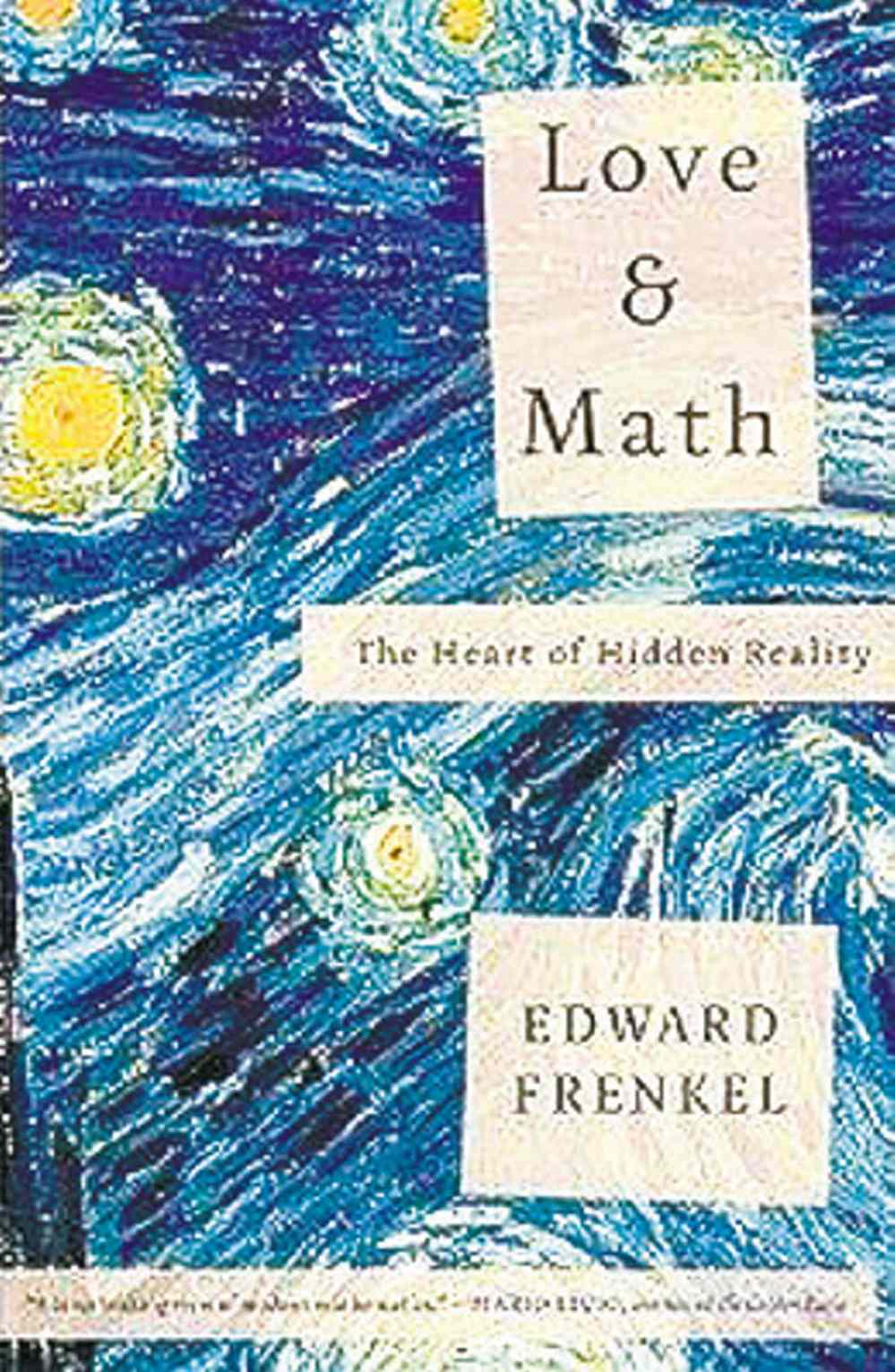
Frenkel breaks with the math-nerd stereotype at every step. The cover of Love & Math is a van Gogh painting. Inside, the book is rich with quotations from poets and novelists.
At one point he reproduces Marcel Duchamp’s 1912 painting Nude Descending a Staircase, No. 2 and documents its link to Einstein’s work.
Love & Math interweaves Frenkel’s personal story with his research. He is known for his work on representations of algebras relevant to quantum theory, including the Feigin-Frenkel isomorphism.
As a student, he was simultaneously trained and rejected by the Soviet system. He recounts scaling fences with a friend to break into seminars at Moscow State University. The elite school had excluded them through rigged entrance exams.
Alongside his personal struggles and successes, he tells the story of his participation in the Langlands Program — mathematics crucial to string theory, physics and the prediction of the Higgs boson or “God particle.”
At 45, Frankel is an elite mathematician. At the same time, he is an anti-elite mathematician. In his view, “(w)e should all have access to the mathematical knowledge and tools needed to protect us from arbitrary decisions made by the powerful few in an increasingly math-driven world.”
Notwithstanding the preachy tone of this pronouncement, Frenkel’s motivation in sharing mathematics is anything but prosy. He is definitely in love with the subject.
In fact, in 2010 he wrote and starred in the erotic short film Rites of Love and Math. In the key scene, which took many hours to shoot, his character tattoos a formula from Frenkel’s research onto the belly of Mariko, his lover. “(T)he formula is an expression of his love. It can carry the same passion and emotional charge as a poem.”
At times, Frenkel is a little naØve regarding how much mathematics readers can tolerate. He does strive to be approachable: “Think of the rational numbers as a cup of tea,” he writes.

“We can drink it by itself, but our experience will be enhanced if we mix in sugar, milk, honey, various spices — and these are like the numbers square root of 2, square root of 3, etc.”
An editor famously warned Stephen Hawking that for every equation in A Brief History of Time, his readership would be cut in half. Frenkel braves the most detailed description of mathematical ideas that one might see in a popular book. At one point he remarks: “All this stuff, as my dad put it, is quite heavy; we’ve got Hitchin moduli spaces, mirror symmetry, A-branes, B-branes, automorphic sheaves…. One can get a headache just trying to keep track of all of them.”
For a tiny sliver of readership born with high-level mathematical talent, this book could provide a life-changing inspiration. However, any intelligent reader will be rewarded. Frenkel raises the curtain on life as a mathematical genius, and shows it to be one filled with vibrant emotional colour.
Mathematician James Currie is dean of science at the University of Winnipeg.