Friend and foe
Tales of questionable allies bookend Second World War
Advertisement
Read this article for free:
or
Already have an account? Log in here »
To continue reading, please subscribe:

Digital Subscription
One year of digital access for only $205*
- Enjoy unlimited reading on winnipegfreepress.com
- Read the E-Edition, our digital replica newspaper
- Access News Break, our award-winning app
- Play interactive puzzles
*First annual payment billed as $205.00 + GST for one year. This annual subscription will automatically renew at $233.00 + GST every 52 weeks (10% off the regular annual price of $259.35). Offer available to new and qualified returning subscribers only. Cancel any time.
To continue reading, please subscribe:
Add Free Press access to your Brandon Sun subscription for only an additional
$1 for the first 4 weeks*
- Enjoy unlimited reading on winnipegfreepress.com
- Read the E-Edition, our digital replica newspaper
- Access News Break, our award-winning app
- Play interactive puzzles
*Your next Brandon Sun subscription payment will increase by $1.00 and you will be charged $17.95 plus GST for four weeks. After four weeks, your payment will increase to $24.95 plus GST every four weeks.
Read unlimited articles for free today:
or
Already have an account? Log in here »
Hey there, time traveller!
This article was published 08/02/2014 (4595 days ago), so information in it may no longer be current.
A pessimist is someone who sneezes and thinks it’s a pandemic. Anyone who tackles these two books may feel equally disheartened.
For if Operation Paperclip and The Pope and Mussolini are gauges of human conduct, then it can be argued we live in the worst of all worlds: where evil conquers good, nobody is to be trusted, things are seldom what they seem, cheaters always prosper, the guilty go free, rogues outnumber the righteous and, therefore, an anti-optimistic view of mankind is both honest and correct.
But before rushing out to buy mood-altering drugs, consider this: These two veteran, award-winning authors are very good, and the true stories they tell are made even more magnetic and compelling by their skill and scholarship. These books are worth reading.
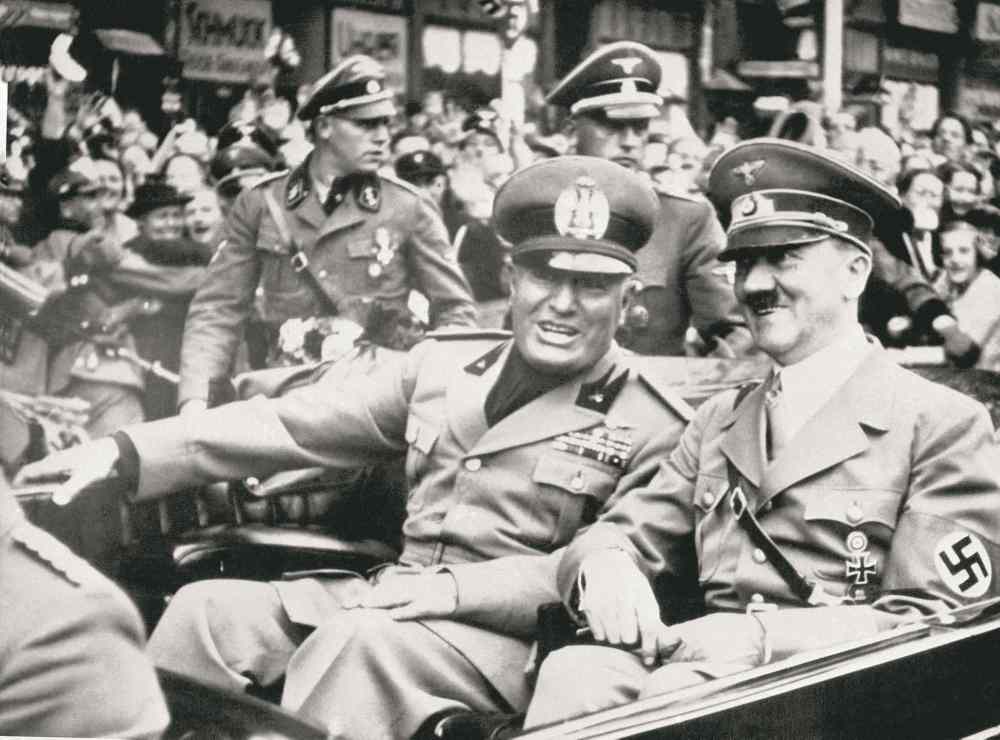
First in this arresting duo is Operation Paperclip: The Secret Intelligence Program that Brought Nazi Scientists to America. Set for release on Tuesday (Feb. 11), its message is clear: while war can screw up your day, it can make an even bloodier mess of your principles.
Annie Jacobsen’s tale is about a repulsive gallery of Nazis, including well-known German rocket scientist Wernher von Braun and his fellow geeks, and how and why the Americans brought them to the U.S. to work after the Second World War instead of locking them up forever for war crimes.
Paperclip also deals with even more hideous Nazis, including one found guilty of mass murder and slavery, as well as doctors undeniably involved in one way or another in barbaric and murderous medical experiments on concentration-camp inmates.
These villains were also ferried to the U.S. in secret to work for the government on all kinds of military projects, including chemical and biological weapons.
It’s easy to imagine how Americans, particularly those who served (or lost someone who served) in the war, would have reacted had he or she been told that 1,600 of Hitler’s technologists were welcomed in the U.S. and put on the government payroll over 10 postwar years.
Adding insult to injury, the veterans who were home from overseas and paying taxes — people who had risked their lives to help defeat these rascals — were now contributing to their pay packets. No wonder the U.S. so zealously guarded Paperclip from public disclosure.
During the Second World War, von Braun worked for the Nazis to develop the terrifying V-2 rocket that killed men, women and children by the thousands, a clear violation of the Geneva Convention governing conduct in war. Without him this wicked, indiscriminate Nazi weapon would never have been created. He accepted the use of slave labour to do his work, and thousands died doing it.
So why were von Braun and his cronies lavishly courted and brought stateside to work? The answer is simple: the U.S. wanted their brains.
Many still argue that bargain with the devil was worth it in order to ward off the postwar Soviet expansionist threat and outdo them in weapons development and the space race. (In later years, by the magic of public relations, von Braun became openly accepted as a kind of sanitized Dr. Strangelove.)
Meanwhile, throughout Jacobsen’s tale two questions keep coming to mind: Is it morality or legislation that determines who is right and wrong in war, or is it the winners who arbitrarily decide? And do beneficial contributions to a winning democracy cancel out any preceding contributions to a losing dictatorship? Paperclip will help readers make up their own minds.
***
The Pope and Mussolini is a prewar tale, telling how a Roman Catholic pontiff and a vain and ambitious politician helped each other to achieve their goals, then went cold on each other in the end. Like Paperclip it, too, is the story of moral expediency.
Kertzer’s book covers the period from 1922 to 1939, detailing the relationship of Italian dictator Benito Mussolini and Pope Pius XI. They exercised an interesting if cynical quid pro quo: The church played an important role in bringing the Fascists to power and supporting them, while Mussolini, among other things, agreed to make the Vatican in Rome a city-state and the smallest nation in the world that it remains today.
According to Kertzer, the church’s official version of what went on between the two men — that the church fought tooth-and-nail against the Fascists — is a fable. His seven years of archival investigation, says Kertzer, unveiled overwhelming evidence that the reverse of the church’s version of events is the unbridled truth.
Even more interesting is the disclosure that Cardinal Eugenio Pacelli, a close confidant of the pope, did Mussolini’s bidding, ignoring Pius’s last intention before he died to publicly expose the Italian leader as a Hitler stooge and anti-Semite.

At the request of Mussolini, the cardinal erased all evidence of the ruinous speech the pope had been about to give that might have destroyed il Duce. With world war just over the horizon, guess who became pontiff three weeks later?
British prime minister Winston Churchill said that in war the most important truths are protected by a “bodyguard of lies.” There’s no war in Paperclip or in The Pope, but there are bodyguards.
There always are.
Barry Craig is a retired journalist and former investigative reporter living in Winnipeg.
History
Updated on Saturday, February 8, 2014 8:37 AM CST: Tweaks formatting.