

A developing story
Musings on the news anything but manual-like
Advertisement
Read this article for free:
or
Already have an account? Log in here »
To continue reading, please subscribe:
Monthly Digital Subscription
$1 per week for 24 weeks*
- Enjoy unlimited reading on winnipegfreepress.com
- Read the E-Edition, our digital replica newspaper
- Access News Break, our award-winning app
- Play interactive puzzles
*Billed as $4.00 plus GST every four weeks. After 24 weeks, price increases to the regular rate of $19.95 plus GST every four weeks. Offer available to new and qualified returning subscribers only. Cancel any time.
Monthly Digital Subscription
$4.99/week*
- Enjoy unlimited reading on winnipegfreepress.com
- Read the E-Edition, our digital replica newspaper
- Access News Break, our award-winning app
- Play interactive puzzles
*Billed as $19.95 plus GST every four weeks. Cancel any time.
To continue reading, please subscribe:
Add Free Press access to your Brandon Sun subscription for only an additional
$1 for the first 4 weeks*
*Your next subscription payment will increase by $1.00 and you will be charged $16.99 plus GST for four weeks. After four weeks, your payment will increase to $23.99 plus GST every four weeks.
Read unlimited articles for free today:
or
Already have an account? Log in here »
Hey there, time traveller!
This article was published 15/02/2014 (4451 days ago), so information in it may no longer be current.
One way or another, most of us check the news several times a day. What “the news” means to us and how we define it, however, can vary considerably.
Public philosopher Alain de Botton relates deep-thinking ideas to our daily lives. His books include Religion for Atheists, The Architecture of Happiness, and Essays in Love.
In The News, de Botton asks what the news is as well as what it could be. His sometimes-superb ideas, though, are buried amid often-ponderous text. There’s no definition of the news — rather, it is “deliberately left vague” — and there’s almost nothing about corporate ownership. Isn’t who owns the news important for our understanding of it?
The book starts off well enough, divided into logical topics like politics, economics and celebrity, but de Botton’s orderliness ends there. There are some terrific insights on our news culture, but no central narrative; frustratingly, we’re left with various thoughts to piece into some coherent whole.
In his section on politics, with the bizarre subtitle Boredom and Confusion, he argues we choose more prurient items over those of substance because the media arranges them that way. Or, he proposes, “perhaps one is, at heart, a truly shallow and irresponsible citizen.” Which is it, then?
News arguably has more influence on us than school, family or government; yet, as de Botton suggests, it “focuses so much on the darkness,” leaving us feeling fear or anger (or maybe both). The news should direct its users towards “pride, resilience and hope,” and not just with a few minutes during a newscast’s windup for a “soft” interest story. The news should lead us to ask, “What can I learn?” from the events of the day, but with money at the helm and a business model to follow, this is unlikely.
Business is why “real” news is not reported: readers and viewers aren’t particularly interested about substantive events, and — hard as this may be to accept — we (journalists and consumers) do not fully understand them. De Botton has sympathy for reporters who become “instant experts” in fields where they have no formal training.
As experts spring up — largely in social media — who can we trust? As de Botton notes, tasked with providing real explanations for complicated matters (such as the 2008 economic meltdown), most media is either too confused or distracted — or worse, simply serving the status quo.
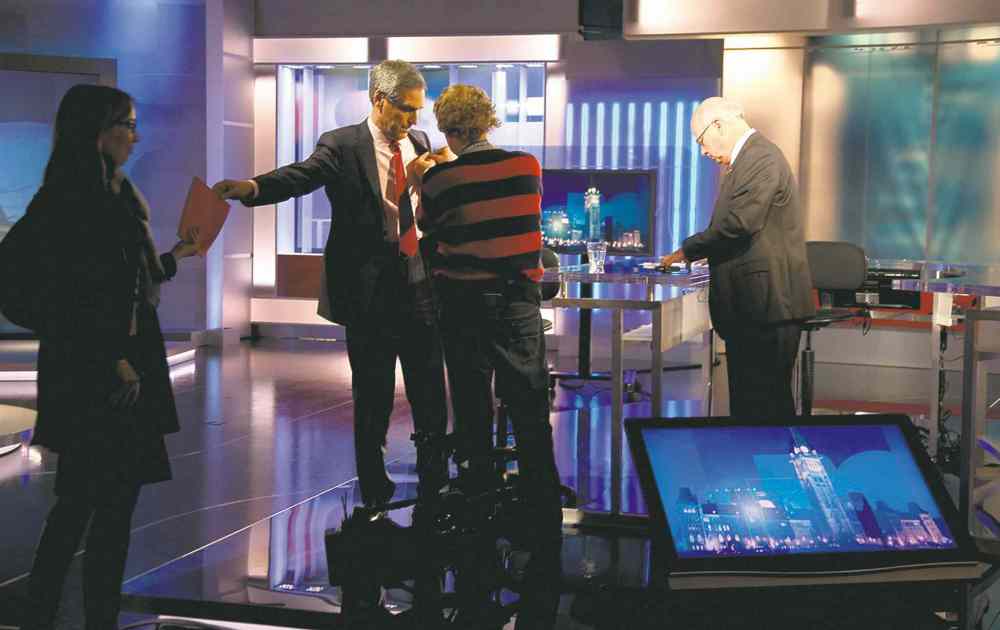
De Botton correctly points out we have expectations from conventional media: the news desk, the graphics, the stock photos. The potential for storytelling in a photograph that contains real information and emotion rather than simply the bland two-dimensional image — the head-and-shoulders shot — is beyond what we’d accept with our news.
Oddly, he says the news “speaks to us in a natural unaccented voice, without reference to its own assumption-laden perspective.” Not really: journalists and media firms always impose their assumptions on us.

A newscaster’s emphasis on a dollar figure, the positioning of a headline item, a story on the anchor webpage for a news outlet: all of these are based on heavily “accented” assumptions made for us by the news outlet. Unfortunately, de Botton doesn’t really make the case about partiality in reporting, particularly as it regards corporate ownership.
We’re more interconnected than ever before, and information is at our constant beck and call. The modern news industry, therefore, deserves some reflection and critical evaluation.
Given de Botton’s past writings, he should have been the one for the job, but this effort falls short.
George A. MacLean is associate dean in the faculty of graduate studies and professor of political studies at the University of Manitoba.
History
Updated on Saturday, February 15, 2014 8:04 AM CST: Tweaks formatting.
Updated on Saturday, February 15, 2014 8:21 AM CST: Adds video.