‘God particle’ book a brain-buster
Advertisement
Read this article for free:
or
Already have an account? Log in here »
To continue reading, please subscribe:

Digital Subscription
One year of digital access for only $205*
- Enjoy unlimited reading on winnipegfreepress.com
- Read the E-Edition, our digital replica newspaper
- Access News Break, our award-winning app
- Play interactive puzzles
*First annual payment billed as $205.00 + GST for one year. This annual subscription will automatically renew at $233.00 + GST every 52 weeks (10% off the regular annual price of $259.35). Offer available to new and qualified returning subscribers only. Cancel any time.
To continue reading, please subscribe:
Add Free Press access to your Brandon Sun subscription for only an additional
$1 for the first 4 weeks*
- Enjoy unlimited reading on winnipegfreepress.com
- Read the E-Edition, our digital replica newspaper
- Access News Break, our award-winning app
- Play interactive puzzles
*Your next Brandon Sun subscription payment will increase by $1.00 and you will be charged $17.95 plus GST for four weeks. After four weeks, your payment will increase to $24.95 plus GST every four weeks.
Read unlimited articles for free today:
or
Already have an account? Log in here »
Hey there, time traveller!
This article was published 15/02/2014 (4568 days ago), so information in it may no longer be current.
Straddling the border between France and Switzerland is an enormous particle accelerator 27 kilometres in circumference, about 100 metres below the surface of the Earth. This is the Large Hadron Collider (LHC) at the Organisation européenne pour la recherche nucléaire — better known as CERN — where the Internet as we know it today was first created.
Inside this monstrosity of a machine is a concrete tunnel in which beams of particles travel in a set of two pipes at enormous speeds, zipping around the track 11,000 times each second and colliding, generating energy.
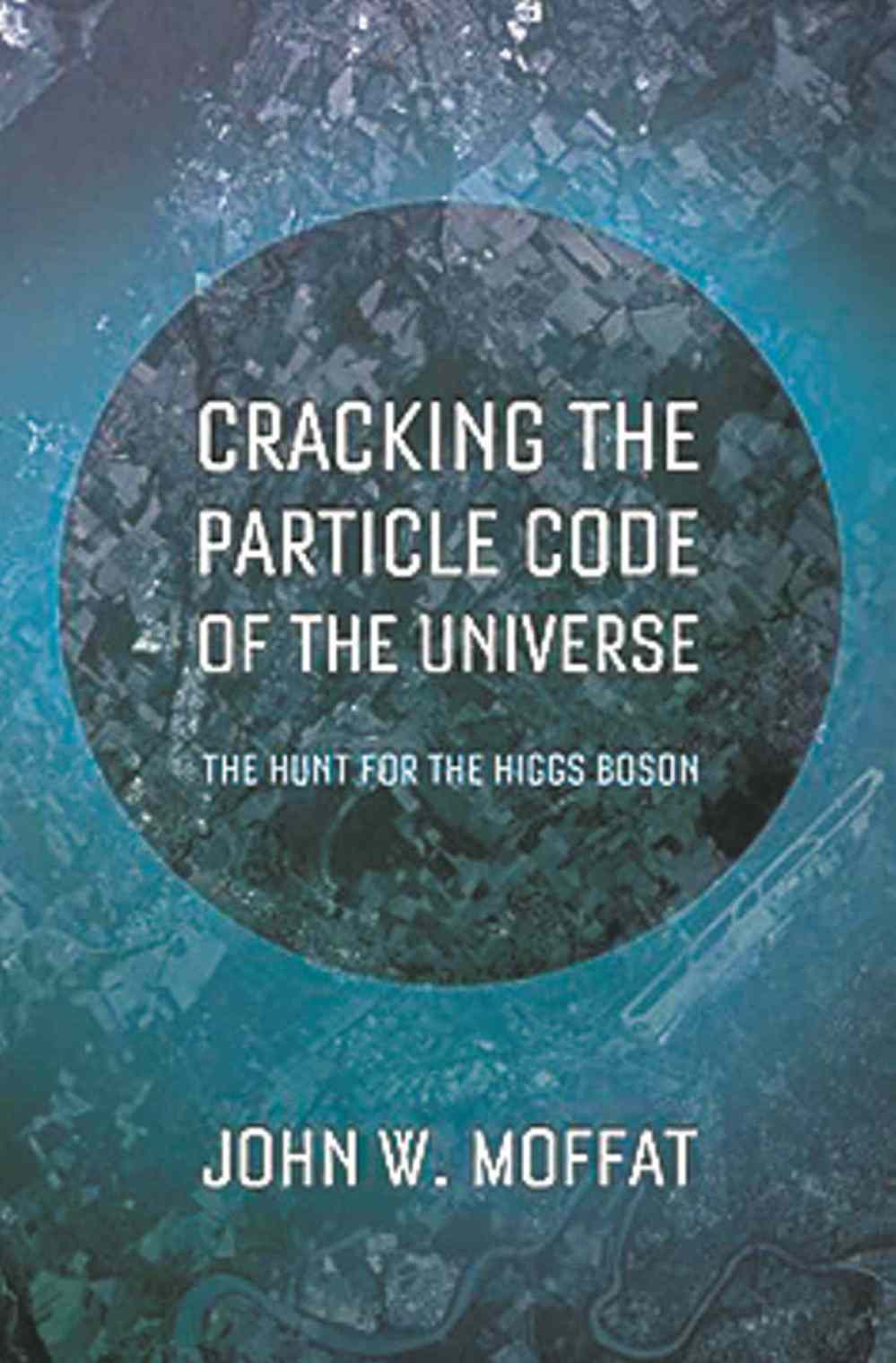
This is the playground for particle physicists such as John Moffat, professor emeritus of physics at the University of Toronto and a senior researcher at the Perimeter Institute for Theoretical Physics in Waterloo. In Cracking the Particle Code of the Universe, Moffat questions the holy grail of physics: the so-called “God particle.”
This is the elusive “Higgs boson” that is theorized to give everything in the universe its mass, and would effectively unify the four main forces in nature: electromagnetism, gravity and the “strong” and “weak” forces inside atoms.
In 2012, European physicists announced they may have found the Higgs boson, but Moffat doubts it exists.
To explain his reservations about the claimed success by CERN physicists, Moffat takes the reader on a grand tour de force, giving essentially a complete graduate seminar in particle physics. Along the way, we learn about the basic constituents of matter and the myriad subatomic particles that make up you and me.
There are quarks of different colours and flavours (although these attributes only describe different kinds of particles, not the way they actually taste), some with spins and some with charges — and then there are the antiparticles of each of them.
Cracking the Particle Code of the Universe attempts to make the visualizations of the particle interactions and collisions more understandable through the use of graphs and drawings, including vectors and Feynman diagrams, but the text is really designed for academics with some previous knowledge of physics, although some advanced casual science readers will be able to follow his discussion.
The more accessible portions of Moffat’s book give insight into his personal views, such as his caution that physicists come to their field with a certain amount of bias that reveals their human sides.
Moffat also notes that the search for the Higgs boson is an economic issue, since the quest involves funding for not only physicists at CERN but also researchers around the world whose work is dependent on the elusive particle.
He explains in detail how the search for a new particle is so dependent on the interpretation of data streaming from a multitude of sensitive detectors buried within the LHC device, and of physicists’ advocacy for one interpretation of a faint signal over another.

Moffat’s own theory of particle unity includes a particle he calls “quarkonium,” which solves some of the charge-and-spin issues that have been hampering the search for the Higgs. Yet he also acknowledges that the non-discovery of the Higgs boson may not be the end of particle physics if a unification particle cannot be found, as he notes a revolution in physics might be a good thing, after all. There are other problems in physics to solve that may keep CERN funded and running for years to come.
In 2013, Peter Higgs was awarded the Nobel Prize in physics for the discovery of the Higgs boson. But Moffat finds it “disturbing” that the calculated energies and parameters of the newly discovered particle don’t match well with physicists’ predictions.
CERN is undergoing maintenance for the next year or so. Perhaps in 2015, Moffat may be vindicated.
Chris Rutkowski is a science writer in Winnipeg.
History
Updated on Saturday, February 15, 2014 8:16 AM CST: Tweaks formatting.