

‘Heinous’ eugenic history explored
Advertisement
Read this article for free:
or
Already have an account? Log in here »
To continue reading, please subscribe:
Digital Subscription
One year of digital access for only $75*
- Enjoy unlimited reading on winnipegfreepress.com
- Read the E-Edition, our digital replica newspaper
- Access News Break, our award-winning app
- Play interactive puzzles
*Billed as $5.77 plus GST every four weeks. After 52 weeks, price increases to the regular rate of $19.95 plus GST every four weeks. Offer available to new and qualified returning subscribers only. Cancel any time.
Monthly Digital Subscription
$4.99/week*
- Enjoy unlimited reading on winnipegfreepress.com
- Read the E-Edition, our digital replica newspaper
- Access News Break, our award-winning app
- Play interactive puzzles
*Billed as $19.95 plus GST every four weeks. Cancel any time.
To continue reading, please subscribe:
Add Free Press access to your Brandon Sun subscription for only an additional
$1 for the first 4 weeks*
- Enjoy unlimited reading on winnipegfreepress.com
- Read the E-Edition, our digital replica newspaper
- Access News Break, our award-winning app
- Play interactive puzzles
*Your next Brandon Sun subscription payment will increase by $1.00 and you will be charged $17.95 plus GST for four weeks. After four weeks, your payment will increase to $24.95 plus GST every four weeks.
Read unlimited articles for free today:
or
Already have an account? Log in here »
Hey there, time traveller!
This article was published 01/03/2014 (4466 days ago), so information in it may no longer be current.
By the time the government of Alberta repealed its Sexual Sterilization Act in 1972, almost 3,000 individuals had been sterilized in just over 40 years.
In Facing Eugenics, University of Saskatchewan history professor Erika Dyck explores the “dark, even heinous history” of Albertan eugenics, linking it to the discourse of reproductive rights. She shows how constructions of ability, disability, motherhood, masculinity and citizenship shifted in their application and ideal.
Facing Eugenics is the first scholarly book to focus solely on Alberta’s eugenic history, adding to the 2010 publication of journalist Jane Harris-Zsovan’s Eugenics and the Firewall: Canada’s Nasty Little Secret. It is Dyck’s second book within the history of medicine. Her first, Psychedelic Psychiatry, examined the role of LSD in psychiatric experiments.
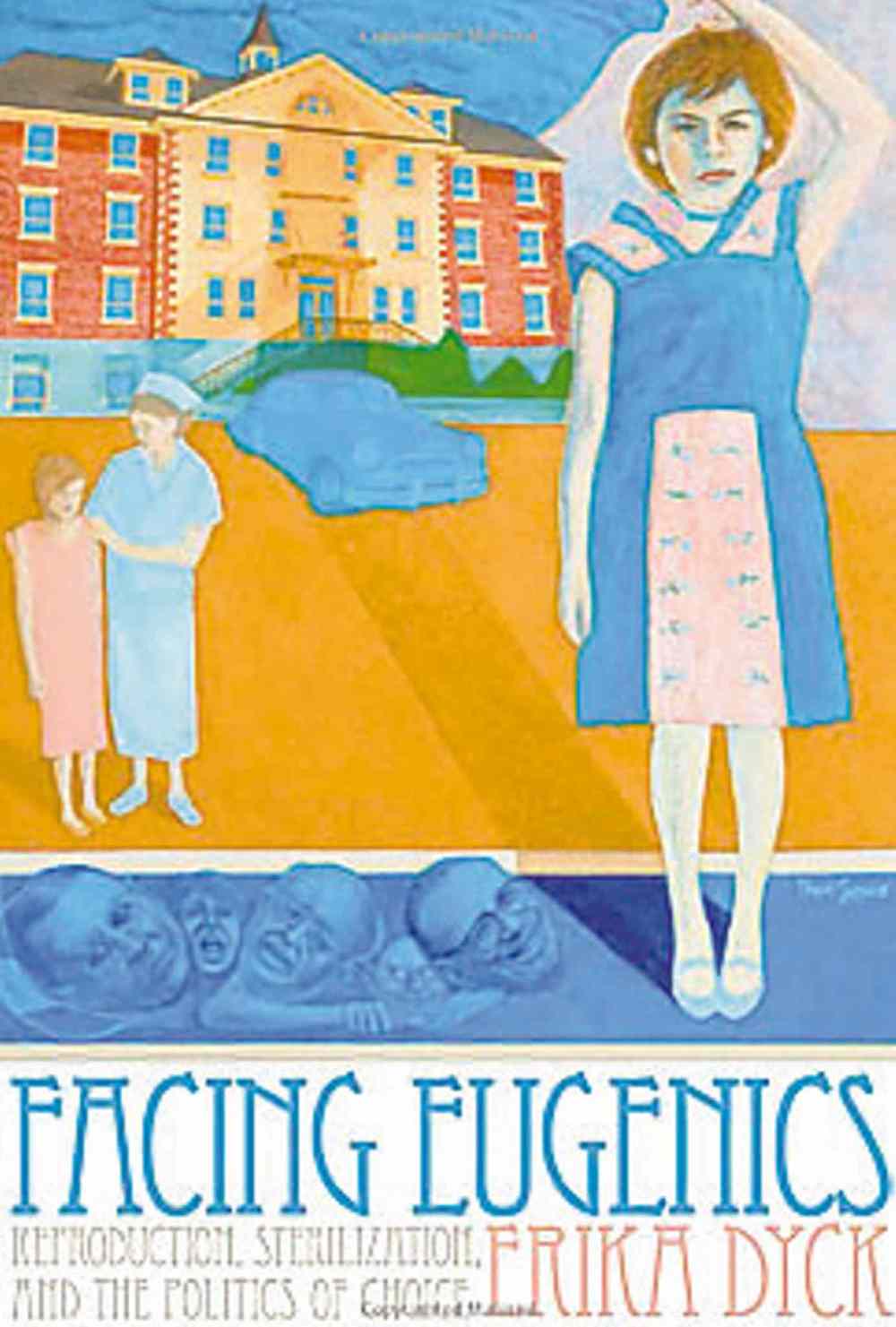
While the clinching argument for sterilization was always alleged levels of intelligence and purported ability for responsible parenthood, the roving eye of the Alberta Eugenics Board moved from group to group over the history of its existence, focusing first on immigrants, then teenagers and finally on indigenous women.
In many cases, people confined in the Provincial Training School, later named the Michener Centre, had been sterilized without their knowledge during such operations as appendectomies. In other cases, release from institutions was dependent upon their agreement to be sterilized.
For women, sterilization was meant to restrict their ability to become mothers once they were released into the community. Men were sometimes castrated to curb their sexual drive.
Dyck brings to life this academic history by including case studies of individuals. Leilani Muir entered the PTS at age 11 and stayed for 10 years. It was only after many years of attempting to conceive that she found out she had been sterilized at 14 during what she thought was only an appendectomy.
In 1996 Muir successfully challenged the legality of the Alberta government’s action and was awarded a $1-million settlement. During the trial against the government, it was discovered her institutionalization and sterilization was based in large part on an administrative error in adding up the results of her intelligence test.
After Muir’s award of compensation, then-premier Ralph Klein tried to invoke the notwithstanding clause to prevent compensation being awarded to other victims of sterilization. While this was not accepted, all other cases were settled out of court for far more meagre sums.
Although many case studies are introduced by Dyck, only the chapters on Leilani Muir and activist Doreen Befus feature fleshed-out stories. Other case studies, such as that of George Pierre, an indigenous man who refused to be sterilized, suddenly stop short due to the end of archival sources.
Likewise, the stories of thousands of others who passed before the Eugenics Board can only be surmised, as 80 per cent of the board’s records were destroyed by the Archives of Alberta in 1987.
Dyck’s emphasis on reproductive rights highlights interesting ironies. She shows that while the provincial legislation forced people labelled as having intellectual disabilities to be sterilized, up until 1969 the Canadian criminalization of contraception denied these same procedures to married adults living in society who asked for this permanent, reliable means of birth control.
A weak spot in Dyck’s wide-ranging analysis is that she gives little consideration to the policy of segregation and confinement of people with disabilities in institutions. This is a practice other scholars, such as Dick Sobsey of the University of Alberta, have called an even bigger weapon of eugenics than sterilization.
Dyck’s scholarly treatment of Alberta’s eugenic history is scrupulously researched and referenced. The 50-plus pages of endnotes and bibliography will prove a boon to academics. To the interested lay-reader, however, the hundreds of citations may simply provide too much detail and repetition.
That people labelled with intellectual disability have had their human rights abused by eugenic practices is poignantly and succinctly expressed by activist Doreen’s Befus’s question “Why can’t they leave our bodies alone?”
Facing Eugenics invites us to carefully consider both our past and present assumptions about who we determine to be valuable human beings.
Mary Horodyski is writing her MA thesis on archival records regarding people labelled with intellectual disability and who have been institutionalized in Manitoba.
History
Updated on Saturday, March 1, 2014 8:33 AM CST: Tweaks formatting.