Black’s Canadian historical tome an entertaining but uneven affair
Advertisement
Read this article for free:
or
Already have an account? Log in here »
To continue reading, please subscribe:

Digital Subscription
One year of digital access for only $205*
- Enjoy unlimited reading on winnipegfreepress.com
- Read the E-Edition, our digital replica newspaper
- Access News Break, our award-winning app
- Play interactive puzzles
*First annual payment billed as $205.00 + GST for one year. This annual subscription will automatically renew at $233.00 + GST every 52 weeks (10% off the regular annual price of $259.35). Offer available to new and qualified returning subscribers only. Cancel any time.
To continue reading, please subscribe:
Add Free Press access to your Brandon Sun subscription for only an additional
$1 for the first 4 weeks*
- Enjoy unlimited reading on winnipegfreepress.com
- Read the E-Edition, our digital replica newspaper
- Access News Break, our award-winning app
- Play interactive puzzles
*Your next Brandon Sun subscription payment will increase by $1.00 and you will be charged $17.95 plus GST for four weeks. After four weeks, your payment will increase to $24.95 plus GST every four weeks.
Read unlimited articles for free today:
or
Already have an account? Log in here »
Hey there, time traveller!
This article was published 15/11/2014 (4337 days ago), so information in it may no longer be current.
Conrad Black, whose family began its “rise to greatness” in Winnipeg with his grandfather, local businessman George Black, has written another big, slightly maddening but fascinating 1,000-plus-page book, a history of Canada.
As a writer, Black is hard to categorize — he’s not an academic historian, although he has a M.A. in history and includes a 24-page bibliography and 20 pages of endnotes in Rise to Greatness.
Nor is he one of many freelance popular historians writing today, although his intended audience is the intelligent general reader.

His books have been generally well-received and his biographies of Maurice Duplessis, Franklin Roosevelt and Richard Nixon are based on solid research and make important contributions.
During his recent time in prison he wrote Flight of the Eagle: A Strategic History of the United States, a broad survey similar to Rise to Greatness.
It may be the fact that Black has been close to powerful people and a powerful person himself that gives a lot of his narrative the quality of an amusing “insider” story told in the comfort of a private club. But he is an engaging, perceptive writer who draws you in and makes you want to keep reading.
Black is a firm believer in the now-unfashionable “great man” theory of history. He argues that the long journey of Canada from colonial status toward independence and greatness has been mainly the work of the French and British governors, and of Canadian prime ministers and their sometimes-crafty, sometimes-brazen manoeuvring and manipulation of powerful colonial masters (and of the United States).
Black describes a country that has made enormous but not unbroken progress over the past 500 years, and continues to do so under our present leader.
This narrow focus ignores the contributions of everybody else as well as the enormous body of historical research and writing about Canadian social, economic and cultural history available to us. Having said that, the story is interesting and well-told. Black provides political junkies with the popular vote, seat counts and major issues for every federal election; if you like anecdotes about Canadian politics there are plenty to enjoy here.
There are important gaps in the book. The title suggests he is to begin with the Vikings, but really only devotes one paragraph each to the Norsemen and cod fishers, the first Europeans to land in what is now Canada.
A more serious omission is the way in which Black deals with the history of aboriginal Canadians. While acknowledging them as allies in the colonial wars, he passes over 10,000 years of pre-contact history in three pages.
He writes: “The Indians were splendid woodsmen and craftsmen but they were a Stone Age culture and economy that had not discovered the wheel.” They were “… capable people of much promise” but, he concludes, “Indian society was not in itself worthy of integral conservation, nor was its dilution a suitable subject for great lamentation.”
Given the amount we know about pre- and post-contact cultures, such dismissal is simply not credible. It’s unfortunate Black did not choose to give us more about this important area of our history.

There are other omissions. In his pages on the Great War, for example, while he alludes to the contribution of the Canadian Army to the country’s increasing sovereignty, he pays much more attention to the political and diplomatic activities of Sir Robert Borden. He dismisses the Canadian Corps as a mere six per cent of the allied armies, and completely ignores its role in the eventual defeat of Germany in the last 100 days of the war, a factor that greatly strengthened Borden’s position. He makes no mention of the wartime successes of General Arthur Currie — surely one of our “great men.”
Black is at his best in his descriptions of Canada’s prime ministers, and he gives balanced portraits of all of them. His greatest praise is reserved for the most successful — Sir John A. Macdonald and the long Liberal dynasty of Sir Wilfred Laurier, William Lyon Mackenzie King and Louis St. Laurent. He is also very informative on the subject of Quebec political history, and not only in the era of Maurice Duplessis, the subject of his first book.
Despite its occasional shortcomings, this is an entertaining and well-written book to curl up with during the approaching long winter evenings. Even academics will enjoy the slightly guilty pleasure of having a peek at what Conrad Black has to say.
Jim Blanchard is a local writer and historian.
BOOK REVIEW
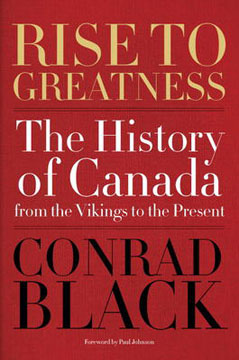
Rise to Greatness: The History of Canada from the Vikings to the Present
By Conrad Black
McLelland & Stewart, 1,020 pages, $50

Advertisement Advertise With Us
Advertisement Advertise With Us
History
Updated on Saturday, November 15, 2014 8:19 AM CST: Formatting.