No different than Darwin
In our own little ways we're all scientists, says author
Advertisement
Read this article for free:
or
Already have an account? Log in here »
To continue reading, please subscribe:
Digital Subscription
One year of digital access for only $1.44 a week*
- Enjoy unlimited reading on winnipegfreepress.com
- Read the E-Edition, our digital replica newspaper
- Access News Break, our award-winning app
- Play interactive puzzles
*Billed as $5.77 plus GST every four weeks. After 52 weeks, price increases to the regular rate of $19.95 plus GST every four weeks. Offer available to new and qualified returning subscribers only. Cancel any time.
To continue reading, please subscribe:
Add Free Press access to your Brandon Sun subscription for only an additional
$1 for the first 4 weeks*
- Enjoy unlimited reading on winnipegfreepress.com
- Read the E-Edition, our digital replica newspaper
- Access News Break, our award-winning app
- Play interactive puzzles
*Your next Brandon Sun subscription payment will increase by $1.00 and you will be charged $17.95 plus GST for four weeks. After four weeks, your payment will increase to $24.95 plus GST every four weeks.
Read unlimited articles for free today:
or
Already have an account? Log in here »
Hey there, time traveller!
This article was published 13/12/2014 (4329 days ago), so information in it may no longer be current.
It is tritely true that science is ubiquitous in contemporary society. This fact surely accounts for the proliferation of books popularizing science for non-science readers.
The challenge for writers of this genre is to find a way to educate and enlighten readers on scientific matters without oversimplifying and thus distorting science in the process. In today’s jargon, it’s about the limits of dumbing down the complex, esoteric and occasionally mathematical aspects of scientific explanations.
The hook to grab readers employed in Eureka by Chad Orzel, an associate professor in the department of physics and astronomy at Union College, is to make the case that scientific thinking is just a further, more complex and sophisticated version of everyday thinking about everyday things. As an example, in the first chapter, which is a template for most of the book, Orzel argues that Darwin’s vast collecting of information on flora and fauna of the world, which led to his theory of evolution, was, in essence, an advanced and more developed version of what stamp collectors do.

Instead of just dumbing down the scientific activities of geeks, Orzel’s ploy is to smarten up the non-scientific antics of ordinary folk.
There follows a set pattern to most chapters. Take Chapter 5: It begins with prosaic pursuits, such as classifying a record collection or organizing books in a personal library, and then discusses in some detail the history of the creation of the periodic table of the chemical elements by D.I. Mendeleev in the mid-19th century. It goes on to some brief examples of other related sciences that use this collecting process, and finally brings it all back to organizing records and books, and other ordinary things, as these non-scientists discover their “inner scientist.”
Other examples: Associating card players bidding in the game of bridge, who are try to uncover hidden hands, with astronomers uncovering the nature of stars and galaxies by sending light from these objects through spectrographs; comparing the process of finding the quantum nature of the sub-atomic world with solving advanced crossword puzzles; detectives trying to recreate a murder from the evidence left at a crime scene with the discovery of dinosaurs from their fossils and other geological records; the easy resemblance of statistics used in sports to those used in science.
The overall structure of the book is based on Orzel’s acknowledged over-simplification of the four-step scientific process: collecting facts, creating a model, testing the model and explaining what was found. In the tried-and-true spirit of the school science-fair project, he calls the four sections Looking, Thinking, Testing and Telling.
Drawing on a wide variety of examples and stories, many from sports and pop culture, Orzel writes in a crisp, clear, and entertaining style.
The idea for this scheme grew out of his experience as a scientist of incessantly being called “smart” by people intimidated by his status. He intimates that he is downright embarrassed by this adulation, and is convinced that being smart in science is fundamentally no different from being smart in other areas such as creative cooking and baking. Rather than there being an unfathomable gap between non-scientific and scientific activities, Orzel believes there is a conceptual relationship — one of the reasons for writing this book.
The exact nature of this relationship, however, is not clearly stated by Orzel, and this is a methodological problem. Is there really a continuum between ideas, or it is merely an analogous relationship?
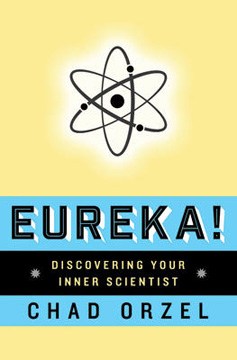
A concrete example of the problem: it may be true that finding antique treasures in yard sales is like finding elusive sub-atomic particles called neutrinos — but what is the nature of that “like?” Orzel seems to imply a continual gradient: just recall the book’s subtitle: Discovering Your Inner Scientist.
Some scholars would indubitably contest that assertion, going only so far as to grant a metaphorical relationship between such non-scientific and scientific activities.
David Topper is senior scholar in history at the University of Winnipeg. His latest book is Idolatry and Infinity: Of Art, Math, and God.
History
Updated on Saturday, December 13, 2014 8:47 AM CST: Formatting.