Ambitious sci-fi opus highlights author’s confidence in his craft
Advertisement
Read this article for free:
or
Already have an account? Log in here »
To continue reading, please subscribe:

Digital Subscription
One year of digital access for only $205*
- Enjoy unlimited reading on winnipegfreepress.com
- Read the E-Edition, our digital replica newspaper
- Access News Break, our award-winning app
- Play interactive puzzles
*First annual payment billed as $205.00 + GST for one year. This annual subscription will automatically renew at $233.00 + GST every 52 weeks (10% off the regular annual price of $259.35). Offer available to new and qualified returning subscribers only. Cancel any time.
To continue reading, please subscribe:
Add Free Press access to your Brandon Sun subscription for only an additional
$1 for the first 4 weeks*
- Enjoy unlimited reading on winnipegfreepress.com
- Read the E-Edition, our digital replica newspaper
- Access News Break, our award-winning app
- Play interactive puzzles
*Your next Brandon Sun subscription payment will increase by $1.00 and you will be charged $17.95 plus GST for four weeks. After four weeks, your payment will increase to $24.95 plus GST every four weeks.
Read unlimited articles for free today:
or
Already have an account? Log in here »
Hey there, time traveller!
This article was published 23/05/2015 (4134 days ago), so information in it may no longer be current.
It takes a certain confidence as a writer to open your book with the destruction of the moon and then never bother mentioning how or why it happened. It also takes confidence to interrupt your novel two-thirds of the way through with the words “Five Thousand Years Later” and to trust your readers to keep up.
That American author Neal Stephenson does both of these things in Seveneves, his ninth novel, is an indication that the bestselling author of technically dense, thematically ambitious science-fiction novels has a fair bit of faith in himself as a writer.
In the novel, the destruction of the moon results in an exponential increase in meteorite activity, as fragments of the satellite drop out of orbit and burn up in the Earth’s atmosphere. This culminates in what the novel’s scientists refer to as the White Sky event, in which the rate of meteorites becomes so high that the atmosphere literally catches fire, destroying all life on Earth.

The book is divided into two parts, with most of the first part describing, in the painstaking detail that Stephenson’s readers will be familiar with, the design, development and building of a space ark designed to preserve humanity through a combination of living passengers and preserved genetic materials.
The ark is built around the International Space Station, nicknamed “Izzy,” and the book’s first part focuses on a group of characters linked to it, as the hastily assembled crew struggles to survive the immense environmental and psychological strain of riding out a millennia-long global apocalypse in space.
The book’s second part is about half as long as the first part, and more plot-heavy. In it, the descendants of the survivors of the ark, the products of centuries of selective breeding and deliberate genetic engineering, have begun terraforming the now-livable Earth only to discover that they are not, as they had believed, the only survivors of the lunar catastrophe.
The two parts stand relatively well on their own as stories. The brevity of the second part combined with the massive temporal jump makes the two “halves” of the book seem somewhat tangential to each other — as if the first part were a massive prologue to the second or the second were a very large epilogue to the first.
Even though Stephenson’s novels vary widely in plot and setting — from stories of 17th-century pirates and natural philosophers to more traditional cyberpunk tales — he has an unmistakable writing style. The actual plot and action of this 880-page doorstopper would probably fill about 300-350 pages, with the rest of the book filled with long ruminations on various topics, mostly connected in some way to space travel and orbital mechanics.

At times, especially in the first part of the book, it makes the plot feel almost secondary. Crucial events happen and major decisions are made remarkably quickly, each feeling a little like a means of getting from one info dump to another.
As fans of Stephenson’s work will tell you, though, one of his talents as a writer is to make these long discursive passages surprisingly engaging so that, by the end of reading his books, you can end up seeing the world around you through the lens of whatever system of knowledge animates the particular book you’ve read. In that Seveneves is no exception, and the book is a return to the “big idea” form of earlier books such as Cryptonomicon, Anathem, and The Baroque Cycle.
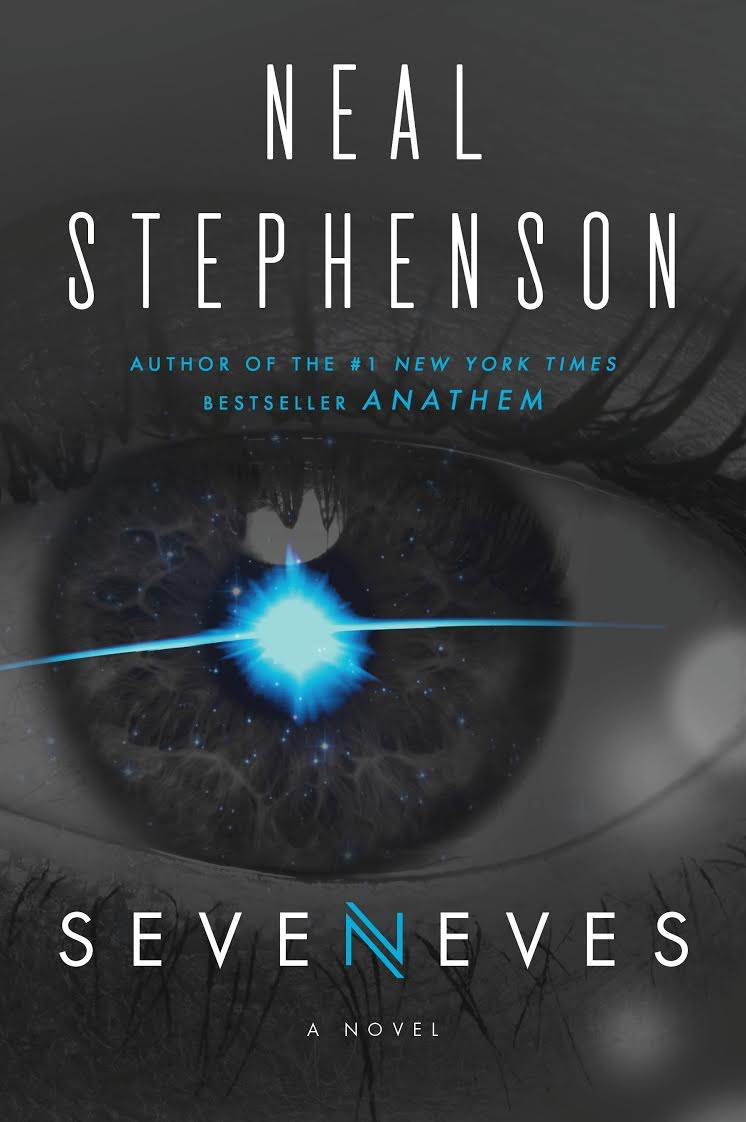
It takes confidence to write a book like this one, but it takes skill to pull it off. Seveneves, while not perfect, is still pretty compelling evidence that Stephenson has got both to spare.
Brandon Christopher is an associate professor in the department of English at the University of Winnipeg.
History
Updated on Saturday, May 23, 2015 8:19 AM CDT: Formatting.