

Geoffrey Pyke’s genius revealed in remarkable ideas and inventions
Advertisement
Read this article for free:
or
Already have an account? Log in here »
To continue reading, please subscribe:
Digital Subscription
One year of digital access for only $1.44 a week*
- Enjoy unlimited reading on winnipegfreepress.com
- Read the E-Edition, our digital replica newspaper
- Access News Break, our award-winning app
- Play interactive puzzles
*Billed as $5.77 plus GST every four weeks. After 52 weeks, price increases to the regular rate of $19.95 plus GST every four weeks. Offer available to new and qualified returning subscribers only. Cancel any time.
To continue reading, please subscribe:
Add Free Press access to your Brandon Sun subscription for only an additional
$1 for the first 4 weeks*
- Enjoy unlimited reading on winnipegfreepress.com
- Read the E-Edition, our digital replica newspaper
- Access News Break, our award-winning app
- Play interactive puzzles
*Your next Brandon Sun subscription payment will increase by $1.00 and you will be charged $17.95 plus GST for four weeks. After four weeks, your payment will increase to $24.95 plus GST every four weeks.
Read unlimited articles for free today:
or
Already have an account? Log in here »
Hey there, time traveller!
This article was published 20/06/2015 (3994 days ago), so information in it may no longer be current.
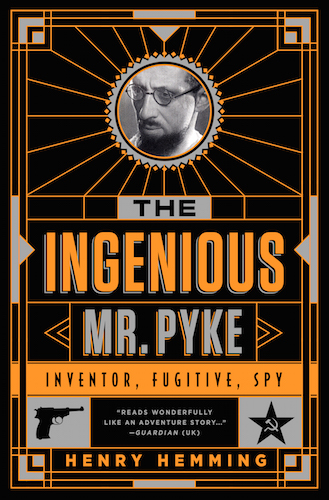
Geoffrey Pyke is one of the most extraordinary people you have never heard of.
As the title of British author Henry Hemming’s biography of Pyke suggests, the man had a varied and intriguing CV. Pyke was an inventor, war reporter, escaped prisoner, educator, father of the U.S. special forces and stock-market genius. Best of all, he convinced Winston Churchill to build an aircraft carrier out of reinforced ice.
Pyke did much of this while under suspicion by Britain’s internal spy catchers, MI5, of being a prominent member of the Soviet Comintern.

Eccentric, often overbearing and seldom diplomatic, Pyke nonetheless found himself selling his wartime projects to top-level Allied officials, including Lord Louis (Dickie) Mountbatten, cousin of the king and chief of combined operations for the British armed forces, who gave Pyke and his ideas a cachet the inventor would not have otherwise had.
Pyke’s adventures began in the First World War when, as a successful Cambridge student, he convinced a British newspaper he could get into wartime Germany (while seasoned correspondents and MI6 spies could not), and the paper agreed to run any articles he could manage to send home. Pyke made it to Germany and was preparing a dispatch on German troop movements when he was arrested. He was jailed, awaiting execution, before being moved to a regular internment camp.
There he applied his trademark scientific approach: anyone could solve an intricate problem if they came at the question the right way. He devised a plan for himself and a fellow Brit to escape the camp and make it through Germany and home to England. He wrote a bestseller about it.
His plan was such an unexpected success that British intelligence officials immediately suspected Pyke of being a German spy and opened a file on him.
Back home, Pyke finished school and embarked on a life applying his scientific approach to education, finance and war planning.
When he wanted a better education for his son than he had in British public school, he planned and opened a new school. When he needed funding for it, he studied metals futures trading and made a fortune with his scheme. (He later lost it when a copper cartel plotted to fix prices and threw his calculations off.)
He devised new motorcycle styles for the Republican forces in the Spanish Civil War, a cause that added to his MI5 dossier.
Pyke sold government officials on a way to send Britons into Nazi Germany and gauge public support for Hitler’s ant-Semitism laws. Pyke, a Jew, thought the material collected could be used to convince Germans to reject the racist policy.
His wartime activities include a plan for Allied forces to fight a guerrilla war in Norway using specially designed snowmobiles to attack strategic targets, a plan that was taken over by the Americans and is credited as the genesis of U.S. special forces. Pyke also floated the idea of underwater pipelines to carry fuel to France after D-Day.
Plans for an aircraft carrier made of reinforced ice that would be more resistant to marauding German U-boats were well on their way before circumstances in the war changed and they were no longer needed. Much of the research work was done in northern Canada, and the U.K. version of this book, published last year, bears the title Churchill’s Iceman.
Pyke’s forte was ideas and enthusiasm, and he seldom saw his plans through to the end; he was already off on a new crusade, the main reason he was not widely known during his life.
After his war service, he was at loose ends and in 1948, after a Times of London editor told him it was time to solve “the problem of Pyke,” he killed himself.
British spy catchers spent a great deal of time following Pyke, listening to his phone calls and talking to people who knew him, but a case was never made to arrest him for spying.
However in his file, released in 2009, it is noted papers relating to Pyke were found in the apartment of notorious Cambridge spy Guy Burgess in 1951 after he defected to Moscow.
Pyke’s obituary in the Times described him as “one of the most original if unrecognized figures of the present century.” Fellow scientist J.D. (Sage) Bernal hailed him as “one of the greatest… geniuses of his time.” Lancelot Law Whyte, who helped develop the jet engine, compared Pyke to Albert Einstein, adding “Pyke’s genius was more intangible, perhaps because he produced not one, but an endless sequence of ideas.”
Time described Pyke’s suicide as “the only unoriginal thing he had ever done.”
Hemming has introduced the world to an enigmatic genius whose life is as fascinating as it is puzzling.
Chris Smith is a Winnipeg writer.